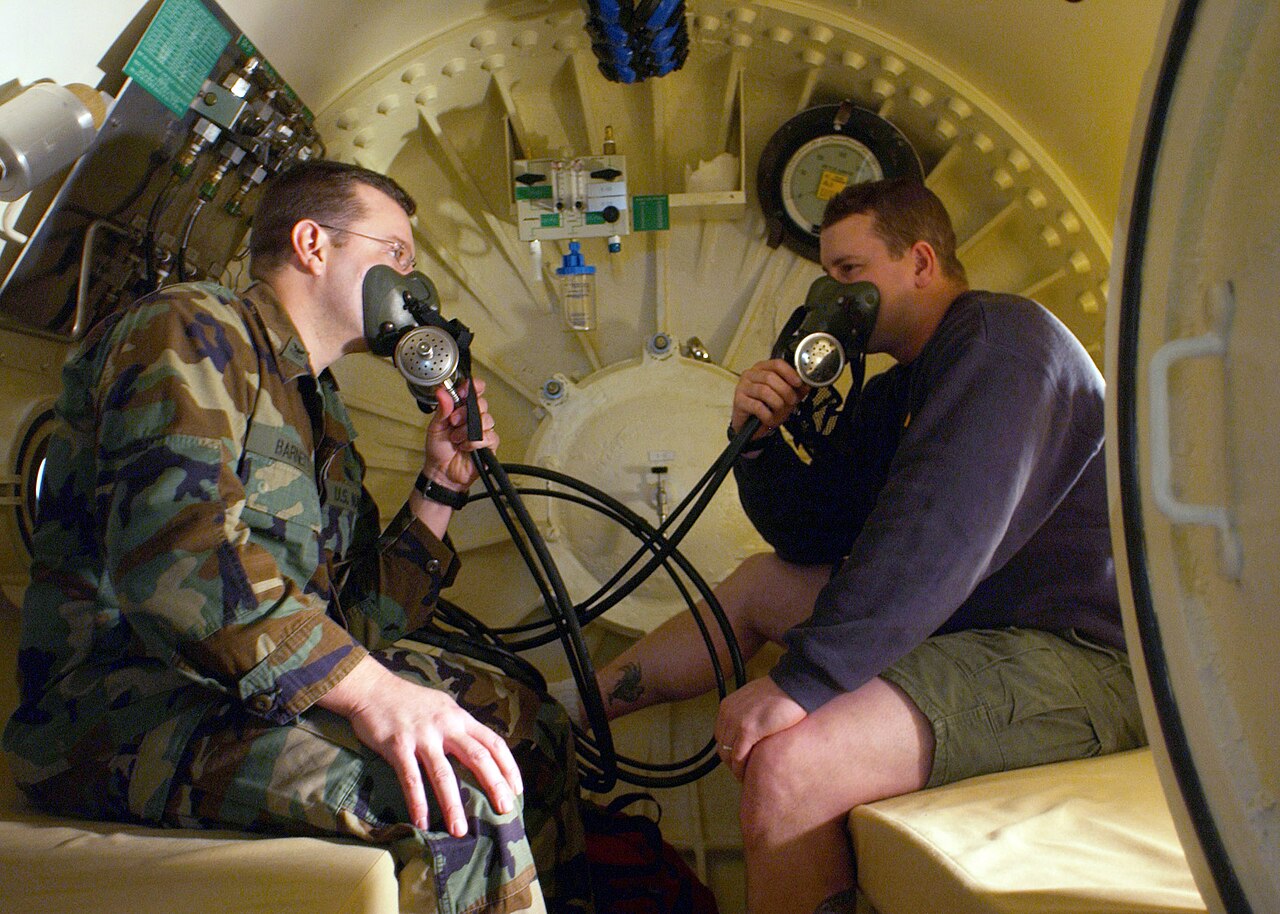
The two divers in the cover photograph are not underwater. They are seated in a steel cylinder in Keyport, Washington, testing masks connected to a built-in breathing system. One machine is creating two distinct conditions around them: the chamber raises ambient pressure, while the masks let its occupants breathe a selected gas.[1][7]
That separation is the key to understanding recompression treatment. Calling it a way to “squeeze bubbles” is true but incomplete. Pressure can make a bubble smaller and stop it from growing. Oxygen does a different job: it removes inhaled inert gas from the equation, steepens the route by which nitrogen leaves tissue and bubbles, and carries oxygen into blood even when bubbles have compromised the microcirculation. The slow return to surface pressure then protects that progress. Recompression is not one forceful moment. It is a controlled sequence of pressure, gas and time.[1]
The sequence carries a long history. In 1878, Paul Bert described nitrogen coming out of solution after rapid decompression and proposed oxygen, recompression and a slower release of pressure. In 1908, Arthur Boycott, Guybon Damant and John Scott Haldane published experiments that turned different rates of tissue gas exchange into staged decompression. By the time the Keyport photograph was made in 2007, those ideas had become hardware, masks and treatment tables rather than a theory of “caisson disease.”[4][5][7]
At depth, the body acquires an invisible gas load
A diver breathing compressed air at depth is not merely carrying a tank at higher pressure. The gas arriving at the lungs is itself at the surrounding pressure. As depth increases, the partial pressure of nitrogen rises; nitrogen therefore dissolves into blood and diffuses into tissues. Fast, well-perfused tissues approach a new equilibrium sooner than slower tissues. Depth sets the pressure gradient, while time determines how far uptake proceeds.[1]
The 1908 paper by Boycott, Damant and Haldane represented those different rates with hypothetical tissue compartments and “half-times.” A compartment was not a newly discovered organ. It was a mathematical way to approximate how quickly parts of the body take up and release inert gas. Modern decompression algorithms are more elaborate, but they retain that essential insight: a dive profile creates several gas clocks, not one body-wide timer.[1][5]
This is why “no-decompression limit” does not mean “no nitrogen absorbed,” and why a dive computer cannot guarantee that sickness is impossible. It estimates a lower-risk ascent from depth-and-time inputs and a model of gas exchange. The CDC notes that decompression illness can still occur after apparently compliant dives; depth, duration and ascent rate matter, but repeated diving, cold, exertion, dehydration and altitude exposure after diving can change the surrounding risk.[2]
On ascent, supersaturation can turn into injury
As a diver rises, ambient pressure falls immediately. Dissolved nitrogen cannot leave every tissue at the same speed. If tissue-gas pressure now exceeds the surrounding pressure, the tissue is supersaturated. Nitrogen may remain dissolved and wash out harmlessly, or bubbles may form and persist in tissue and venous blood. The presence of bubbles alone is not identical to clinical decompression sickness, but symptomatic bubbles can distort sensitive structures, obstruct small vessels and disturb blood-vessel lining. Platelet, coagulation and inflammatory responses can then continue the injury beyond simple plumbing.[1]
There is an important second route to a bubble injury. In decompression sickness, inert gas generally forms bubbles from gas previously dissolved during the dive. In arterial gas embolism, expanding gas trapped in the lungs during ascent can rupture lung tissue and enter the arterial circulation. The origins differ, but symptoms can overlap, and a field distinction may be impossible. Clinicians therefore use the umbrella term decompression illness when the practical first steps—urgent assessment, high-concentration oxygen and consideration of hyperbaric recompression—are the same.[1][2]
That distinction also explains why the fizzy-drink metaphor eventually fails. Opening a bottle captures the pressure drop and visible bubbles. It does not capture spinal-cord white matter, an injured endothelium, an arterial bubble from pulmonary barotrauma or an immune response that persists after a bubble changes shape.
Pressure buys geometry and stops further growth
Inside a chamber, increasing ambient pressure reduces the volume of compressible gas. In an idealized pressure-volume calculation, raising pressure from one atmosphere to 2.8 atmospheres absolute would reduce a bubble to roughly 36% of its former volume. A real bubble in tissue is not an isolated ideal-gas sphere, and its diameter falls by much less than its volume. Even so, shortening a bubble may reduce tissue distortion, free part of an obstructed vessel and reduce contact between gas and the vessel wall.[1]
Pressure also changes the direction in which nitrogen wants to move. Early after ascent, supersaturated tissue can feed more nitrogen into a bubble. Recompressing the diver above the tissue’s dissolved-gas pressure ends that supersaturation. The bubble’s internal gas pressure rises, and the gradient can reverse: nitrogen moves out of the bubble rather than into it.[1]
More pressure is not automatically better. Bubble volume falls asymptotically, so each additional increment yields less shrinkage. In conventional chamber protocols, 2.8 atmospheres absolute, or 60 feet of seawater equivalent, is treated as the greatest pressure at which a patient can breathe 100% oxygen before toxicity risk becomes unacceptable; deeper recompressions require a lower-oxygen treatment gas. Reviews of animal experiments and human outcomes have not shown better results from routinely beginning deeper than 2.8 atmospheres. Modern treatment therefore balances useful compression against the breathing gas that makes compression therapeutically valuable.[1]
Oxygen creates the exit route
At surface pressure, first-aid oxygen begins lowering nitrogen in the alveoli and arterial blood. Under hyperbaric pressure, breathing 100% oxygen drives alveolar nitrogen toward zero while pressure has already checked bubble growth. A steep chain of gradients follows: inert gas can move from bubble to tissue, from tissue to blood, and from blood to the lungs for exhalation. Recompression shrinks; oxygen accelerates clearance.[1]
Hyperbaric oxygen also raises the amount of oxygen physically dissolved in plasma and increases how far oxygen can diffuse through tissue. That may support areas whose microcirculation has been impaired by bubbles. Laboratory evidence also suggests effects on leukocyte adhesion and other inflammatory processes, although the 2024 comprehensive review is careful about the boundary: how much improved tissue oxygenation or anti-inflammatory signaling contributes to outcomes in each form of decompression illness is not known.[1]
The photograph makes this division visible. In a multiplace chamber, the compartment is commonly pressurized with air while the patient breathes oxygen through a specialized mask. Pressure is the environment; oxygen is the treatment gas. The hoses crossing between the two divers are not incidental clutter. They are part of the mechanism.[1][7]
The ascent out of treatment is part of the treatment
The U.S. Navy’s Treatment Table 6 shows how carefully the paired mechanism is staged. Its standard version begins at 60 feet of seawater equivalent, cycles the patient through oxygen periods and short air breaks, moves gradually to 30 feet, and finally returns to surface pressure. An unextended treatment takes 285 minutes, excluding the brief initial compression. The five- and fifteen-minute air breaks reduce the risk of central-nervous-system oxygen toxicity; the slow pressure reductions preserve controlled inert-gas elimination rather than reproducing a sudden ascent.[1][3]
Those numbers are an operational example, not a home protocol. A hyperbaric clinician can extend a table when serious symptoms have not resolved, choose another table for a mild presentation, repeat treatment when deficits persist, or first stabilize a patient whose airway, breathing or circulation takes priority. Even the familiar Table 6 encodes judgment: assessments occur during air breaks, and oxygen exposure, barotrauma risk, attendant safety and the patient’s response all constrain the schedule.[1][3]
This is why feeling better during oxygen or early recompression does not amount to medical clearance. Symptoms may remit and recur; serious neurologic injury may respond incompletely; and another diving emergency can imitate decompression sickness. Treatment is a monitored process, not a pressure reset button.[1][2]
On the surface, oxygen is first aid—not a license to descend again
The CDC’s current advice is direct: unusual symptoms soon after a dive, especially neurologic symptoms, deserve prompt evaluation; high-concentration oxygen should be given as soon as possible when decompression illness is suspected; and serious cases require urgent hyperbaric treatment. Activate local emergency medical services and seek consultation from a dive-medicine or hyperbaric service. Surface oxygen can improve symptoms while a diver is moved toward qualified care, but improvement does not cancel the evaluation or evacuation plan unless the treating specialists change it.[2]
The boundary becomes more complicated in remote diving. Some mild, stable or improving cases may be managed without recompression after case-specific discussion with a diving-medicine physician, particularly when evacuation itself carries hazards. That is a specialist logistics decision, not a rule that mild pain can be watched casually.[1][2]
Nor should the chamber’s logic be improvised by putting a symptomatic recreational diver back underwater. Divers Alert Network’s public guidance, published on August 12, 2021, does not recommend in-water recompression: consciousness can deteriorate, oxygen can provoke a seizure, gas supply can fail, and cold or drowning can turn an incomplete treatment into a second emergency.[6] The 2024 medical review describes a narrower, debated exception for remote settings: an oxygen-based in-water protocol may be considered only when chamber access would take more than two hours, no contraindication is present, and the patient, buddy and supervisor have advanced decompression training, airway-protecting equipment, a stable platform and expert support.[1] Those positions serve different audiences, but their shared message is clear. “Go back down” is not ordinary first aid.
The durable lesson from Bert’s experiments, Haldane’s staged ascents and the masks in the Keyport chamber is therefore not that pressure reverses time. It is that treatment builds a safer set of gradients. Pressure reduces and stabilizes the bubble. Oxygen gives inert gas an exit and threatened tissue a supply line. Controlled decompression lets both jobs continue on the way back to the surface.
Sources
- Simon J. Mitchell, “Decompression Illness: A Comprehensive Overview,” Diving and Hyperbaric Medicine 54, no. 1 supplement (March 31, 2024), 1–53 — physiology, clinical boundaries, first aid and recompression mechanisms and protocols.
- James Chimiak and Daniel A. Nord, “Scuba Diving: Decompression Illness and Other Dive-Related Injuries,” CDC Yellow Book 2026 (April 23, 2025) — current prevention, recognition, first-aid oxygen and treatment guidance.
- Naval Sea Systems Command, U.S. Navy Diving Manual, Revision 7 (December 1, 2016), chapter 17 — official Treatment Table 6 pressure, gas and timing schedule, preserved by the U.S. Government Publishing Office.
- Scott Ninokawa and Kristen Nordham, “Discovery of Caisson Disease: A Dive into the History of Decompression Sickness,” Proceedings (Baylor University Medical Center) 35, no. 1 (2021), 129–132 — compressed-air workers, Paul Bert’s 1878 account and the historical move toward oxygen and recompression.
- Arthur E. Boycott, Guybon C. C. Damant and John S. Haldane, “The Prevention of Compressed-Air Illness,” Journal of Hygiene 8, no. 3 (1908), 342–443 — the primary paper on tissue gas exchange and staged decompression.
- Divers Alert Network, “In-Water Recompression” (August 12, 2021) — public-facing safety position, practical hazards and the boundary between surface first aid and specialist remote protocols.
- Andrew Breese, U.S. Navy, “Navy Diver 1st Class Mike Barnett and Navy Diver 1st Class Chad Christensen Test Built-In Breathing Masks Inside a Recompression Chamber” (February 8, 2007) — source record for the cover photograph.