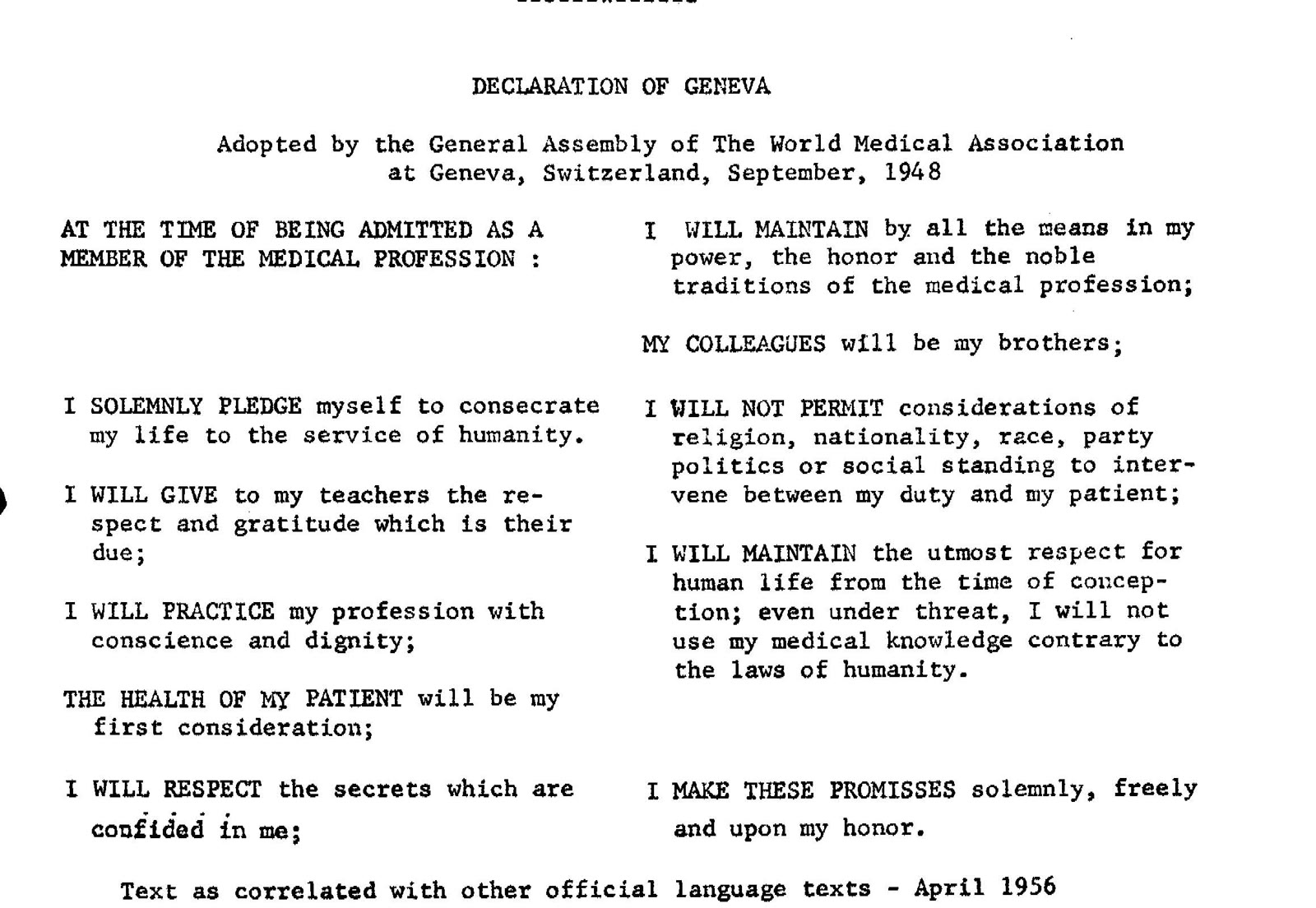
The archival page looks handled rather than monumental. Its typewriter letters strike the paper unevenly; a black punch mark intrudes at the left edge. In the lower half, beneath a 1949 code of ethics, the Declaration of Geneva compresses an entire professional identity into a two-column pledge. The physician promises service, conscience, secrecy, nondiscrimination, loyalty to colleagues, and restraint even under threat.[1]
One sentence became its moral center: “The health of my patient will be my first consideration.”[1] Yet the patient is present as the object of protection, not as a person who speaks, chooses, accepts, or refuses. The word autonomy is absent.
It remained absent until 2017, when the World Medical Association placed respect for the patient's “autonomy and dignity” immediately after an expanded promise to put the patient's health and well-being first.[2][4] That 69-year interval does not support an easy fable in which an unethical old oath became an ethical new one. The 1948 text was already an ambitious postwar statement against discrimination and the abuse of medical knowledge. What changed was the pledge's model of a good clinical relationship: from a conscientious physician acting for a patient toward a physician whose duty is also bounded by the patient's agency—and whose ability to care depends on colleagues, shared knowledge, and personal capacity.
A postwar pledge built around “I”
The World Medical Association was formally established on 18 September 1947. Its own institutional history says that medical oaths had fallen into disuse or become ceremonial, so member associations submitted national vows for a study committee to compare. After what the WMA describes as two years of work, the resulting modernized oath was adopted at the association's second General Assembly in Geneva in September 1948.[3]
That provenance needs a careful boundary. The declaration emerged from a medical organization preoccupied with ethics in the aftermath of the Second World War. Its language about refusing to use medical knowledge against the “laws of humanity” plainly belongs to that moral landscape.[1][3] But the WMA's history does not say the declaration was simply drafted as the direct result of the Nuremberg Doctors' Trial. It describes a report on “War Crimes and Medicine” at the same 1948 assembly as the trigger for a separate project, the International Code of Medical Ethics adopted in 1949.[3] The pledge and the code are related postwar instruments, not interchangeable origin stories.
The declaration's grammar is revealing. Nearly every commitment begins with the physician: I pledge, I will practise, I will respect, I will maintain. This is appropriate for an oath, which can bind only the person taking it. It also concentrates moral authority in that person. The doctor possesses conscience, knowledge, secrets, honour, and a duty; the patient receives the benefit of those virtues.[1]
That structure was not empty paternalism. The promise barred religion, nationality, race, party politics, and social standing from coming between duty and patient. It made confidentiality and humane restraint part of professional identity, not optional bedside manners. Against medicine's demonstrated capacity to classify, exclude, and injure, those were consequential lines.[1][3]
“First consideration” leaves a question open
Putting a patient's health first sounds complete until doctor and patient disagree about what should happen. A clinician may judge that an operation, transfusion, medicine, or diagnostic procedure offers the best balance of benefit and harm. A decision-capable patient may understand that judgment and still decline. Which promise governs the encounter?
The 1948 declaration does not answer. It commits the physician to the patient's health, but it does not say who defines the patient's good or what role the patient's values play in choosing among medically reasonable paths.[1] This textual silence is not proof that every doctor in 1948 rejected consent or that professional duty inevitably produces coercion. It shows something narrower and more defensible: patient self-determination was not one of the principles the authors selected for the profession's short, memorable pledge.
That omission leaves room for two versions of “first.” In one, clinical expertise is offered to a person who remains the author of the decision. In the other, expertise becomes permission to override because the physician believes the outcome is beneficial. Conscience and benevolence cannot, by themselves, distinguish the two.
The WMA itself eventually named this gap. When it began a major review in 2016, the revision workgroup identified the lack of explicit patient autonomy as the declaration's most notable difference from other important medical-ethics texts. The group sought comments from national medical associations, experts, and a three-week public consultation in May and June 2017.[4]
The 2017 revision changes the order
The revised pledge was adopted in Chicago on 14 October 2017, after earlier amendments in 1968, 1983, and 1994 and editorial revisions in 2005 and 2006.[2][4] Its most important change is not merely the insertion of a fashionable word. It is the sequence.
The 2017 version first dedicates the physician to humanity, then places the patient's health and well-being first, and then promises respect for autonomy and dignity. The workgroup said it deliberately moved clauses focused on patients' rights toward the beginning.[4] Welfare and self-determination therefore sit beside each other as simultaneous obligations. The text does not replace clinical judgment with customer preference, nor does it allow a physician's idea of benefit to erase a capable patient's decision.
Other revisions widen the same relationship. Confidentiality now expressly continues after death. The nondiscrimination clause names a broader range of characteristics and ends with an open category rather than implying the list is exhaustive. The prohibition on abusing medical knowledge now speaks in the language of human rights and civil liberties.[2] Each change narrows the space in which professional status alone can settle what is owed.
The distinction between a pledge and a rulebook still matters. The WMA tells readers to interpret the declaration alongside its fuller International Code of Medical Ethics.[2] The code revised in 2022 turns the compact promise into operational duties: respect a patient's right to accept or refuse care, provide understandable information, obtain voluntary informed consent, involve people with impaired or fluctuating capacity as much as possible, and recognize limited emergency exceptions.[5] Autonomy becomes meaningful through processes, not through one ceremonial noun.
The physician is no longer written as a solitary hero
The 2017 pledge also turns toward the conditions under which doctors work. It asks physicians to share medical knowledge, extends mutual respect across teachers, colleagues, and students, and adds a duty to attend to their own health, well-being, and abilities so they can provide high-standard care.[2]
The revision paper explains the logic directly. Rising workload and occupational stress can damage physicians' health and their capacity to care; the self-care clause was included because clinician impairment can become a patient problem.[4] Read in that order, the addition is not permission to put comfort ahead of duty. It rejects the fantasy that exhaustion, illness, or eroding competence can be made ethical through sacrifice alone.
Knowledge-sharing makes a parallel correction. The 1948 page imagines a physician carrying “all the resources of his science” and summoning another doctor when needed in the code printed above the pledge.[1] The newer declaration recognizes teaching and exchange as obligations in their own right.[2] Modern care is produced by teams, handoffs, records, laboratories, and accumulated expertise. A pledge focused only on one doctor's virtue would miss how safety is actually built—or lost.
What a changed oath can and cannot change
The strongest affirmative reading is that the declaration learned to distribute moral standing more accurately. The physician remains accountable for skill, confidentiality, nondiscrimination, and humane practice. The patient is now explicitly a chooser with dignity. Colleagues and students become reciprocal partners rather than a hierarchy held together only by deference. The physician appears as a human being whose condition affects the care others receive.[2][4]
A skeptical reading also deserves to survive. The declaration remains a physicians' association writing a pledge for physicians. Naming autonomy does not create appointment time, interpreters, accessible information, independent advocacy, adequate staffing, or a genuine range of choices. A consent form can record a signature while leaving the older structure of authority intact. That is an inference from the gap between principle and implementation, not a claim the declaration makes for itself.
The two readings meet in the 2022 code's insistence that duties be read together.[5] Autonomy without competent advice can become abandonment; beneficence without permission can become domination; physician well-being without staffing reform can become another individual obligation imposed by a strained system. The ethical work lies in holding the terms together when they pull in different directions.
Look again at the cropped scan. Its force comes partly from what it was willing to print in 1948: humanity, secrecy, nondiscrimination, conscience, restraint. Its limit is visible in the white space around the patient, whose health is promised but whose voice is not named.[1] The 2017 revision did not discard the old center. It placed another person inside it.
Sources
- World Medical Association, “Declaration of Geneva 1948” — official archived scan and transcription of the original pledge, in the text correlated across official languages in April 1956.
- World Medical Association, “Declaration of Geneva: The Physician's Pledge” — current text and amendment chronology from 1948 through the 2017 revision.
- World Medical Association, “History” — institutional account of the WMA's 1947 foundation, oath study, 1948 adoption, war-crimes report, and subsequent International Code of Medical Ethics.
- Ramin Walter Parsa-Parsi, “The Revised Declaration of Geneva: A Modern-Day Physician's Pledge,” JAMA 318, no. 20 (2017), 1971–1972 — full-text copy hosted by the Council of Medical Specialty Societies, describing the workgroup, consultation, ordering, autonomy, knowledge-sharing, and physician-well-being changes.
- World Medical Association, “WMA International Code of Medical Ethics” (revised 2022) — detailed duties concerning autonomy, informed consent, capacity, emergencies, confidentiality, professional ability, and the relationship among ethical obligations.