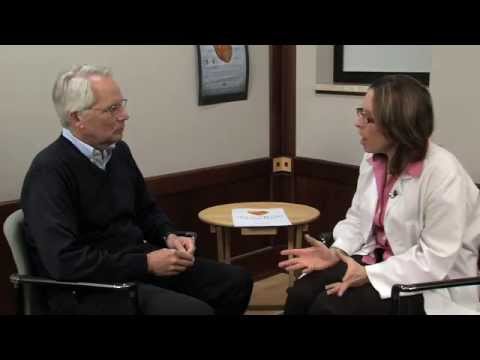
A patient says “yes” at the end of an explanation. What has that answer established? Perhaps the instructions were clear. Perhaps the patient is being polite, feels embarrassed, is tired, or simply wants a long appointment to end. A yes-or-no question cannot distinguish among those possibilities. The short role-play Teach back in a cardiology practice makes the missing step visible: the clinician asks the patient to put a daily weight-monitoring plan into his own words.[1]
The video was uploaded on October 7, 2015. A July 25, 2023 training guide from the Institute for Healthcare Advancement identifies the North Carolina Program on Health Literacy as its maker and places the role-play inside a three-part method: explain clearly, ask the patient to tell or show what they will do, then explain again more clearly if needed.[1][2] That sequence sounds modest. On screen, however, it changes the meaning of the encounter. Information is no longer considered delivered merely because it left the clinician’s mouth.
Watch the short scene for the conversational handoff, not for medical advice about any particular heart condition.[1] Its subject is daily weighing, but the communication pattern can be used for a new medicine, follow-up testing, wound care, treatment choices, or instructions given to a family caregiver.[5] The action threshold mentioned in this 2015 scenario belongs to that patient’s plan; it is not a universal heart-failure rule, and patients should follow the plan set with their own care team. The video demonstrates a technique, not an outcome that is guaranteed in every patient, setting, or clinical problem.
0:06–1:27: make one behavior concrete
The clinician introduces a take-home booklet, asks whether the patient checks his weight, and then explains one bounded routine: why the measurement matters in this scenario, when to weigh, where to record the result, and when the written plan says to call.[1] That focus is part of the method, not merely a convenience of a short training film. If an explanation contains a diagnosis, several medicines, diet rules, warning signs, referrals, and follow-up dates all at once, a final request to repeat “the plan” is too blunt to reveal where understanding broke down.
AHRQ’s third-edition Health Literacy Universal Precautions Toolkit, reviewed in April 2024, recommends “chunk and check”: divide information into small segments, ask for teach-back after each segment, and only then move to the next.[3] The universal-precautions framing matters. A clinician does not need to guess who has limited health literacy before communicating clearly. Stress, unfamiliar language, pain, hearing difficulty, cognitive load, and the sheer novelty of a diagnosis can disrupt anyone’s ability to absorb instructions. The safe default is to make the next action concrete for every patient.
Notice, too, what a handout can and cannot do. Written instructions provide a record to consult later, and AHRQ explicitly supports letting patients look at them during teach-back.[3][5] But reading a sentence back verbatim is not the same as building a usable plan. The paper supports memory; the conversation reveals whether the patient can reconstruct meaning.
1:35–2:00: make the check sound like real life
The pivotal move is not “repeat what I said.” Because the patient’s wife missed the visit, the clinician asks how he will explain the plan to her.[1] The prompt sounds like a task the patient might actually perform after leaving. From 1:43, he reconstructs the rationale and morning routine in his own words rather than reciting the clinician’s sentences.[1] The Institute for Healthcare Advancement describes the larger principle as a check on whether the provider communicated clearly—a test of the explanation, not of the patient.[2]
That distinction keeps teach-back from becoming an oral examination. If the question implies “prove that you were listening,” confusion becomes a personal failure and the socially easy response is agreement. If it implies “show me where I need to explain this better,” confusion becomes useful feedback.
This is why “Do you understand?” is not a substitute. AHRQ warns that patients often answer yes even when they only think they understand or feel embarrassed to say otherwise.[5] A useful prompt is open-ended and future-facing: in your own words, what will you do when you get home? What will you tell the person helping you? Can you show me how you will use this device? Those questions require a plan rather than assent.
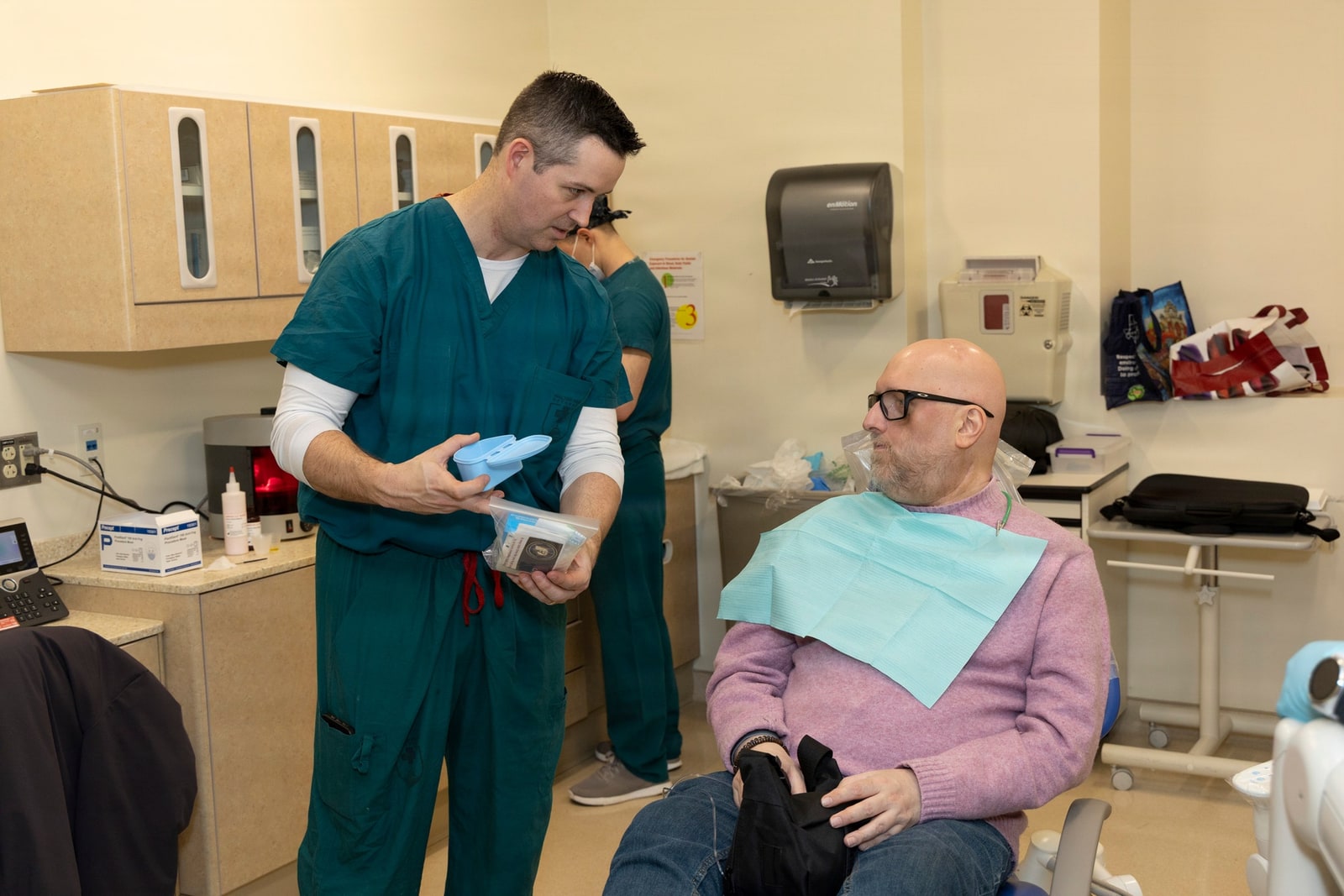
The wording also protects dignity. Health literacy is not a fixed trait that divides competent patients from everyone else. The communication task belongs to the institution and clinician as much as to the listener. In the cover photograph, a prosthodontist visibly shows a patient how to care for a new dental prosthetic after complex treatment.[6] That is valuable instruction. Yet the image alone cannot tell us what the patient understood, what he would do later, or which step might still need clarification. Teach-back completes that otherwise invisible part of the exchange.
2:08–2:18: probe what did not come back
When the patient answers, the clinician’s job changes from speaking to diagnosing the explanation. His first account covers the reason for monitoring and the morning routine but omits the plan’s action threshold. The clinician does not restart the lecture; she asks for that missing piece. He consults the booklet, answers, and receives confirmation.[1]
That makes listening active rather than ceremonial. A useful response reveals relationships: what the action is, when it happens, what record or equipment is involved, and what happens next. A polished repetition may conceal uncertainty; an imperfect paraphrase may show that the core plan is sound. The point is not to demand the video’s exact wording. AHRQ says patients may refer to handouts but should answer in their own words, because parroting can occur without understanding.[3]
For a physical skill, “show me” is the stronger version. A person can correctly state when to take a medicine yet make an error when demonstrating the dose; a caregiver can describe wound care yet miss a step when performing it.[3][5] The medium of the check should match the action. Ask for words when the plan is conceptual, demonstration when it is procedural, and both when safe performance depends on both.
2:27–2:34: close the loop—and notice what the clip omits
The clinician confirms when the patient will begin the routine, then ends with an open invitation for questions.[1] That closes this particular loop. It is also important to name what the role-play does not show: the patient’s answer is correct, so there is no scene of the clinician repairing a misunderstanding and checking again.
That missing branch is essential in practice. If an answer is incomplete or incorrect, AHRQ recommends explaining with a different approach and asking for teach-back again.[3] Repeating the same sentence louder preserves the original problem. The repair might use fewer ideas, an everyday term, a concrete example, a demonstration, a marked-up handout, or a qualified interpreter. AHRQ’s TeamSTEPPS guidance specifically includes interpreters and family caregivers in the loop, while still asking the patient or caregiver to express the information in their own words.[5]
Sometimes the loop will expose a barrier that clearer words cannot solve: no scale at home, no safe place to store medicine, difficulty reading the display, or uncertainty about whom to call. Teach-back does not remove those barriers, but it can stop a clinical team from mistaking an unworkable plan for an understood one.
The evidence supports use, with important uncertainty
The scene is persuasive because its mechanism is easy to see: explanation, reconstruction, targeted probing, and closure. The outcomes literature is less tidy. A 2025 systematic review from the U.S. Department of Veterans Affairs identified 16 randomized trials across inpatient and outpatient settings.[4] Eight trials assessed short-term knowledge, but all had substantial methodological limitations. Six trials found a moderate increase in short-term health-behavior adherence, mostly through self-reported measures. Four trials found a large increase in self-efficacy, again with substantial limitations.[4]
Those numbers are grounds for calibrated confidence, not a slogan. The review also found seven single-site pre/post implementation studies, little evidence about which patients or settings benefit most, small individual studies, inconsistent outcome measures, and no included studies conducted in VA.[4] It judged teach-back a low-risk strategy whose potential benefit supports continued clinical use, while leaving uncertainty about knowledge and skill acquisition, how long effects last, and how to make routine use consistent.[4]
That boundary changes what this video can responsibly teach. It can show the anatomy of a better communication loop. It cannot establish that one script will reduce readmissions, eliminate errors, or work identically across languages and care settings. Teams still need suitable written material, interpreter access, time, practice, observation, and a way to learn whether patients can act on the plan outside the room.[3][5]
The most useful viewing question is therefore not whether the clinician said everything correctly. It is: at what moment did the patient’s account become part of the clinical information? The answer is the teach-back itself. Until the listener has had room to rebuild the plan—and the speaker has responded to what returns—the explanation is still unfinished.
Sources
- North Carolina Program on Health Literacy, “Teach back in a cardiology practice,” YouTube video, uploaded October 7, 2015.
- Institute for Healthcare Advancement, “Create Effective Health Literacy Education Programs for Providers,” July 25, 2023.
- Agency for Healthcare Research and Quality, “Use the Teach-Back Method: Tool 5,” Health Literacy Universal Precautions Toolkit, 3rd Edition, reviewed April 2024.
- U.S. Department of Veterans Affairs, Evidence Synthesis Program, “Effectiveness and Implementation of Teach-Back as an Approach to Patient Education: A Systematic Review,” Management Brief No. 236, June 2025.
- Agency for Healthcare Research and Quality, TeamSTEPPS 3.0, “Tool: Teach-Back,” reviewed May 2023.
- Defense Visual Information Distribution Service, “Extraordinary Teamwork: How Walter Reed and the National Institutes of Health Collaborated to Give a Cancer Patient Hope,” photograph by Ann Brandstadter, February 18, 2026.