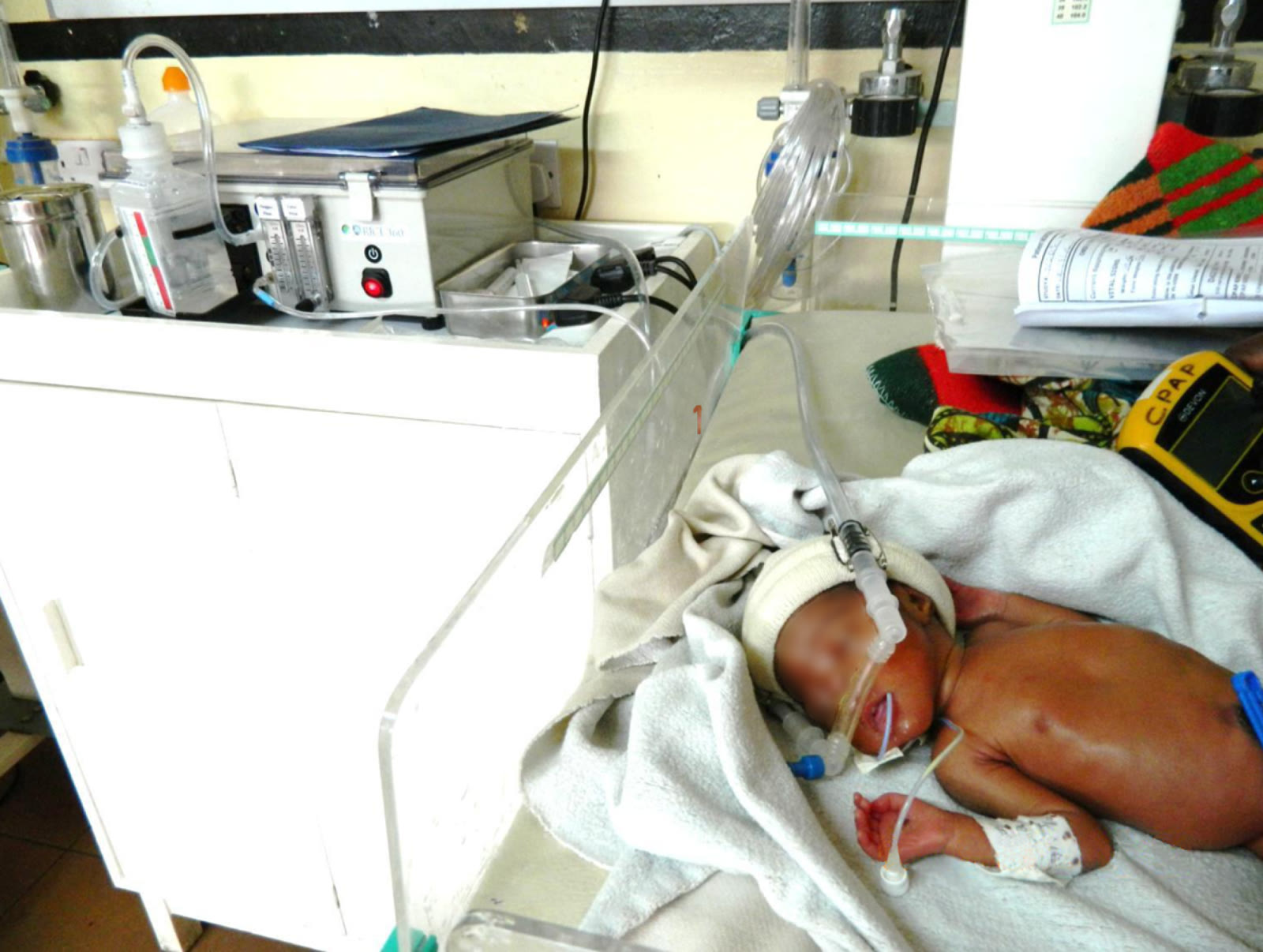
The easiest part of bubble CPAP to notice is the bottle. An expiratory tube dips below the surface of water; gas escapes in a steady percussion of bubbles. The arrangement looks almost too simple for a neonatal unit.
But the bottle is not breathing for the baby. Bubble continuous positive airway pressure, or bubble CPAP, supports a newborn who is making spontaneous breaths by keeping positive pressure in the airway between those breaths. It is not oxygen by another name, and it is not a miniature ventilator. Its central act is quieter: it helps the lung retain volume at the end of exhalation, when an immature, surfactant-deficient lung is most liable to collapse.[3][4]
That distinction explains both the technology's power and its safety boundary. Water can make pressure visible. It cannot make the rest of the system optional.
1971: the breakthrough was pressure between breaths
On June 17, 1971, George Gregory and colleagues reported using continuous positive airway pressure in 20 severely ill infants with respiratory distress syndrome. Eighteen received pressure through an endotracheal tube and two through a chamber around the head. The infants still breathed spontaneously. Arterial oxygen tension rose in all 20, allowing the team to lower inspired oxygen by an average of 37.5 percentage points within 12 hours.[1]
That paper established the clinical importance of continuous distending pressure, but it is often given an imprecise sequel. Gregory's apparatus was not the later bubble-CPAP circuit: a resistor clamp generated its working pressure, while a water-submersion valve served as a high-pressure release. A 2020 engineering study by Sonja Baldursdottir and colleagues traces the low-resistance bubble design to Columbia University in the mid-1970s, when the resistor was replaced by a wide expiratory tube submerged in water and short binasal prongs connected the circuit to the infant.[2]
The correction matters because “it bubbles” is not a sufficient device specification. The classic design works as a low-resistance circuit whose pressure is governed mainly by the water column. Change the bore of the tube, the resistance of the prongs, the flow, the dead space, or the amount of leakage, and the infant may receive something materially different even if the bottle looks busy.[2]
Exhalation is where the mechanism earns its name
A healthy lung does not empty to zero after every breath. It preserves an end-expiratory reserve called functional residual capacity. In respiratory distress syndrome, immature lungs lack enough effective surfactant—the material that lowers surface tension at the air-fluid boundary. Terminal air spaces become harder to keep open, the chest wall may retract, and each breath must recover volume that was lost during the previous exhalation.[3][4]
CPAP changes that starting point. A continuous flow of warmed, humidified gas enters through a sealed nasal interface. The infant inhales from that flow and exhales against positive pressure. In a low-resistance bubble circuit, the open end of the expiratory limb sits under water. Gas must push down the water column before it can escape, so submersion depth supplies a simple pressure reference: roughly 5 centimetres beneath the surface contributes about 5 cm H2O in an ideal circuit.[2]
That pressure splints the upper airway, preserves end-expiratory lung volume, reduces repeated collapse, and improves the area available for gas exchange. The baby is still doing the rhythmic work of breathing; the circuit is improving the mechanical position from which each breath begins.[4]
The bubbles also create small pressure oscillations. Laboratory work has suggested that these fluctuations might assist gas exchange, but the clinically secure claim is the continuous distending pressure, not a promise that bubbling acts like high-frequency ventilation. The 2023 Cochrane review found uncertainty around most important differences between bubble systems and other CPAP pressure sources.[5]
Pressure and oxygen are different dials
The photograph from Queen Elizabeth Central Hospital in Blantyre, Malawi, came from a study of a low-cost device used between January and October 2012. That system could deliver gas flows from 0 to 10 litres per minute, pressures from 5 to 8 cm H2O, and oxygen concentrations from room air at 21% up to 65%.[6]
Those ranges reveal two separate interventions. Pressure recruits and stabilizes lung volume. Supplemental oxygen raises the fraction of oxygen in the gas entering that lung. More oxygen cannot reliably reopen collapsed air spaces; more pressure does not remove the need to measure oxygen exposure. Modern neonatal guidance therefore pairs controllable CPAP with an air-oxygen blender and pulse-oximetry-guided adjustment rather than treating the bottle as the whole therapy.[3][4]
The same distinction sets a boundary around numbers. The European consensus guideline titled as its 2025 update and published in March 2026 suggests beginning neonatal CPAP around 6 cm H2O and then titrating to the infant's response, but that is a clinical starting point, not a construction recipe or a universal setting. Diagnosis, gestational age, spontaneous breathing, oxygen need, blood gases, air leak, and response determine what happens next. An apnoeic or deteriorating infant may need ventilation breaths, surfactant, intubation, or another escalation that CPAP cannot supply.[4]
The circuit is a chain, not a bottle
For the pressure at the nose to resemble the intended pressure, every link must behave.
The flow source has to meet the infant's inspiratory demand and compensate for controlled leakage. Gas should be warmed and humidified. Short nasal prongs or a mask must transmit pressure without imposing excessive resistance, yet the interface also requires vigilant skin and nasal care. The expiratory tube needs a wide enough bore that its own resistance does not add an unseen pressure load. Connecting volume must not become dead space in which exhaled carbon dioxide is rebreathed. The water level has to remain at the intended depth, and staff need a way to measure the pressure actually reaching the circuit.[2][4]
Baldursdottir's 2020 mechanical-lung experiments expose why visual resemblance is dangerous. With a 1.5-metre expiratory limb and gas flow of 8 litres per minute or less, tubing narrower than 8 millimetres increased delivered pressure and imposed work of breathing; with tubing at least 8 millimetres wide, pressure differences stayed below 1.5 cm H2O in their comparisons. High-resistance interfaces made the breathing workload worse. In other words, a narrow tube can turn the water-depth label into a false assurance.[2]
Nor do bubbles prove that the infant is receiving effective support. Some systems can bubble without a patient connected. A leak at the nose or mouth can reduce transmitted pressure; obstruction can increase resistance; worsening lung disease can outrun an otherwise functioning circuit. The observable bottle must therefore be read alongside the infant's work of breathing, heart rate, oxygen saturation, gas exchange, interface condition, and the team's escalation plan.[2][4]
What the outcome evidence does—and does not—show
The evidence is strongest when the question is framed correctly. In its November 2022 guideline, the World Health Organization strongly recommended CPAP for preterm infants with clinical signs of respiratory distress syndrome, based on moderate-certainty evidence. It separately said bubble CPAP may be considered instead of another pressure source such as ventilator CPAP—a conditional recommendation based on low-certainty evidence.[3]
That separation prevents two different comparisons from being blended. CPAP versus no distending-pressure support is one question. A bubbling water-seal device versus a ventilator or variable-flow device delivering CPAP is another.
For the second question, the 2023 Cochrane review combined 15 trials involving 1,437 preterm infants. Bubble devices may have reduced CPAP treatment failure compared with ventilator or Infant Flow Driver systems (risk ratio 0.76, 95% confidence interval 0.60 to 0.95; low-certainty evidence). They did not show a clear mortality difference (risk ratio 0.93, 95% CI 0.64 to 1.36). Bubble CPAP probably increased moderate-to-severe nasal injury (risk ratio 2.29, 95% CI 1.37 to 3.82; moderate-certainty evidence), an estimated one additional injury for every 14 infants treated rather than with the comparison systems.[5]
The Malawi study tells a different, operational story. Its 87 eligible newborns weighed more than 1,000 grams and were breathing spontaneously with severe respiratory distress. Survival to discharge was 71% among 62 infants who received bubble CPAP and 44% among 25 who received nasal oxygen.[6] Those numbers are compelling, but allocation depended on whether a device and trained staff were available; the study was not randomized, and some infants crossed from oxygen to CPAP. Its 27-point survival difference should not be treated as a clean causal estimate. What the study demonstrates more securely is feasibility: a purpose-built lower-cost system, embedded in a ward with training and monitoring, could deliver genuine CPAP where ordinary nasal oxygen had been the practical baseline.[6]
Simplicity is disciplined, not improvised
Bubble CPAP deserves its reputation as an elegant technology. It converts a basic physical relationship—the pressure required to displace a water column—into a form of non-invasive respiratory support. It can avoid an endotracheal tube for some spontaneously breathing preterm infants, preserve functional residual capacity, and buy an immature lung a better position for its next breath.[3][4]
Its elegance is easy to misread. The treatment is not “a tube in a bottle.” It is a pressure system joined to neonatal assessment, controlled gas and oxygen, humidification, an appropriate interface, measured performance, skin care, infection prevention, and a team able to recognize failure. The bottle is the most photogenic link because it moves. The safer lesson is everything around it.
This is hospital respiratory support for trained neonatal teams, not a device to improvise or adjust outside a clinical protocol. A water column can hold pressure. Only a care system can decide whether that pressure is reaching the right infant, at the right level, for the right reason.
Sources
- Gregory GA, Kitterman JA, Phibbs RH, Tooley WH, and Hamilton WK, “Treatment of the Idiopathic Respiratory-Distress Syndrome with Continuous Positive Airway Pressure,” New England Journal of Medicine 284 (1971) — the original 20-infant report establishing continuous distending pressure in spontaneously breathing infants.
- Baldursdottir S et al., “Basic principles of neonatal bubble CPAP: effects on CPAP delivery and imposed work of breathing when altering the original design,” Archives of Disease in Childhood: Fetal & Neonatal 105 (2020) — device history, water-column pressure, interface and tubing resistance, dead space, flow, and bench-test boundaries.
- World Health Organization, WHO recommendations for care of the preterm or low-birth-weight infant (15 November 2022) — recommendations and certainty ratings for CPAP in respiratory distress syndrome, immediate CPAP, and bubble versus other pressure sources.
- Sweet DG et al., “European Consensus Guidelines on the Management of Respiratory Distress Syndrome: 2025,” Neonatology (published 2026) — current consensus on early CPAP, spontaneous breathing, pressure and oxygen control, humidification, interfaces, monitoring, and escalation boundaries.
- Prakash R, De Paoli AG, Davis PG, Oddie SJ, and McGuire W, “Pressure sources for nasal continuous positive airway pressure (CPAP) in preterm infants,” Cochrane evidence summary (2023) — synthesis of 15 trials, including treatment failure, mortality, air leak, bronchopulmonary dysplasia, and nasal injury.
- Kawaza K et al., “Efficacy of a Low-Cost Bubble CPAP System in Treatment of Respiratory Distress in a Neonatal Ward in Malawi,” PLOS ONE 9 (2014) — device specifications, non-randomized ward study, outcome limitations, and supplementary clinical photograph used as the article image.