The first human heart transplant survives in public memory as a feat of nerve. In Barnard's own 1967 report, it reads differently.[1] The paper is dramatic, but its drama is not mainly personal. It is procedural. A donor has to become usable before brain-death doctrine has settled into law. A heart has to survive transfer, cooling, reperfusion, and anastomosis on a minute-by-minute clock. Then a recipient has to live through an immunosuppressive regime strong enough to protect the graft without inviting overwhelming infection.[1][2][5]
That is why the report is still worth reading in 2026. It does not show a mature field celebrating its first victory. It shows a field discovering, in public, what still has to be solved. Later institutional summaries compress the story into one unforgettable line: just before 6 a.m. on December 3, 1967, a new heart in Louis Washkansky's chest was electrically shocked into action at Groote Schuur Hospital.[3] Barnard's article keeps the camera closer to the table. It cares about compatible red-cell antigens, adjoining operating theatres, mid-oesophageal temperatures, perfusion intervals, drainage tubes, steroid doses, and bacteriological swabs.[1]
The central claim of this close reading is that Barnard's report matters less as a monument to surgical courage than as a record of three unstable boundaries. First, it shows how the team handled donor death before formal brain-death criteria had been codified.[1][2][3] Second, it treats myocardial preservation as a timing problem measured in minutes rather than as a general miracle of technique.[1][3] Third, its postoperative pages reveal that early transplantation had proved the operation faster than it had solved the infection-versus-rejection tradeoff.[1][5]
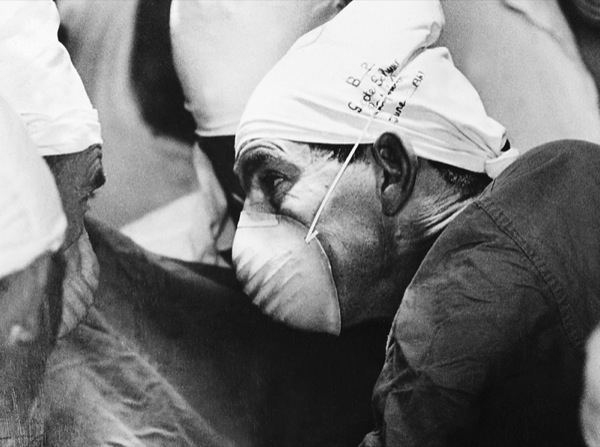
Image context: the cover uses an archival Groote Schuur operating-theatre photograph from the University of Cape Town's historical heart-transplant pages.[3] It belongs here because the original report is crowded with systems detail. The first transplant was never only a surgeon and a scalpel; it was perfusion machinery, temperature control, theatre layout, blood matching, sterility procedure, and a large team moving on one clock.
Timeline anchors before the story hardens into legend
- December 2, 1967: Denise Darvall and her mother were struck by a car in Cape Town; Denise was taken to Groote Schuur Hospital in critical condition.[3]
- Early December 3, 1967: Louis Washkansky, a 53-year-old man with end-stage ischemic heart disease, underwent the transplant at Groote Schuur.[1][3][5]
- December 21, 1967: Washkansky died 18 days after the operation; later review tied the immediate cause to pneumonia rather than graft rejection.[5]
- December 30, 1967: Barnard's interim report appeared in the South African Medical Journal, giving the field its first detailed technical account.[1]
- September 1968: Harvard's ad hoc committee issued its report on irreversible coma, helping provide the conceptual and legal language that the first transplant had exposed as unfinished.[2]
1. The report treats death as an operational threshold, not a settled doctrine
One of the most revealing features of Barnard's paper is how it handles the donor.[1] Modern retellings often use the language of brain death without hesitation. The University of Cape Town's historical page says Denise Darvall was later declared brain dead after the accident that killed her mother.[3] Barnard's own report is more provisional, because the doctrine itself was still provisional. He writes that the donor was certified dead when the electrocardiogram had shown no activity for 5 minutes, there were no spontaneous respiratory movements, and reflexes were absent; only then did the team inject heparin, open the chest, and begin the preservation sequence.[1]
That wording matters because it captures a transitional medical and legal world.[1][2] Hoffenberg's later BMJ reflection says the heart transplants of late 1967 helped trigger a new set of legal and philosophical justifications for removing a beating heart from a donor, and he states plainly that, at the time of Barnard's first operations, there were no guidelines for diagnosing death in beating-heart donors.[2] Put differently, the famous operation did not arrive after the concept of brain death had been stabilized. It helped force the stabilization.
Read closely, Barnard's article therefore solves the donor problem pragmatically rather than theoretically.[1] It does not pause over metaphysics. It specifies observable criteria, then moves at once into cannulation, bypass, and cooling. That compressed transition is one of the paper's most historically important facts. The first human heart transplant was not performed in an ethically tidy era and later criticized by philosophers. It was performed in an ethically unsettled era that then had to invent sturdier language for what had just happened.[1][2]
2. The paper measures success in minutes
The second thing the report makes unmistakable is that transplantation, at this stage, was a problem of myocardial time accounting.[1] Barnard describes two adjoining theatres, one for donor preparation and one for the recipient. The donor was cooled to 26°C because the kidneys were also being protected for transplantation elsewhere, while the donor heart itself was cooled further to 16°C before excision.[1] The excision took 2 minutes. The heart was placed in 10°C Ringer's lactate, transferred next door, and reperfused there after an interval of only 4 minutes between cessation and resumption of perfusion.[1]
This obsession with intervals is the real pulse of the paper.[1] The report says that after implantation and rewarming, 35 joules from a DC defibrillator restored coordinated ventricular contraction. At that point, the graft had been without coronary perfusion for 7 minutes at normothermia and 14 minutes at 22°C, and it had been perfused artificially for a total of 117 minutes.[1] Those figures are not decorative. They are the article's argument. Barnard is telling his readers that the operation succeeded because the graft was not treated as a symbolic organ passing from one body to another. It was treated as tissue living on borrowed metabolic time.
The UCT historical page compresses this whole sequence into a cleaner public image: a new heart shocked into action shortly before 6 a.m..[3] That image is true, but the primary report gives it its real meaning. The technical achievement was not merely sewing the heart in place. It was keeping the myocardium inside a survivable corridor long enough that sewing it in place meant anything at all.[1][3]
3. The postoperative pages show what the field had not yet solved
If the operation section proves that a human heart could be transplanted, the postoperative section shows how incomplete the wider solution still was.[1] Barnard lists a rejection-surveillance regime built from leucocyte response, changes in cardiac output, serum enzyme levels, and shifts in R-wave voltage on electrocardiography.[1] The treatment package was aggressive: intravenous hydrocortisone starting at 500 mg over 24 hours, oral prednisone at 60 mg daily, azathioprine beginning at 150 mg and later increased to 200 mg, plus local cobalt irradiation on days 3, 4, 5, 7, and 9.[1]
At the same time, the infection-prevention section reads almost like an isolation-manual appendix.[1] The room is chemically disinfected. Staff are screened. The mattress is autoclaved. Sheets are changed twice daily. Floors are mopped with phenolic disinfectant. Daily blood cultures are taken. The minimal number of personnel are allowed near the patient.[1] This is the paper's third major lesson. The team already understood that transplantation was not only a suture-line problem. It was also a microbial and pharmacologic balance problem.
Later retrospective evidence clarifies how hard that balance still was.[5] David Cooper's account says Washkansky's immediate recovery was excellent, but after roughly 12 days pulmonary infiltrates were misread as a rejection-related phenomenon sometimes called "transplant lung." Barnard's team intensified immunosuppressive therapy, and only later did it become clear that the patient had pneumonia. Washkansky died on December 21, 1967, and autopsy found no evidence of rejection in the heart itself.[5]
That sequence changes the meaning of "success."[1][5] The first transplant proved the graft could work surgically before the field had learned how to protect a profoundly immunosuppressed human being from the environment around him. The operation succeeded faster than postoperative management matured. Barnard's report, read with later review, therefore marks not the end of uncertainty but the exact place uncertainty moved after the chest was closed.[1][5]
What this primary source still clarifies
The temptation is to remember December 1967 as the moment the impossible became possible.[3] Barnard's report supports a narrower and stronger conclusion. It shows that three different questions were briefly held together in one patient: when death could be certified for donation, how long a heart could be preserved across transfer and reperfusion, and whether early immunosuppression could preserve the graft without destroying host defence.[1][2][5]
That is why the article remains such a powerful health document. Its achievement lies in specificity. It names temperatures, intervals, cannulation choices, drug doses, and cleaning routines because transplantation had to become reproducible before it could become normal.[1][4] The first human heart transplant did not enter history as a finished system. It entered history as a successful operation that exposed the next layer of unsolved medicine.
Sources
- C. N. Barnard, "The Operation: A Human Cardiac Transplant: An Interim Report of a Successful Operation Performed at Groote Schuur Hospital, Cape Town" (South African Medical Journal, republished 2017) - full text of the original 1967 report, including donor-death criteria, temperatures, perfusion intervals, operative sequence, and postoperative regimen.
- Raymond Hoffenberg, "Christiaan Barnard: his first transplants and their impact on concepts of death" (BMJ, 2001; PMC full text) - retrospective analysis of how the 1967 operations exposed the absence of formal beating-donor death criteria and helped accelerate brain-death doctrine.
- Chris Barnard Division of Cardiothoracic Surgery, University of Cape Town, "World's First Human Heart Transplant" - institutional history covering the Darvall accident, Washkansky's selection, the operation clock, and archival operation-era photographs used for this article's image.
- Chris Barnard Division of Cardiothoracic Surgery, University of Cape Town, "First Heart Transplant Team" - official roster page showing the multidisciplinary team behind the first transplant and reinforcing the systems nature of the event.
- David K. C. Cooper, "Christiaan Barnard-The surgeon who dared: The story of the first human-to-human heart transplant" (Global Cardiology Science & Practice, 2018; PMC full text) - later clinical narrative on Washkansky's deterioration, pneumonia, autopsy findings, and the distinction between graft function and postoperative survival.