Andreas Grüntzig is usually remembered as the man who performed the first successful coronary balloon angioplasty.[1][2][3] That memory is true, but it is thinner than the history. The lasting turn did not come from one heroic inflation in Zurich on September 16, 1977 alone. It came from a tighter chain: a new catheter design, a strict idea of which lesions were suitable, a willingness to publish outcomes early, and a teaching culture that let other physicians watch the procedure happen in real time.[1][3][4][5]
That is why a biography/microhistory fits better than a founder myth. Grüntzig's achievement was not merely to prove that a narrowed coronary artery could be opened without a sternotomy. Several earlier lines of work already pointed toward transluminal treatment, and even coronary attempts before the famous Zurich case had taken place in more limited settings.[1][4] What Grüntzig supplied was a way to make coronary obstruction look less like a surgical destiny and more like a percutaneous routing problem. A lesion could be visualized, judged for suitability, crossed with a catheter, dilated under pressure, and then discussed as a repeatable technique rather than as a one-off dare.[1][2][3]
That is the central claim of this article: Grüntzig mattered because he made coronary angioplasty teachable. The 1977 procedure was the hinge, but the larger transformation came from how he built the tool, constrained the indications, and then spread the method through demonstration courses and training networks.[1][2][4][5]
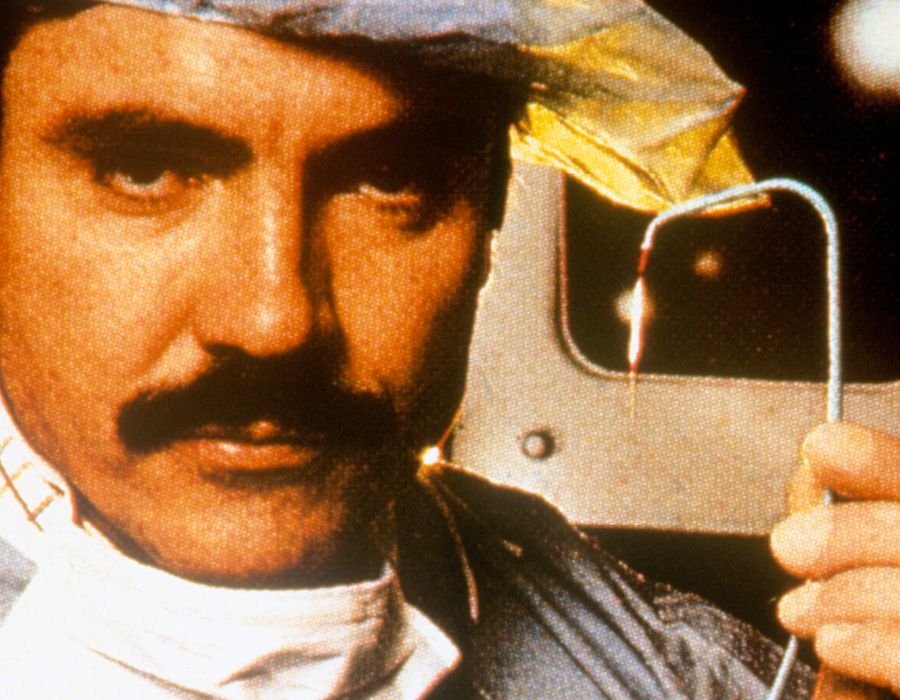
Image context: the cover uses an archival Emory photograph of Andreas Grüntzig holding an early balloon catheter.[6] It belongs here because this history is not about an abstract concept called "less invasive cardiology." It is about a very specific object that had to become credible in the hand before it could become credible in the coronary artery.
Timeline anchors before the legend hardens
- 1975: after earlier balloon work in peripheral vessels, Grüntzig developed the double-lumen catheter design that became crucial for coronary angioplasty.[4]
- 1976: he presented animal-study results at the American Heart Association meeting and met both skepticism and a few early collaborators.[4]
- September 16, 1977: in Zurich, he performed the first successful coronary angioplasty on an awake human in the catheterization laboratory.[1][4]
- 1978: the first Zurich live demonstration courses began, sending cases by closed-circuit television from the cath lab to a nearby auditorium.[1]
- 1978 publication baseline: by the time one early clinical report was indexed on PubMed, 29 patients had been treated, with primary success in 23 (79%) and long-lasting success in 21 (72%); 3 patients required emergency coronary surgery.[2]
- 1980: Grüntzig moved from Zurich to Emory, where the training and research network around angioplasty expanded further.[1][5]
- 2026 institutional afterlife: Emory's interventional cardiology fellowship still identifies itself as a program started by Grüntzig, evidence that his legacy was educational as much as procedural.[5]
Those dates matter because they keep the story from collapsing into one immortal snapshot. The famous 1977 case sits at the center, but it only explains the field's future if the engineering before it and the teaching after it are kept in frame.
1. The breakthrough began in a kitchen because the existing catheter logic was not good enough
Before coronary angioplasty became a medical specialty, it was a materials problem.[1][4] Balloon-tipped catheters were not new in medicine, but the existing devices were not suitable for compressing atherosclerotic plaque inside a coronary artery with enough precision and without simply bursting or losing shape.[1] The Karger biographical review describes Grüntzig's long period of trial and error bluntly: he spent years refining balloon construction, eventually working with polymer expertise and arriving at a polyvinyl-chloride balloon system that could actually perform the task.[1]
The older Dotter-style transluminal approach had already established the broad ambition of opening vessels from within.[1][4] What Grüntzig changed was the device's discipline. By the time the double-lumen catheter was functioning, one lumen could handle balloon inflation and deflation, while a second central lumen could support guidewire passage, pressure measurements, and distal perfusion logic that made coronary work more plausible.[1] In modern language, he did not simply "have an idea." He built a tool that reduced the gap between concept and coronary anatomy.
That engineering labor matters because it explains why the history does not read like pure boldness. Coronary arteries are small, mobile, and unforgiving. A physician could not simply scale down a peripheral maneuver and hope for the best. Grüntzig's years of catheter fabrication are therefore part of the clinical history, not an anecdotal preface to it.[1][4] The hand-built object and the later procedure belong to the same chain.
2. The first clinical success depended on strict lesion selection, not on universal confidence
The 1977 Zurich case looks inevitable only in hindsight.[1][4] It was not. Even after the catheter worked experimentally, Grüntzig still needed institutional permission, surgical backup, and a patient whose anatomy fit the technique's narrow safe zone.[1] The Karger review notes that he waited until an "almost ideal patient" appeared: a single, short, discrete proximal lesion in the left anterior descending artery.[1] That detail is one of the most important correctives in the whole story. Angioplasty did not enter medicine as a general answer to coronary disease. It entered as a carefully staged answer to a highly selected lesion.
The early PubMed-indexed clinical report preserves the same discipline in technical language.[2] The system was introduced through the femoral artery under local anesthesia. A guiding catheter was positioned at the coronary ostium, and the dilatation catheter's sausage-shaped balloon was inflated to 5 atmospheres.[2] The indications were not broad or populist. Grüntzig described the best targets as lesions that were proximal, subtotal, concentric, and non-calcified.[2] In other words, the method became credible because it knew its boundaries.
Those boundaries also explain the early outcomes better than triumphalist retellings do.[2] By the time of that report, 29 patients had been treated. 23 achieved primary success, 21 had long-lasting success, and 3 required emergency coronary surgery to avoid infarction.[2] That is not the profile of a magical cure arriving fully formed. It is the profile of a strong but still risky technique defining its safe territory in public.
This is why the first case mattered so much. Grüntzig had shown that one coronary narrowing, in the right anatomical circumstances, could be crossed and opened without cracking the chest.[1][2][4] The achievement was real precisely because it was narrow enough to be believable.
3. Live demonstration turned a daring case into a field
Many medical innovations remain local legends. Grüntzig's did not, because he converted the procedure into a shared performance of evidence.[1][4][5] Angioplasty.org's archive captures the social pivot well: after the 1977 Zurich success, his early four-case presentation at the AHA meeting drew a standing ovation, and he then pushed the field forward through live demonstration courses and a PTCA registry supported by the National Heart, Lung and Blood Institute.[4]
The Karger review gives the next level of detail.[1] Beginning in 1978, Zurich courses transmitted live angioplasty cases from the catheterization lab to a nearby auditorium, where attendees could watch the procedure unfold and debate the method in real time. That setup mattered far beyond spectacle. It compressed the usual delay between publication and practical uptake. Physicians were not only reading about angioplasty; they were seeing lesion selection, wire handling, balloon positioning, and complication management in one continuous visual sequence.[1]
That educational structure helps explain why Grüntzig's later move to Emory in 1980 was historically important.[1][5] Emory's current fellowship page still states that its interventional cardiology program was started by Andreas Grüntzig.[5] The 2025 Emory feature on institutional "problem solvers" frames his achievement in the same direction, describing him not only as the pioneer of balloon coronary angioplasty but as the builder of a global hub for training specialists in the new method.[6] The point is not that these later institutional tributes prove the 1977 case. The point is that they reveal what endured: a training pipeline.
Seen that way, Grüntzig's most durable innovation was half device and half pedagogy.[1][4][5][6] He taught other cardiologists to imagine that a patient could walk into a cath lab, undergo a coronary revascularization procedure under local anesthesia, and walk back out without sternotomy or heart-lung bypass. Once that mental picture became concrete, the rest of interventional cardiology could expand from it.
Two ways to remember Grüntzig
Interpretation A: Grüntzig's importance lies mainly in being first
This interpretation survives because firsts are easy to remember. One date, one patient, one doctor, one breakthrough.[1][3]
Interpretation B: Grüntzig's importance lies in making angioplasty bounded, reproducible, and teachable
This interpretation fits the record more closely. The double-lumen catheter, the narrow lesion criteria, the openly reported early success-and-rescue numbers, and the live courses all point in the same direction.[1][2][4][5] Grüntzig changed medicine not by pretending every blockage was suddenly simple, but by showing how a selected blockage could be treated in a way that others could watch, judge, and eventually repeat.
Interpretation A explains the headline. Interpretation B explains the specialty.
Why this microhistory still matters
Grüntzig still matters in 2026 because his story shows how procedural revolutions usually work in medicine. A tool has to be engineered into reliability. The first cases have to be chosen narrowly enough to succeed without lying about the risk. The results have to be published before they are mythologized. Then the method has to be taught until strangers can reproduce it in other rooms.[1][2][4][5]
That is the stronger history of balloon angioplasty. Grüntzig did not merely open one artery in Zurich and let fame do the rest.[1][2][4] He turned coronary obstruction into a percutaneous problem with technical boundaries and a training culture. The stent era, the guidewire era, and the entire later vocabulary of interventional cardiology grew out of that earlier discipline rather than replacing it.[3][5][6]
Sources
- Thomas J. Ryan, "Andreas R. Gruentzig, MD (1939-1985)" (Cardiology, 2020) - biographical review covering balloon design, the double-lumen catheter, the September 16, 1977 Zurich case, the 1978 teaching courses, and the later Emory move.
- A. Grüntzig, "Percutaneous transluminal dilatation of chronic coronary stenoses: first experiences" (Schweizerische Medizinische Wochenschrift, 1978; PubMed abstract) - early technical description, local-anesthesia femoral approach, 5-atmosphere inflation, lesion-selection criteria, and the first 29-patient results.
- Zhen Vin Lee and Bashir Hanif, "Historical Perspectives on Management of Acute Myocardial Infarction" in Primary Angioplasty: A Practical Guide (NCBI Bookshelf, 2018) - overview treating the 1977 double-lumen-balloon milestone as the beginning of modern PCI.
- Angioplasty.org, "Angioplasty / PTCA Bio of Andreas Gruentzig" - accessible historical archive on the 1975 double-lumen catheter, 1976 AHA skepticism, 1977 awake-human procedure, standing ovation, and the live-demonstration era.
- Emory School of Medicine, "Interventional Cardiology Fellowship" - current institutional page noting that the fellowship program was started by Andreas Gruentzig and remains a high-volume training center.
- Emory University, "Problem Solvers" feature - archival Andreas Grüntzig photograph used as the article image and summary of his role in pioneering balloon coronary angioplasty and specialist training.