Public memory likes the thalidomide story when it can be compressed into one dramatic frame: one reviewer says no, one country escapes the worst of a drug disaster, and regulation suddenly becomes wiser. Frances Kelsey matters for a sharper reason.[1][2] Her real contribution was procedural. She treated missing evidence as its own kind of warning, refused to let commercial momentum stand in for proof, and kept doing so even when the file in front of her was already wrapped in international confidence.[1][3]
That is why a biography/microhistory fits her better than a hero sketch. Kelsey did not "discover" thalidomide's teratogenicity before Europe did.[3] What she did was hold the review line at exactly the point where the system was most tempted to substitute custom for evidence. When the catastrophe became visible in late 1961, her discipline looked prophetic. Read more closely, it was rigorous rather than mystical.[1][2][3]
The second reason to look at her closely is that the near miss in the United States was not as clean as the legend implies. FDA's own history says the sponsor distributed over two million tablets of Kevadon for investigational use while the law and regulations still left that pathway "mostly unchecked."[4] Kelsey's file review slowed formal approval, but the thalidomide episode still exposed a broader control failure around clinical investigation, adverse-event reporting, and patient knowledge.[3][4][5]
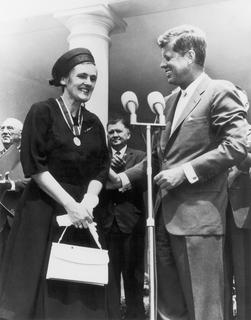
Image context: the cover uses the National Library of Medicine's archival photograph of President Kennedy presenting Kelsey with the President's Award for Distinguished Federal Civilian Service in 1962.[2] The image belongs here because it shows the public afterlife of a much quieter act. Kelsey's importance began at a desk, inside a review process where delay itself became a safety tool.
Timeline anchors
- August 1, 1960: Kelsey began work at FDA; in her own recollection, thalidomide landed on her desk during her first month at the agency.[3]
- 1960-1961: while Richardson-Merrell pressed for approval, Kelsey kept asking for stronger evidence and did not treat the drug's European use as sufficient proof of safety.[1][2][3]
- November 30, 1961: Merrell informed FDA that the German firm was withdrawing the drug after the emerging birth-defect crisis in Europe.[3]
- March 8, 1962: the Kevadon application was formally withdrawn.[3]
- August 7, 1962: President John F. Kennedy awarded Kelsey the President's Award for Distinguished Federal Civilian Service.[2]
- Late 1962: the Kefauver-Harris Drug Amendments made efficacy, adverse-event reporting, and tighter investigational controls part of federal drug law.[5][6]
1. Kelsey arrived at FDA with a habit of reading drugs against their evidence, not against their marketing
One reason the later mythology feels too simple is that it turns Kelsey into a spontaneous heroine rather than a trained pharmacologist and physician who had spent years learning how evidence could fail.[1][2][3] The FDA and NLM biographies agree on the basic sequence: Vancouver Island childhood, science training at McGill, a Ph.D. in pharmacology at the University of Chicago in 1938, an M.D. completed in 1950, editorial work at the American Medical Association, then teaching and medical practice in South Dakota before the move to Washington in 1960.[1][2]
That background matters because it explains the texture of her later skepticism. She was not reading the Kevadon application as a moral allegory. She was reading it as someone trained to ask what the file actually proved, what repeated exposure data were missing, and whether reassuring usage stories had been confused with scientifically adequate demonstration.[1][3] The FDA exhibit is blunt on the key point: manufacturers had to provide evidence of safety before a drug could go on the market, and Kelsey did not think the application met that burden.[1]
In retrospect, that sounds obvious. In context, it was abrasive. The drug had already circulated in many countries, and the sponsor treated that international familiarity as a practical argument for speed.[1][2][3] Kelsey refused the shortcut. Her contribution begins there: not with clairvoyance, but with a professional refusal to let popularity masquerade as proof.
2. The decisive move was to treat uncertainty as an active risk, not as a temporary inconvenience
The NLM biography says Kelsey took her stand during her first month at FDA, on her first assignment.[2] The file seemed routine: a sedative already used abroad, presented as something the United States could process without much drama. Yet Kelsey was troubled by signs that repeated use might carry dangerous side effects, and by the weakness of the supporting evidence more broadly.[2][3]
Her own autobiographical reflections are especially useful here because they strip away the later triumphal tone. She says the objections were "largely based" on the lack of evidence that the drug was safe.[3] That phrase is the whole operating logic. Kelsey did not need a fully developed alternative theory of disaster before slowing the file. She treated the absence of convincing proof as a problem in itself.
This is the public-health hinge. Many regulatory failures happen because officials wait for conclusive evidence of harm before acting, even when the proposed use is broad and the burden of proof is supposed to run in the other direction. Kelsey worked from the opposite assumption.[1][3] If a company wanted mass marketing, the company had to close the evidentiary gap first. Until then, delay was not bureaucratic friction. Delay was the safety function.
That also explains why the thalidomide story should not be reduced to individual bravery alone. Courage mattered, but courage without a disciplined evidentiary standard would not have been enough. What made Kelsey effective was her willingness to keep the burden where the law said it belonged.[1][3]
3. Thalidomide showed that blocking approval was only one layer of the problem
The cleanest correction to the familiar story is that the U.S. system was still more porous than the later legend admits. FDA's CDER history says that although Kevadon was never approved for marketing, Richardson-Merrell distributed over two million tablets for investigational use, a pathway the pre-1962 regime left mostly unchecked.[4] That is not a minor footnote. It means Kelsey's review discipline protected the formal approval gate while the side door remained far too open.
Her autobiographical reflections show the same issue from inside the agency. Looking back on the thalidomide episode, she wrote that the FDA survey of these 1,000 doctors revealed how weak investigational oversight had been.[3] Many patients had not been told they were receiving an investigational drug, and many doctors themselves did not fully understand the status of what they were distributing.[3] In other words, the file on Kelsey's desk connected directly to a wider governance failure in the field.
This is why her significance cannot stop at "the woman who said no." She belonged to the moment when the American drug regime discovered that formal NDA review, clinical investigation, physician communication, and patient consent could not be treated as separate compartments.[3][4][5] The thalidomide near miss showed that a reviewer might hold the front gate and still find the perimeter unsecured.
4. Once the European catastrophe became visible, Kelsey's method turned into a public argument about what review is for
The late 1961 turn is often narrated as vindication, and it was. Kelsey recalls being surprised when Merrell informed FDA on November 30, 1961 that the German firm was withdrawing the drug because of possible links to birth defects.[3] The point of surprise matters. It reminds us that her initial resistance had not rested on foreknowledge of the exact disaster to come. It rested on the narrower and sturdier claim that the evidence in hand was inadequate for safe mass use.[1][3]
That distinction is worth keeping because it changes what readers learn from the case. If Kelsey had simply guessed the precise danger before anyone else, the lesson would collapse into exceptional personal intuition. If instead she was enforcing a rigorous review norm under conditions of uncertainty, then the lesson becomes institutional and reproducible.[1][3][5] Public health improves when systems know how to stop and ask for better evidence before irreversible injury arrives.
The award ceremony in August 1962 turned that procedural discipline into a national symbol.[2] Kennedy's administration presented the decision as protection of the American public; the NLM biography notes that he honored Kelsey for preventing a major tragedy of birth deformities in the United States.[2] The symbolism was deserved, but it can distract from the mechanism. Kelsey did not save the country by improvising outside the file. She saved it by taking the file more seriously than the system around her expected.
5. The 1962 amendments mattered because they turned one reviewer's discipline into system design
The FDA milestones page is explicit that thalidomide, and the visibility of Kelsey's role in keeping it off the U.S. market, helped generate support for stronger drug regulation in 1962.[5] The amendments that followed required drug manufacturers to prove effectiveness before marketing, strengthened safety obligations, and changed the structure of investigation and reporting.[5][6] Kelsey's own reflections point to one especially consequential late addition: patient consent for investigational drug use, sharpened by what the agency learned from the thalidomide distribution network.[3]
That is the deepest policy outcome. The pre-1962 system had allowed too much room for promotional drift inside "investigational" distribution.[3][4] The post-thalidomide regime moved toward a more modern settlement: clinical investigation had to be documented more completely, adverse effects had to move back to the agency, and efficacy could no longer be treated as a marketing assumption.[5][6]
The anniversary history of Kefauver-Harris adds one more useful layer. It argues that the amendments helped consolidate the modern randomized clinical trial as a regulatory instrument for showing efficacy, not just safety.[6] Put differently, Kelsey's story belongs not only to catastrophe prevention. It also belongs to the construction of a more demanding evidentiary state for medicines.
The bounded conclusion
Frances Kelsey changed public health by making one narrow professional rule hold under pressure: if the evidence is thin, the default answer is delay.[1][3] Thalidomide later made that rule look heroic because the danger turned out to be catastrophic. Yet the more transferable lesson is quieter. Kelsey mattered because she treated uncertainty as actionable, recognized that investigational use could become a loophole large enough to injure patients, and helped push U.S. drug regulation toward a system where safety, efficacy, reporting, and consent had to live in the same architecture.[3][4][5][6]
That is why the biography still holds. The decisive act was not a cinematic refusal floating above institutions. It was a disciplined use of institutional authority inside a badly stressed system, followed by a legal rewrite that tried to make such discipline less dependent on one person the next time.
Sources
- U.S. Food and Drug Administration, "Frances Oldham Kelsey: Medical reviewer famous for averting a public health tragedy" - FDA history exhibit on Kelsey's training, FDA arrival, refusal to approve thalidomide on inadequate evidence, and her later leadership roles.
- U.S. National Library of Medicine, "Biography - Dr. Frances Kathleen Oldham Kelsey" - NLM biography covering Kelsey's first month at FDA, the European birth-defect revelations, Kennedy's August 7, 1962 award, and the gallery image used for this article.
- Frances O. Kelsey, Autobiographical Reflections (FDA History Office PDF) - Kelsey's own account of starting at FDA on August 1, 1960, reviewing thalidomide, the November 30, 1961 withdrawal notice, the March 8, 1962 NDA withdrawal, and the investigational-use consent problem.
- U.S. Food and Drug Administration, "A Brief History of the Center for Drug Evaluation and Research" - FDA history page documenting that Kevadon was never approved for marketing but that over two million tablets had been distributed for investigational use under weak pre-1962 controls.
- U.S. Food and Drug Administration, "Milestones in U.S. Food and Drug Law" - FDA historical summary of how thalidomide and Kelsey's review helped build support for the 1962 Kefauver-Harris amendments.
- Jeremy A. Greene and Scott H. Podolsky, "The 50th Anniversary of the Kefauver-Harris Amendments: Efficacy Assessment and the Randomized Clinical Trial" (Pharmacoepidemiology and Drug Safety, 2012; PMC full text) - historical analysis of how the amendments helped harden efficacy review and randomized trials inside U.S. drug regulation.