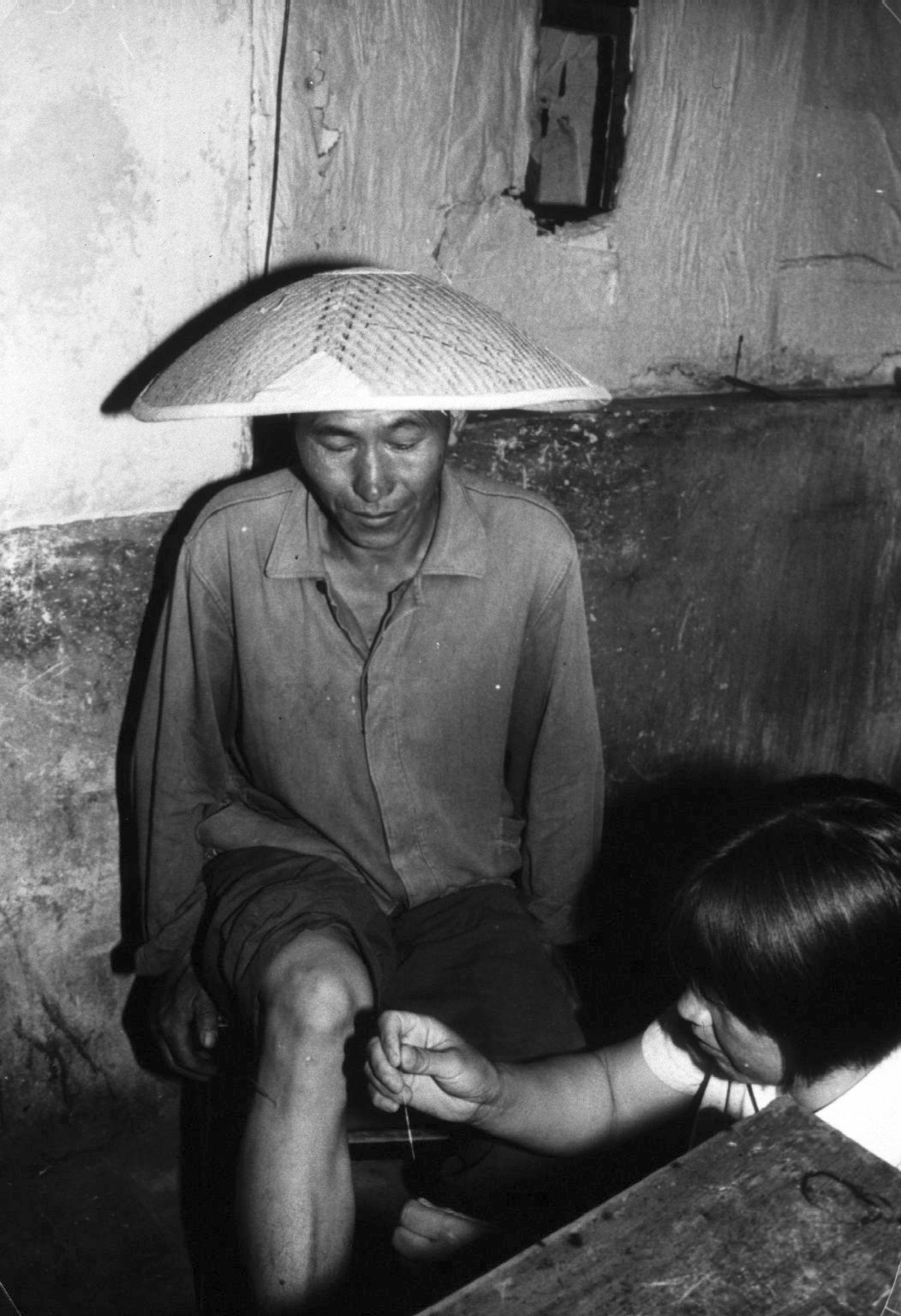
The barefoot doctor is easy to turn into a slogan. In one version, the figure proves that a poor country can solve rural health with local commitment and simple tools. In another, the figure is dismissed as undertrained medicine wrapped in revolutionary theater. Both readings are too clean. The stronger comparative history is about a bridge: barefoot doctors worked when local selection, short practical training, prevention tasks, referral paths, and collective payment held together.
That bridge matters because rural primary care keeps facing the same problem under different names. How do you place a credible health worker close enough to households when physicians cluster in cities, transport is slow, and a clinic visit competes with farm work, wages, childcare, and trust? China's barefoot-doctor period did not solve that problem permanently. It showed the shape of the problem with unusual clarity.[1][2]
The lesson is not "bring back barefoot doctors." The lesson is that a village health worker cannot be judged only by training length or heroic proximity. The worker has to sit inside a system that decides who is selected, who supervises, what services are expected, how referrals work, and how the worker is paid when prevention does not generate a fee.[1][3][4]
Timeline anchors
- 1951-1957: rural health-worker experiments preceded the famous Cultural Revolution label; WHO's Bulletin account notes that by 1957 China already had more than 200,000 village doctors across the country.[3]
- 1968: the barefoot-doctor program became a national policy signal; later reviews describe the 1968 Red Flag article as the starting point for rapid paramedic training in rural areas.[1][2]
- 1979-1981: policy tried to formalize the role, including at least two barefoot doctors per village, one female, and an examination route toward village-doctor status.[1]
- 1985: China's Ministry of Health stopped using the term "barefoot doctor" and shifted policy toward "village doctors."[1][2]
- 1990: a World Bank report counted about 776,000 village doctors, 455,000 health aides, and 470,000 birth attendants, roughly 1.7 million rural health workers in all.[4]
- 2009-2013: after the 2009 health-system reform, government subsidies became a growing income source for village doctors; by the end of 2013, China had 1.08 million village doctors.[1]
The old model was a bundle, not a miracle worker
The most portable insight is that the barefoot doctor was never only a person. The role bundled four things that are often separated in modern policy: village membership, short-cycle training, public-health tasks, and a link upward to township or county medicine. Hu and colleagues describe the barefoot-doctor stage as 1968 to 1985, with about 1.5 million barefoot doctors trained in a few years to provide basic health services to about 0.8 billion rural people.[1]
Those numbers explain why the model became internationally famous. They also warn against nostalgia. A workforce that large could not be made of fully trained physicians. It was a deliberate compromise: enough training to deliver common services, enough local embeddedness to be reachable, and enough connection to the formal system to know when a patient had to move beyond the village.[1][3]
The image of the barefoot doctor with a medicine bag can therefore mislead. The stronger image is a hinge. On one side was the production brigade, the household, sanitation work, vaccination, maternal and child health, health education, and ordinary minor illness. On the other side were township health centers, county hospitals, medical schools, mobile teams, and state policy. The barefoot doctor did not replace that upper system. The role made the first contact with it less distant.[1][3]
Access beat professional purity, but only up to a boundary
The first comparison is between access and competence. Rural areas needed care now; professional education took years. The Bulletin of the World Health Organization account describes short training cycles of three months, six months, or one year in places short of medicine or doctors, after which trainees returned to villages to farm and provide care.[3] That was not equivalent to medical school, and it was not pretending to be.
The practical question was different: is a locally trusted worker with narrow training better than no nearby worker at all? For prevention, basic triage, sanitation campaigns, uncomplicated care, and referral, the answer could be yes. For complex diagnosis, surgery, difficult obstetrics, and severe illness, the answer had to be no. A serious reading keeps both sides in the frame.
This is where modern community-health-worker programs can learn from the model without copying it. Undertraining becomes dangerous when policy uses local workers to cover for absent clinicians. But overprofessionalization also fails when it produces a workforce that will not live, stay, or work where rural households actually need first contact. The design task is not to choose purity or proximity. It is to define which tasks belong near the household and which tasks require escalation.[1][3]
Payment was not a footnote
The second comparison is financial. During the commune era, barefoot doctors were paid from village collective arrangements. That mattered because prevention, home contact, health education, and routine public-health work rarely produce immediate fee-for-service income. When the rural collective economy weakened, the payment base weakened with it.[1][4]
The World Bank's early 1990s report is useful because it catches the transition after the heroic story had cooled. It describes village-level rural health care as de facto privatized and shows a system trying to understand the former barefoot doctors as village doctors under new financing conditions.[4] Hu and colleagues make the same mechanism explicit: after 1985, many village doctors depended heavily on user fees and drug-sale revenue, which created an incentive to provide clinical services for revenue while neglecting public-health work.[1]
That is the least romantic lesson in the story. If a system wants prevention, it has to pay for prevention. If it pays mainly for drug sales, then the village worker's behavior will drift toward drug sales. If it wants immunization, maternal follow-up, chronic-disease registration, outbreak reporting, and household education, then compensation, supervision, and data systems have to make those tasks real work rather than moral expectations.[1][4]
The post-2009 reforms show the same point in reverse. Government subsidies became a larger income source, including support tied to essential public-health services.[1] That did not automatically solve status, workload, or quality problems, but it recognized that the village doctor could not be asked to function as a public-health agent while being paid mainly as a tiny private retailer.
Alma-Ata remembered the right part and risked simplifying the rest
The barefoot-doctor model helped shape the global imagination around primary health care. The WHO page on the Declaration of Alma-Ata identifies the 1978 WHO/UNICEF conference as the moment that focused world attention on primary health care as key to an acceptable level of health.[5] The Bulletin account is more specific about Chinese influence, calling barefoot doctors a major inspiration to the primary-health-care movement leading to Alma-Ata.[3]
That international afterlife got one thing right: serious health systems cannot wait for patients to appear at distant hospitals. Primary care has to be close to ordinary life. It has to include prevention, education, maternal and child health, simple treatment, and referral. It has to treat health as social infrastructure, not only as a specialist encounter.[3][5]
But Alma-Ata memory can also blur the system engineering. Barefoot doctors were not successful because they were cheap in isolation. They were useful because villages selected them, higher levels trained and supervised them, collective financing supported them, and the state gave the role political priority.[1][2][3] Remove those conditions and the same worker becomes fragile: underpaid, undertrained, undersupervised, and pressured to sell services that keep the clinic alive.
What should travel, and what should not
The most dangerous export is the costume version: a lightly trained local worker presented as a substitute for investment. That version can become a way for governments to normalize second-class rural care. It asks the village to accept a thinner workforce because geography makes full service expensive.
The useful export is the bridge logic. Train local people for defined tasks. Keep the task list narrow enough to be safe and broad enough to matter. Pay prevention directly. Build referral paths that work before emergencies. Use supervision as a support system, not just discipline. Preserve local trust without leaving the worker alone. Make the health worker's incentives match the services public health actually needs.[1][3][4]
That distinction also changes how to read quality. A village worker's value is not measured only by how much medicine they know. It is measured by whether they increase the odds that a pregnant person gets risk recognized early, a child receives vaccination on time, a fever is referred before deterioration, a household hears practical prevention advice from someone they trust, and a public-health signal moves upward before it is invisible again.
The useful memory
Barefoot doctors became famous because they answered a hard rural-health question at scale. They were selected from villages, trained quickly, sent back into ordinary community life, and tied to a larger care ladder. That model was imperfect, politically loaded, and vulnerable to financing collapse. It was also more sophisticated than the sentimental shorthand suggests.
The comparative lesson is therefore modest and demanding. Rural primary care works when the first health worker is close enough to be used, trained enough to be useful, bounded enough to be safe, paid enough to keep prevention alive, and connected enough to refer beyond their own limits. The barefoot doctor was never a full health system. At best, the role made the system reachable.
Sources
- Dan Hu et al., "Development of village doctors in China: financial compensation and health system support," International Journal for Equity in Health, 2017 - training scale, 1968-1985/1985-present stages, 1985 terminology shift, 2009 subsidy change, and 2013 village-doctor count.
- Youngsub Lee and Hyoungsup Kim, "The Turning Point of China's Rural Public Health during the Cultural Revolution Period: Barefoot Doctors: A Narrative," Iranian Journal of Public Health, 2018 - historical narrative on the Cultural Revolution period, prevention orientation, rural cooperative medicine, and 1985 reorganization.
- Cui Weiyuan, "China's village doctors take great strides," Bulletin of the World Health Organization, 2008 - WHO Bulletin account of earlier village doctors, short training cycles, Alma-Ata influence, and the continuing village-doctor role.
- Willy De Geyndt, "From barefoot doctor to village doctor in rural China," World Bank Documents and Reports, 1992 - 1990 survey data on village doctors, health aides, birth attendants, training, privatization, and rural health-worker financing.
- World Health Organization, "Declaration of Alma-Ata" - WHO publication page for the 1978 primary-health-care declaration and conference record.
- Wikimedia Commons, "Chinese barefoot doctor performing acupuncture.jpg" - archival WHO photograph by D. Henrioud, sourced to the U.S. National Library of Medicine image record.