Ready-to-use therapeutic food is easy to misread as a miracle paste. That is too small and too vague. RUTF changed severe wasting care because it moved a large part of treatment out of the ward and into a ration that could survive the places where ordinary clinical nutrition failed: homes without refrigeration, clinics with thin staffing, unsafe water, long travel distances, and caregivers who could not leave other children or work for weeks at a time.[2][3]
The mechanism is not "peanuts cure malnutrition." The mechanism is a care model. First, screen children so the sickest and most complicated cases still go to inpatient care. Second, treat uncomplicated severe wasting with a dense food that needs no cooking or added water. Third, make the ration stable enough for clinics, households, and emergency supply chains. Fourth, follow the child until appetite, weight gain, edema, infection risk, and relapse risk have been handled rather than merely postponed.[1][2][4][6]
That is why RUTF belongs in public-health history rather than just product history. It converted a nutritional rescue into something a primary-care system could attempt at scale.
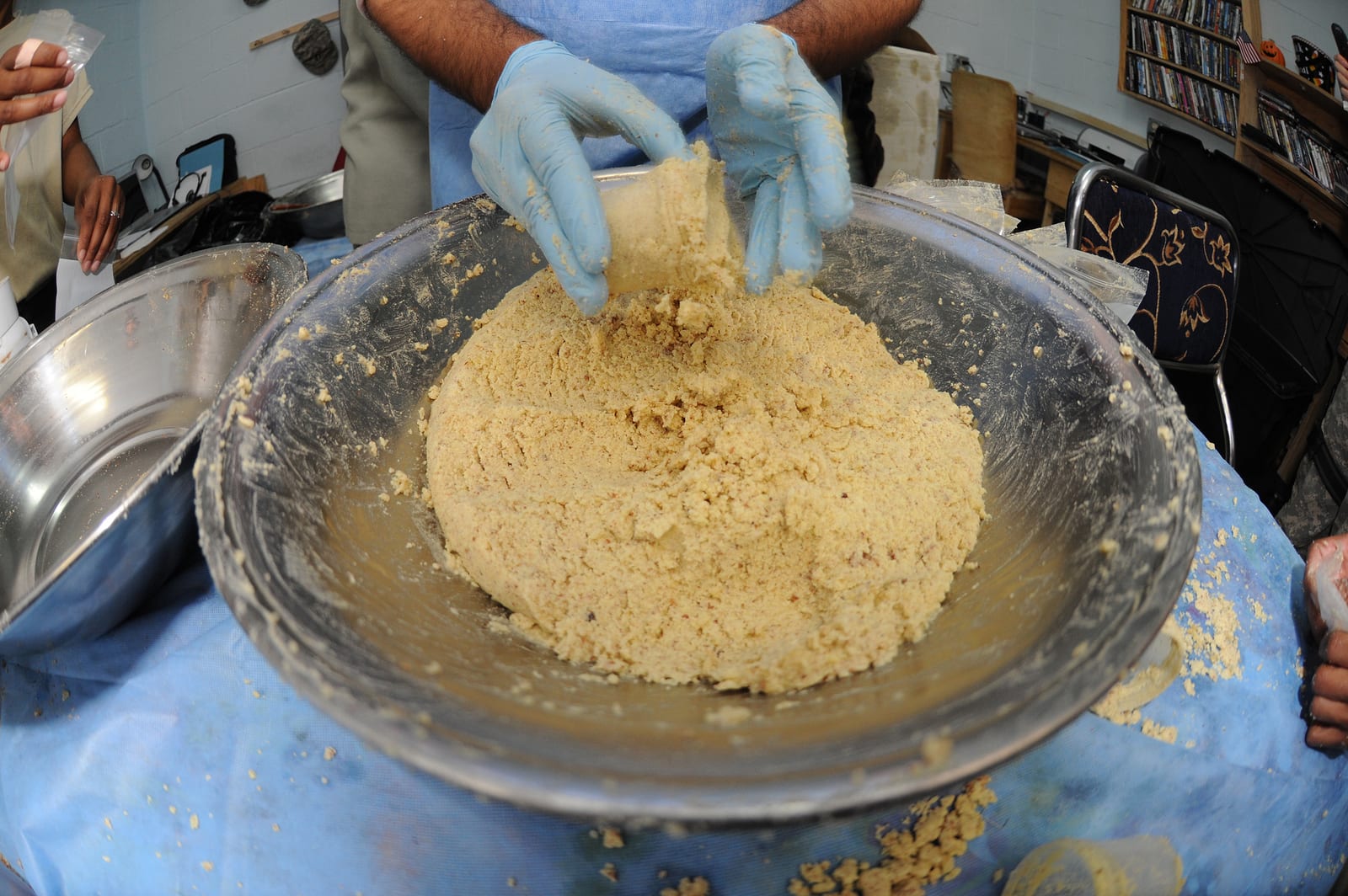
Image context: the cover uses a real U.S. Air Force photograph from Farah Province, Afghanistan, not a diagram or symbolic medical image. Its value is documentary: the treatment appears as a work surface, a scoop, measured doses, and a local clinic handoff, which is exactly where the RUTF story becomes public health rather than chemistry alone.[7]
Timeline anchors
- 1990s: severe acute malnutrition treatment was still strongly hospital-centered in many settings, which limited access for families far from facilities and increased the social cost of care.[2][3]
- 2000: UNICEF says it began procuring and delivering RUTF, helping shift uncomplicated cases toward home treatment under program supervision.[3]
- 2005: a southern Malawi effectiveness trial reported higher recovery with home-based RUTF than with standard therapy: 79% versus 46%, with relapse or death lower at 8.7% versus 16.7%.[5]
- 2007: WHO, UNICEF, WFP, and the UN Standing Committee on Nutrition issued a joint statement promoting community-based management for severe acute malnutrition, estimating that about three quarters of children with good appetite and no medical complications could be treated at home with RUTF.[2]
- 2023: WHO published a new guideline on wasting and nutritional oedema in children under five, superseding its 2013 severe acute malnutrition update and keeping the question inside evidence-informed child-health systems rather than emergency improvisation alone.[1]
The old problem was not only calories
Severe wasting is a visible emergency, but the treatment failure is often less visible. A child may need energy, protein, micronutrients, infection care, warmth, fluids, and careful monitoring at the same time. Traditional inpatient therapeutic feeding can do that for children with complications, but it has a reach problem. A hospital bed is a scarce object. A caregiver's time is scarce too. If treatment requires weeks away from home, the intervention competes with siblings, wages, transport, seasonal work, and safety.[2][3][4]
UNICEF frames wasting as life-threatening because thinness is only the outside sign. The immune system is weakened, developmental risk rises, and infection, poor feeding, poverty, unsafe water, food insecurity, and climate or conflict shocks can all reinforce the condition.[4] That matters because the intervention cannot simply be "give food." It has to fit a child who may also be passing through diarrheal illness, measles risk, malaria risk, or household disruption.
The first RUTF insight was therefore practical: make the therapeutic diet portable without making it fragile. UNICEF describes standard RUTF as a paste made from ingredients such as powdered milk, peanut paste, vegetable oils, sugar, vitamins, and minerals. A 92 g sachet provides about 500 calories, needs no cooking, needs no added water, lasts up to two years without refrigeration, and can be transported into emergency and remote settings.[3]
Each of those details solves a different failure mode. No added water reduces contamination risk where water is unsafe. No cooking protects the dose from fuel scarcity, time pressure, and dilution. Shelf stability keeps the product usable in clinics and households that cannot maintain a cold chain. Energy density means a child with a small appetite can receive more therapeutic value in less volume.[3][6]
The ration only works after the triage decision
The most important boundary is eligibility. Community-based treatment was never supposed to mean that every severely wasted child should stay home. The 2007 joint statement drew the line around children with good appetite and no medical complications; children with complications still need facility-based care.[2] That is not a minor caveat. It is the safeguard that keeps a take-home ration from becoming neglect with packaging.
This is the causal fork. If a child is alert enough, has appetite, has no severe infection or shock signal, and can be followed, RUTF can turn recovery into a household-supported outpatient process. If the child is medically unstable, the same ration cannot replace antibiotics, careful rehydration, thermal care, monitoring, or inpatient stabilization.[1][2]
The appetite test is not just a bureaucratic hurdle. It asks whether the child can actually consume the treatment. A ration that sits unopened at home is not therapy. A child who cannot eat because of infection, metabolic instability, or severe weakness is not made safer by being counted as an outpatient success. RUTF works when the program preserves the difference between "the hospital is no longer necessary for this phase" and "the hospital is inconvenient."
Evidence supports the shift, but not every claim made around it
The early clinical effectiveness signal was strong enough to change imaginations. In the Malawi study published in The American Journal of Clinical Nutrition, 1,178 malnourished children were allocated through a stepped-wedge design to standard therapy or home-based RUTF. The RUTF group recovered more often, relapsed or died less often, and gained weight faster: 3.5 versus 2.0 g/kg/day, a difference of 1.5 g/kg/day with a 95% confidence interval of 1.0 to 2.0.[5]
Those numbers explain why RUTF became compelling. They do not license sloppy certainty. A later Cochrane review updated the evidence through October 2018, including 15 studies and 7,976 children. It concluded that standard RUTF probably improves recovery compared with alternative dietary approaches, with a recovery risk ratio of 1.33 and a 95% confidence interval of 1.16 to 1.54. But the review was much more cautious about relapse and death in that comparison, rating those effects as very low-certainty or unclear.[6]
That distinction is useful. RUTF is not magic because every endpoint is settled. It is important because it reliably attacks one central bottleneck: recovery from severe malnutrition during the rehabilitation phase can become more reachable when the diet is standardized, dense, acceptable, and logistically possible at home.[6] The remaining uncertainties do not erase the mechanism; they keep it honest.
The same evidence also warns against turning the brand-like image of RUTF into a single fixed recipe story. Cochrane found that, across alternative formulations, recovery often looked similar, while standard RUTF reduced relapse in the formulation comparison.[6] The practical inference is not that anything called therapeutic food will do. It is that composition, acceptability, milk or non-milk ingredients, cost, and supply context all matter, and each proposed change has to be tested against recovery, relapse, mortality, and implementation, not just price.[3][6]
Supply is part of the treatment
RUTF's clinical mechanism depends on a boring industrial one: enough product has to arrive before the child's wasting becomes a hospital emergency. UNICEF says a carton contains 150 sachets, usually enough for a full course, and treatment typically lasts four to six weeks depending on age and weight.[3] That turns procurement into a clinical clock. A stockout is not a purchasing inconvenience; it interrupts a child's rehabilitation phase.
Scale makes this visible. UNICEF says it supplies nearly 80% of the world's RUTF and delivered an average of 955 million sachets annually in 2023 and 2024, enough to treat more than 6 million children with severe acute malnutrition each year.[3] It also reports that the supplier base grew from a single international supplier in the early 2000s to more than 20 suppliers in 2025, with more than half of UNICEF-procured RUTF coming from suppliers in low- and lower-middle-income countries.[3]
That expansion matters because public-health tools fail when they remain boutique. Local and regional production can shorten delivery routes, reduce transport and storage costs, lower some supply risks, and create a better fit between procurement and the countries where the treatment is used.[3] But it also adds a quality-control obligation. A therapeutic food is not ordinary peanut paste. It has to meet nutritional composition, food-safety, packaging, and program standards, because the user is a medically vulnerable child.[1][3]
The supply chain is therefore not outside the medicine. It is part of the medicine's ability to exist at the right time and place.
The boundary condition is prevention
RUTF treats severe wasting after prevention has failed. That is its strength and its limit. UNICEF's child-wasting page says only one in three children with severe wasting receive timely treatment and care.[4] Even perfect RUTF would not solve that reach gap by itself. Families still need screening, community trust, transport or outreach, trained workers, follow-up, referral pathways, and a health system that can keep ordinary services running during drought, displacement, price shocks, epidemics, or conflict.[1][4]
Nor does RUTF remove the causes of wasting. Unsafe water still drives diarrheal disease. Food insecurity still narrows diets. Low birthweight, poor feeding support, maternal malnutrition, and infection still load risk early in life.[4] A good RUTF program can rescue many children who would otherwise deteriorate. A serious child-health strategy also asks why the child reached severe wasting in the first place.
That is the cleanest way to understand the product. RUTF is not a substitute for hospitals, food systems, clean water, vaccination, breastfeeding support, poverty reduction, or conflict prevention. It is a way to make the rehabilitation phase of uncomplicated severe wasting portable, supervised, and survivable for many more children than ward-based care alone could reach.
What the sachet actually changed
The RUTF story is powerful because it joins biology to logistics. The food is dense enough for catch-up growth, dry enough to store, safe enough to use without water, acceptable enough for children to eat, standardized enough for programs to procure, and simple enough for caregivers to give at home. Screening and referral keep the model from abandoning complicated cases. Follow-up turns the ration into a treatment course rather than a donation.[1][2][3][6]
That is why "the clinic moves into the ration" is the right causal frame. The clinic does not disappear. It is redistributed: some of its work is in the sachet, some in the eligibility decision, some in the caregiver's hands, some in the warehouse, and some in the next visit. RUTF works when all of those pieces stay connected.
Sources
- World Health Organization, WHO guideline on the prevention and management of wasting and nutritional oedema (acute malnutrition) in infants and children under 5 years (2023) - current normative guideline and evidence framework.
- World Health Organization, UNICEF, World Food Programme, and UN System Standing Committee on Nutrition, Joint statement on the community-based management of severe acute malnutrition (2007) - community-care rationale and eligibility boundary for home treatment with RUTF.
- UNICEF Supply Division, "Ready-to-use therapeutic food (RUTF)" - composition, sachet size, shelf life, treatment duration, procurement scale, and supplier-base context.
- UNICEF, "Nutrition and care for children with wasting" - current wasting burden, treatment reach gap, home-treatment framing, and health-system integration.
- Michael A. Ciliberto et al., "Comparison of home-based therapy with ready-to-use therapeutic food with standard therapy in the treatment of malnourished Malawian children," The American Journal of Clinical Nutrition, 2005 - DOI record for the controlled clinical effectiveness trial.
- A. Schoonees et al., "Ready-to-use therapeutic food (RUTF) for home-based nutritional rehabilitation of severe acute malnutrition in children from six months to five years of age," Cochrane Database of Systematic Reviews, 2019 - PubMed record for the systematic review.
- Wikimedia Commons, "Ready to Use Therapeutic Food DVIDS222343.jpg" - 2009 public-domain photograph by Master Sgt. Tracy DeMarco used as the article cover image.