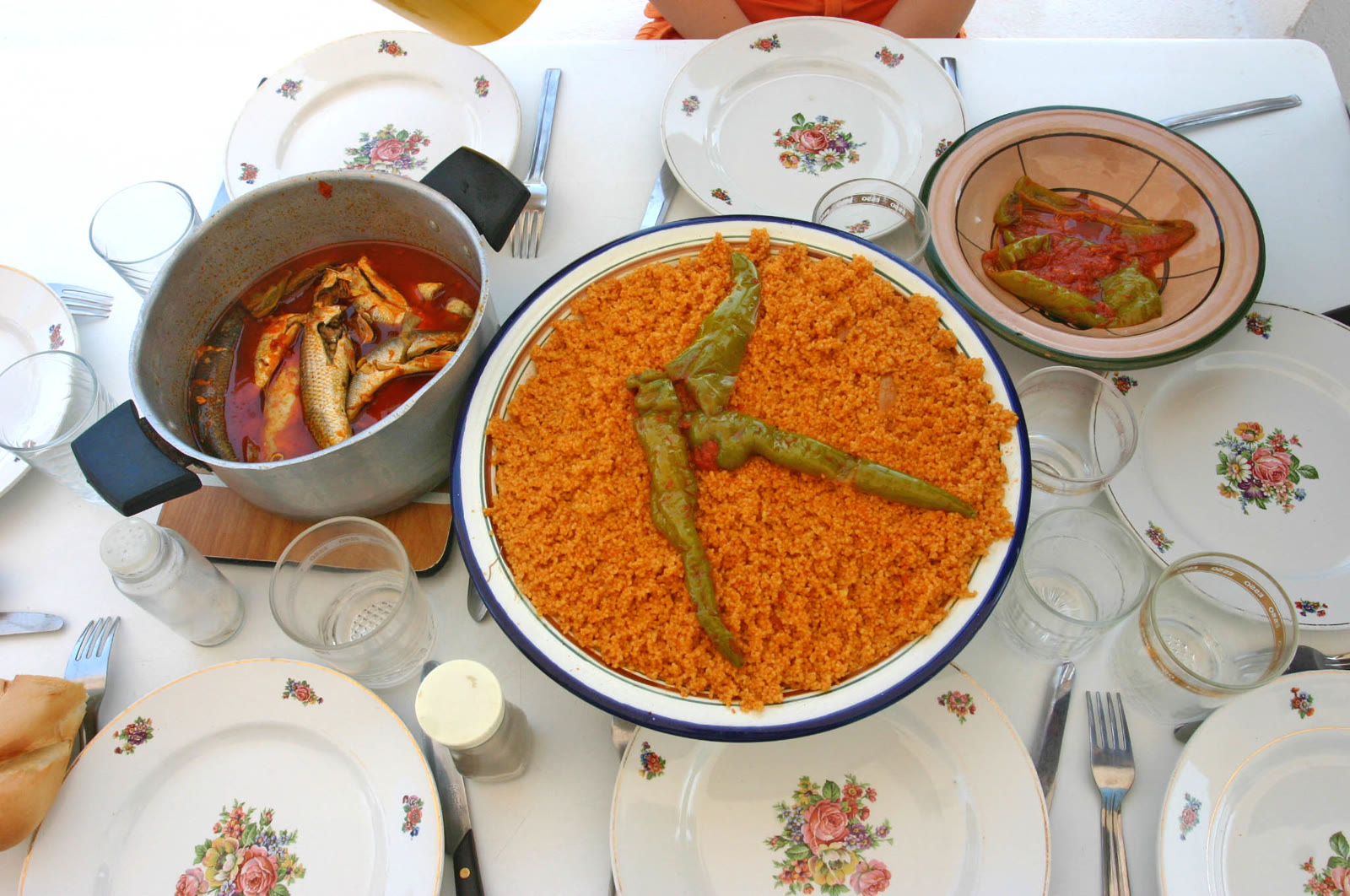
The most revealing photograph of fish couscous catches the dish before it becomes one dish. On a white table in Tunisia's Kerkennah Islands, an enamel basin holds a low orange dune of couscous crossed by long green peppers. Beside it, small fish wait in a scarlet broth inside an ordinary aluminium pot. Floral plates ring the two vessels, still empty. Nothing looks plated. Everything looks ready.[7]
That interval is the craft.
Tunisian fish couscous is often described as though a couscoussier turns grain, sauce and seafood into a one-pot meal. The stacked pot does connect them, but it does not give them one schedule. Broth needs time to become more than hot water. Semolina needs repeated, controlled hydration while its grains remain distinct. Fish has the narrowest window: enough heat to become tender and season the sauce, not enough to collapse into it. Vapour begins the aromatic connection; at the finish, a measured amount of broth completes the seasoning without flooding the grain.[3]
Think of it as three clocks in two chambers. The pleasure comes when they meet, not when they are forced to tick together.
This is a reading of technique, not a claim that one recipe governs Tunisia's coast. The country's own heritage inventory identifies steam cooking without direct contact with flame as a defining part of couscous craft, while UNESCO's multinational inscription explicitly allows accompaniments to change with region, season and occasion.[1][2] Fish may be poached, grilled or stuffed according to place and household.[4][5][6] The useful constant is coordination.
Couscous is built before it is cooked
Instant couscous has made the grain look elemental, like rice in miniature. It is actually manufactured food in the oldest sense: small particles are assembled into larger ones.
UNESCO describes semolina being rolled by hand and steamed, with the work transmitted through observation as well as formal teaching.[1] A scientific review by Rifka Hammami, Reine Barbar, Marie Laurent and Bernard Cuq makes the hidden architecture clearer. In the northern Tunisian method they document, water is worked into durum-wheat semolina, the damp material is rolled, lumps are broken, and several sieves separate usable grains from particles that need another pass. A little oil may be incorporated before steaming and drying.[3]
Water is doing two apparently opposite jobs. It has to make fine semolina particles adhere, but too much uncontrolled hydration produces dough rather than a field of grains. Rolling shapes the agglomerates; sifting keeps their scale in bounds. In the review's processing model, the target wet grains are roughly 0.8 to 2 millimetres across. Steam then consolidates them as starch gelatinizes and proteins crosslink. That internal setting is why a good grain can swell later without simply dissolving into paste.[3]
This distinction matters in a restaurant. Most kitchens will begin with dried, already formed couscous rather than roll a year's supply by hand. They are not starting from raw semolina, and they should not pretend otherwise. Their craft lies in rehydrating and steaming that prepared grain evenly, loosening it between passes, and knowing when it has taken enough moisture to feel tender without caking.
The same review notes that moist couscous in Tunisia may be steamed two or three times. It also warns that longer cooking can increase stickiness, while grain size, initial hydration and prior processing all change how the couscous behaves.[3] “Three steamings” is therefore not a magic number. The cook must read this batch.
One pot creates two climates
A couscoussier is a clever refusal to mix too early. The lower chamber holds the simmering liquid. The perforated upper chamber gives the grain heat and condensing moisture without submerging it. The vessels share vapour and aroma, but they maintain two physical environments: turbulent liquid below, gentler steam above.[1][2][3]
One published Tunisian fish-couscous method makes the choreography wonderfully explicit. The grain is rubbed with oil, steamed after vapour rises through it, turned into a wide vessel, aerated and moistened, then returned for another pass. The process repeats before a final loosening with fat. In the same account, fish cooks in the sauce for a much shorter interval and is removed promptly so it does not overcook or break.[4]
The exact minutes in that recipe belong to its grain, fish and stove. The sequence is more portable than the stopwatch. Steaming, turning out and separating expose clumps while they can still be corrected. A sprinkle of water can reach a dry grain without flooding the whole batch. Returning the couscous to vapour lets the added moisture move inward. Oil or butter is not there merely to make the surface shine; used judiciously between passes, fat helps control sticking and changes how the grain feels when forked.[3][4]
The common shortcut—pour boiling liquid over dried couscous, cover it and hope—compresses all those corrections into one blind interval. It can make an adequate side dish. It cannot reveal what the upper chamber is for.
The broth owns the long clock
The sauce can begin building before delicate fish is exposed to heat. Tomato, pepper paste or harissa, aromatics, vegetables and water need time to lose their raw edges and become a broth capable of seasoning a bowlful of grain.[4][5] In Nabeul, one documented home method prepares the grain in two stages—the second in the upper chamber over simmering vegetables—before the fish enters the lower chamber near the end.[8] The regional record still resists one universal construction. A gastronomy guide produced with Tunisia's Ministry of Tourism describes a Sfaxian version in which small fish cook in the sauce while larger fish may be grilled, keeping extraction and the main piece of fish on different tracks.[6]
That is an elegant piece of kitchen logic. Small fish chosen to flavour liquid do not have to follow the same method as the larger fish presented to the guest.[6] Even when the same fish performs both roles, the cook can remove it at tenderness and let the sauce continue reducing without turning flesh into fibres.
The broth's finish is not “as concentrated as possible.” Couscous will absorb and mute it. The liquid must taste slightly more assertive than a spoonful of soup, yet remain balanced enough to spread through hundreds of grains. Salt, heat and acidity should be judged with the couscous, not in isolation. A sauce that seems exciting in the pot can become harsh across an entire mound; a timid one disappears on contact.
This is the first place a fine-dining kitchen can improve the dish without making it fussier: taste the broth on the actual steamed grain before service. The grain is not a neutral plate filler. It is the final dilution and the largest aromatic surface in the course.
Fish keeps the shortest clock
Fish turns “cook until done” into a useless instruction because the relevant clock changes with size and structure. A local Tunisian recipe by chef Rim Beji adds stuffed sardines only when the vegetables are nearly ready, simmers them for two to three minutes, and cautions against stirring.[5] The larger fish in another Tunisian method is poached for roughly 10 to 15 minutes and then lifted out to avoid overcooking and breakage.[4] These are examples, not a national timing table. Their disagreement is the lesson.
Sardines, a thick fish portion and a whole fish do not owe the pot the same number of minutes. Stuffing changes heat transfer. Grilling the main fish, as in the documented Sfaxian variation, removes it from the sauce clock almost entirely.[6] The cook has to decide which role each piece is playing: broth builder, plated centrepiece or both.
The fine-dining temptation is to solve fragility by choosing a neat boneless fillet and cooking it separately. That can produce perfect flesh, but it can also sever the fish from the couscous. If the sauce contains no trace of bones, skin or the species on the plate, “fish couscous” risks becoming couscous with fish placed on top.
A better translation keeps the connection legible. Build the broth with sauce fish where that regional method calls for them; cook the service portion by the method that best protects it; keep enough of the fish's character in the sauce; then place the main piece only after the grain has been dressed.[6] Precision should strengthen the relationship, not sterilize it.
The final ladle synchronizes the dish
After the last steaming, the grain has structure but not yet the full flavour of the lower pot. The final ladling is therefore not garnish. It is assembly.
The Tunisian method in CuisineTunisienne.tn calls for only one or two ladles of sauce before plating.[4] The useful word is not “two”; it is “ladles.” Broth is added deliberately rather than dumping the grain into the pot. The cook can fold, rest and look. If the surface remains dry, another measured addition is possible. If the couscous is already saturated, there is no rescue that restores separated grains.
The Kerkennah photograph shows this relationship with unusual honesty. The couscous appears already seasoned, yet the fish and more broth remain beside it. The table can decide the last degree of saturation as people serve themselves.[7] An individual restaurant plate has to make that decision in the kitchen, but it should preserve the same generosity. A tiny pool beneath a dry ring of grain misses the point; so does a flooded bowl in which the couscous loses its texture.
Timing continues after assembly. Hot grain keeps absorbing. Fish keeps carrying heat. A course that waits for every table in a large pickup window may arrive with both clocks overrun: swollen couscous and weary flesh. The elegant service move is not more decoration. It is a shorter journey from final ladle to guest.
Heritage is a verb, not a fixed plate
In 2020, UNESCO inscribed the knowledge and practices of couscous through a joint nomination by Algeria, Mauritania, Morocco and Tunisia. The listing emphasizes cultivation, milling, rolling, steaming, tools, transmission and shared meals. Tunisia's national inventory likewise catalogs knowledge, skills and practices—not a mandatory arrangement of fish and vegetables.[1][2]
That framing gives ambitious restaurants room to cook rather than reenact. A chef can refine a broth, portion a fish differently or serve the course individually. But refinement should preserve the dish's causal logic: formed grain strengthened by steam, sauce developed on its own clock, fish protected from that sauce's full cooking time, and final hydration controlled at the moment of service.
Regional specificity matters more than a vague claim of authenticity. If the fish is grilled in a Sfaxian reading, say so. If the method follows a family practice from Kerkennah or Nabeul, name that lineage and its limits. If the kitchen begins with commercial dried couscous, let excellence rest on how it is steamed and dressed rather than inventing a hand-rolling story. Tradition is not made more convincing by hiding the actual work.
Back at the Kerkennah table, the empty plates are an invitation, not an absence. The broth knows what the grain still needs. The grain is ready to carry the broth without disappearing into it. The fish waits beside the grain while the meal is still coming together.[7]
Three clocks reach the table. One ladle makes them dinner.
Sources
- UNESCO Intangible Cultural Heritage, “Knowledge, know-how and practices pertaining to the production and consumption of couscous” — 2020 joint inscription, preparation sequence, tools, regional variation, transmission and social context.
- Institut National du Patrimoine, Tunisia, “Le couscous: savoirs, savoir-faire et pratiques liés à sa production et à sa consommation” — national intangible-heritage inventory sheet 4/540, including the Tunisian steam-cooking definition.
- Rifka Hammami, Reine Barbar, Marie Laurent and Bernard Cuq, “Durum Wheat Couscous Grains: An Ethnic Mediterranean Food at the Interface of Traditional Domestic Preparation and Industrial Manufacturing,” Foods 11 (2022) — open-access review of grain formation, steaming, rehydration, stickiness and northern Tunisian practice.
- CuisineTunisienne.tn, “Couscous aux poissons” — Tunisian preparation sequence for oiling, repeated steaming and aerating of the grain, short fish poaching and measured final saucing.
- Rim Beji, “Couscous à la sardine farcie,” La Presse Magazine, April 14, 2025 — chef's method for adding stuffed sardines near the end of the vegetable cook, with a brief simmer and no stirring.
- Voyage à travers la gastronomie africaine — Tunisie, produced in collaboration with Tunisia's Ministry of Tourism (November 2020) — regional guide describing Sfaxian fish couscous with small fish in the sauce and larger fish grilled.
- Elcèd77, “Fish couscous from Kerkenah, Tunisia, August 16th, 2007,” Wikimedia Commons — source page for the documentary table photograph used as this article's cover.
- Farida Zeynalova, “Sharing traditions and a family meal in coastal Tunisia,” National Geographic Traveller (UK), updated September 12, 2024 — documented Nabeul preparation with twice-cooked grain, later addition of fish and communal service.