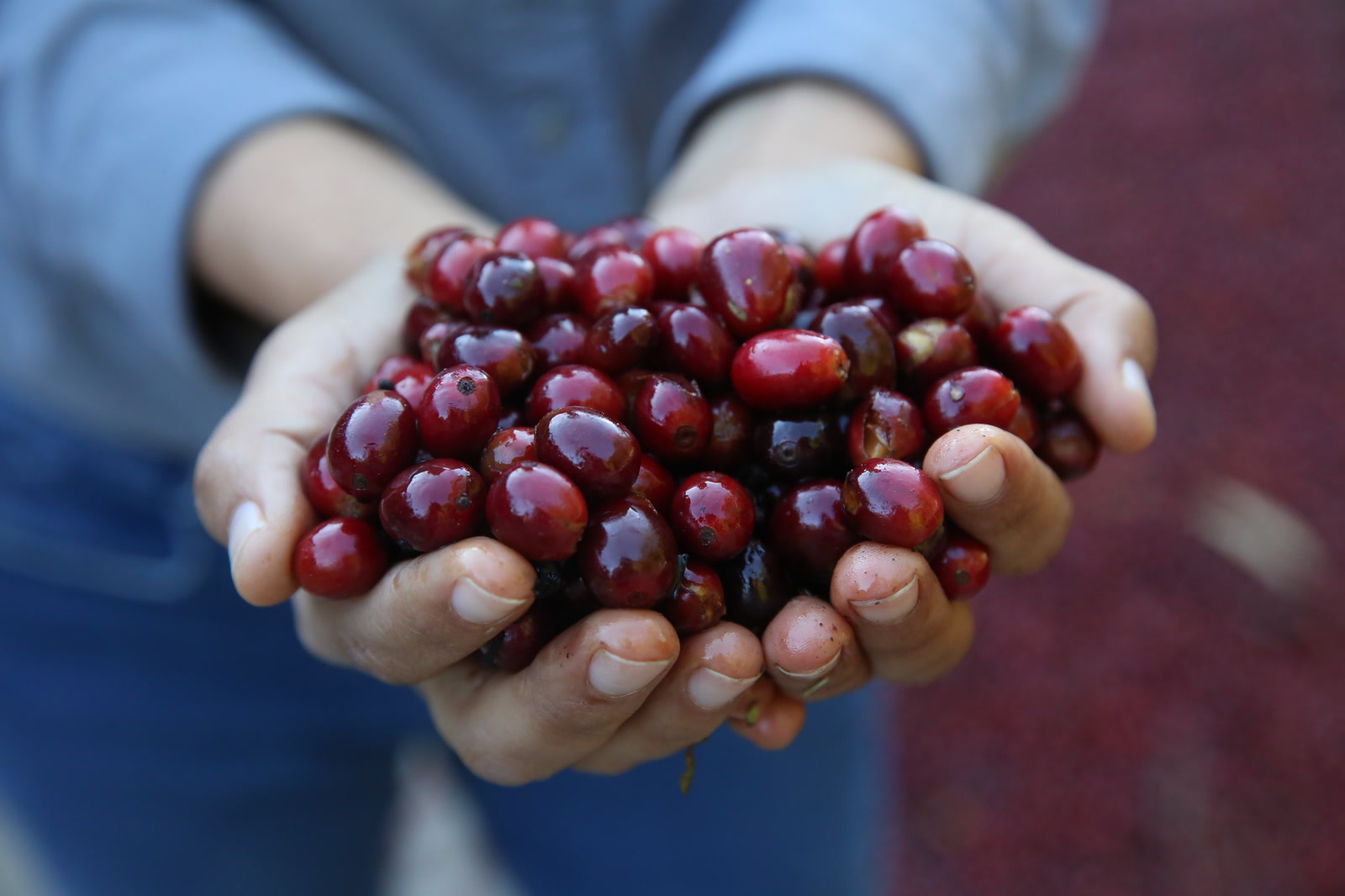
The cherries fill two cupped hands. They are not beige beans and they do not yet smell like jasmine: they are taut, wine-red fruit, glossy with the small irregularities of a real harvest.[7] Much later, after pulping or drying, milling, export, roasting, resting, grinding and brewing, their seed may reach a fine-dining table as a pale amber cup with the lift of flowers, citrus or peach.
Or it may arrive tasting merely expensive.
Panama Geisha is unusually vulnerable to prestige without pleasure. The name is famous enough to decorate a menu, competition scores are spectacular enough to start a tableside speech, and the usual descriptors—jasmine, bergamot, stone fruit—sound luxurious before anyone takes a sip. But this coffee became valuable through specificity: a particular genetic line, grown high, separated into small lots, processed with intent and judged as an individual harvest.[1][2] If a restaurant drops that information and then buries the cup under a dark roast, a stale grind or a plate of chocolate, it has bought provenance only to erase it.
The fine-dining opportunity is not to make coffee more ceremonial. It is to keep the lot intact all the way to the guest.
The name should point to a plant, not a perfume
“Geisha” and “Gesha” are both used in coffee. World Coffee Research explains that the Panamanian line descends from the Ethiopian landrace accession T2722, collected in the 1930s, moved through research stations in Tanzania and Costa Rica, and distributed in Panama in the 1960s. Genetic analysis finds that this Panamanian lineage is distinct and uniform; the catalog also warns that the name is applied to coffees that do not share those genetics.[1]
That distinction matters because the plant itself is an awkward luxury machine. World Coffee Research rates its yield potential as low, its stature as tall and its quality potential at high altitude as exceptional.[1] A label that says only “Geisha” therefore compresses several different questions into one fashionable word. Is this the T2722-derived Panamanian line? Which farm and plot grew it? At what elevation? Was the coffee washed, dried in the fruit or subjected to another process? Which harvest and lot reached the roaster?
Hacienda La Esmeralda's own history shows why those questions became valuable. The Peterson family bought the high-altitude Jaramillo farm in 1997 and planted Geisha in sections above 1,650 metres. In preparation for the 2004 Best of Panama competition, the farm separated production from different areas instead of processing it as one undifferentiated mass. A pure Geisha lot from high on Jaramillo then revealed the intense aromatics that transformed the variety's reputation.[2]
The romance is often told as a discovery story. The operating lesson is lot separation. The coffee did not become expressive in 2004; separation made its expression traceable. A serious dining room should preserve that achievement rather than reverse it with a generic menu line.
A score opens the door; it does not finish the sourcing
The 2026 Best of Panama competition makes the quality ceiling easy to see. Its thirtieth edition began with 102 lots in the national round, from which 64 advanced to international judging. Across the national and international stages, the Specialty Coffee Association of Panama reported participation by 46 official judges and 49 invited judges and pre-judges.[3][4] Lamastus Family Estate won the washed-Geisha category at 96.25 points; Finca Lérida led the natural-Geisha category at 95.63; Hacienda La Esmeralda accumulated enough results across categories to win the producer trophy.[4]
Those are formidable numbers. They are also the beginning of a restaurant's work, not a substitute for it.
The competition itself separates washed and natural Geishas because process is part of what a judge encounters. During the 2026 national round, the Specialty Coffee Association of Panama reported jasmine, lemon, orange, mandarin and white or purple flowers in the washed group. The natural group leaned toward florals layered with raspberry, strawberry and other red fruit. Rachel Peterson described the strongest washed examples as clean expressions of jasmine, peach and bergamot, with little obvious processing signature.[3]
This does not establish a universal flavour key. It records what one expert panel found in one competition field. It does, however, show why “96-point Geisha” is incomplete procurement language. A washed lot whose pleasure comes from clarity asks something different of roasting and service than a fruit-dried lot whose process is sensorially present.
The Specialty Coffee Association's current Coffee Value Assessment makes the broader point explicit. It replaces reliance on one score with four views: physical condition, descriptive sensory attributes, affective judgment and extrinsic information such as origin, traceability and processing.[6] Fine dining already understands this logic with wine. A critic's score does not erase vintage, vineyard, producer or service temperature. Coffee deserves the same resistance to abbreviation.
Terroir is plausible, but the menu must not overclaim it
A 2025 open-access study gives Panama Geisha a rare controlled test. Researchers collected 24 washed coffees from the 2023–2024 harvest across Boquete, Potrerillos Arriba, Renacimiento and Tierras Altas, from farms between 1,300 and 2,000 metres. They applied the same light-to-medium roast profile and the same immersion brew, then asked 24 screened coffee consumers to evaluate aroma, flavour and taste in repeated sessions.[5]
The results are more useful than a tidy marketing slogan. Basic measurements of the green beans, roasted beans and brews did not strongly divide the regions, yet sensory analysis did find regional differentiation. Boquete samples were associated more with fruity and floral aromas; Tierras Altas coffees showed floral, fruit, citrus and herbal flavours alongside tart, sour and sweet tastes. The researchers found significant separation among Boquete, Renacimiento and Tierras Altas in discriminant analysis.[5]
Now the boundary. Potrerillos Arriba had only two samples and was excluded from that regional analysis. Every coffee was washed. The study covered one harvest, one roast profile, one brewing method and a consumer panel rather than a panel of professional cuppers. The authors call the work an initial characterization and say more environmental and chemical data are needed.[5]
Even bergamot, perhaps the variety's most repeated prestige descriptor, complicates the script. It appeared in fewer than 15 percent of responses in the consumer study and was excluded from further analysis, while Rachel Peterson, one of the 2026 national judges, described bergamot as characteristic of the strongest washed lots.[3][5] That is not a defect in either source. It is a warning against teaching the guest what to taste before the cup has spoken. Different lots, panels and methods produce different records.
The defensible menu claim is therefore specific and modest. Region may shape sensory character. Process certainly frames how that character is presented. Neither fact permits a server to promise jasmine, peach and bergamot in every coffee carrying the Geisha name.
The dining room can erase what the farm separated
The controlled study is revealing because it treats preparation as part of the evidence. Researchers roasted each batch to a light-to-medium degree, finishing shortly after first crack; they rested the beans, ground them shortly before brewing, used a 1:16 coffee-to-water ratio, immersed for four minutes and served measured portions at roughly 74°C.[5] Those parameters are a research protocol, not a commandment for restaurants. Their importance is that the variables were named and held still.
That is the right service instinct. A dining room buying a rare lot should record a repeatable recipe, taste the coffee before every service and grind it for the order. The menu should name the farm or producer, production zone, process, harvest or lot, and roaster. If space permits only one spoken detail, the server should explain the distinction that is most apparent in this cup—not recite the variety's entire migration from Ethiopia.
Then comes pacing. Taking the 2026 panel's category-level descriptions as a starting point—not as a pairing trial—my editorial choice would be to keep a delicate washed lot away from a dense chocolate dessert and a tray of sugared mignardises. Its reported floral and citrus register may read more clearly as a small course of its own, with still water and a pause before the sweetest bite. A natural with the red-fruit character the panel encountered may tolerate a berry or lightly fermented dessert.[3] These are inferences, not universal sensory rules; the restaurant has to taste the actual coffee and decide.
Another editorial service choice is to give the cup permission to cool. A small pour invites the guest to return to the aroma and flavour over several minutes instead of treating coffee as a hot, final punctuation mark. The server need not hover and narrate every degree. Set down the cup, offer one useful cue, and let the guest discover whether the advertised flowers are present.
Most of all, do not turn scarcity into theatre that outruns flavour. The 2026 Best of Panama winners had been selected by early August, but that competition's electronic auction was scheduled for September 23.[4] At the time this article was created, there was no honest 2026 Best of Panama auction price to quote. A dining room can still explain why a lot is scarce—low-yield plants, high-elevation farming, selective picking, small-lot processing—without borrowing a future headline.
Luxury is the receipt that reaches the cup
The photograph of red cherries is valuable because it resists abstraction. Someone is holding fruit, not points. The crop has weight and variation before it has a tasting note.[7] Hacienda La Esmeralda's breakthrough depended on separating that fruit by place; the modern competition keeps separating it by producer, lot and process; sensory research is beginning to test whether regional differences survive controlled preparation.[2][3][4][5]
A restaurant completes that chain only when the guest can taste and understand what was preserved. The best service line is not “This is the world's most expensive coffee.” It is closer to: “This washed Geisha comes from this farm and lot; we used a light roast and a repeatable brew recipe because this batch gave us a clean floral and citrus cup.” That sentence leaves room for provenance, craft and disagreement.
Panama Geisha does not need more aura. It needs fewer missing links. Keep the plant attached to the farm, the farm to the lot, the lot to the process, the process to the roast and the roast to a deliberate cup. When all of that survives the dining room, the coffee can finally stop tasting like a price and start tasting like a place.
Sources
- World Coffee Research, “Geisha (Panama)” — genetic lineage, naming boundary, plant traits, low yield, high-altitude quality potential and agronomic history.
- Hacienda La Esmeralda, “Our Story” — first-party history of the Geisha seed route, Jaramillo planting, 2004 lot separation and the farm's subsequent research infrastructure.
- Specialty Coffee Association of Panama, “Café de alta gama brilló en la Cata Nacional del Best of Panama; 64 lotes avanzan a la ronda internacional,” July 2026 — competition categories and judges' sensory descriptions of washed and natural Geisha lots.
- Specialty Coffee Association of Panama, “Lamastus, Lérida y Altieri lideran el Best of Panama; Hacienda La Esmeralda conquista la Copa Panamá,” August 2026 — final scores, field and panel size, category winners and auction schedule.
- Diana Batista Ledezma, Camilla Sartori and Elizabeth Tomasino, “Sensory Perception and Physicochemical Characteristics of Geisha Coffee From Different Production Zones in Panama,” Food Science & Nutrition 13 (2025) — open-access regional comparison, standardized roast and brew, sensory findings and study limits.
- Specialty Coffee Association, “Coffee Value Assessment” — current framework separating physical, descriptive, affective and extrinsic dimensions of coffee value.
- Crop Trust, “CropsInColor.Coffee.PA.LaEsmeralda 21” — Luis Salazar's 2019 documentary photograph of Geisha coffee cherries at Hacienda La Esmeralda used as this article's cover.