The server sets down an ivory fillet under a polished spoonful of sauce. Its skin is gone. Its head, fins and tail left the story hours ago. “Line-caught red snapper,” the menu says, and the words now have to carry everything the plate cannot show: species, origin, method, scarcity and price.
Fine dining is unusually good at making those words feel tangible. The server can name the captain, the boat, the ceramicist and the cove before the sauce reaches the table. Yet seafood identity presents an awkward test for that theatre of precision. Once a fish has been skinned, portioned and cooked, even an attentive diner cannot authenticate it by colour or flake. NOAA describes species substitution as especially difficult to detect after filleting; its investigators use reference collections and DNA analysis because appearance is often insufficient even for professionals.[2]
The problem is not that every ambiguous fish name conceals a scam. It is that the more value a restaurant loads onto provenance, the less it can afford to treat the species name as menu poetry. “Red snapper” should be the beginning of the explanation, not a red adjective pasted onto an anonymous white fish.
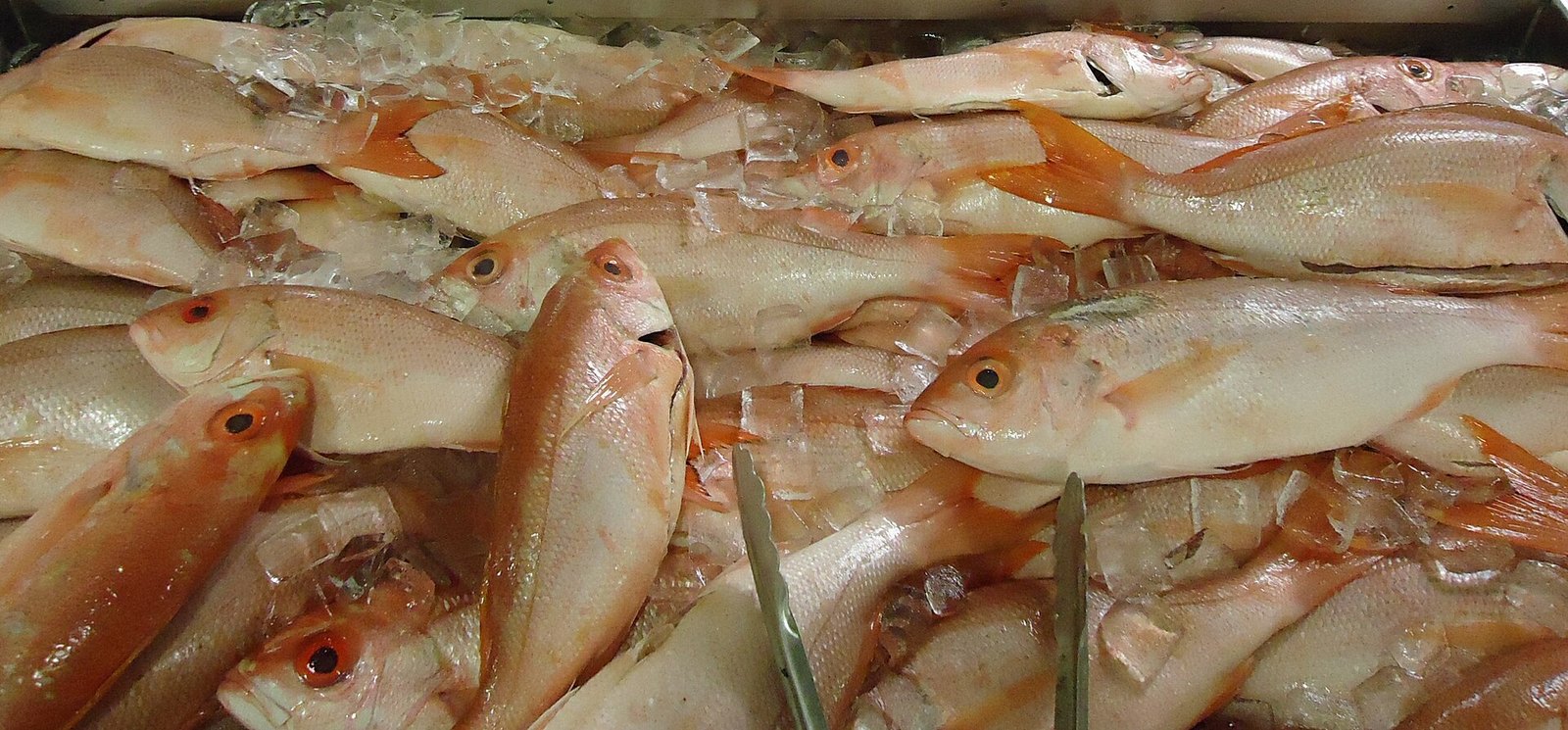
The cover photograph catches the product one step before that trust becomes nearly total. Whole fish lie on ice, their colour, eyes and body shape still available for inspection.[6] Those clues are not a laboratory result, and closely related snappers can resemble one another. But after breakdown, the diner receives a boneless rectangle. What remains visible is kitchen craft; what establishes identity is the record that travelled with it.
“Red snapper” is narrower than it sounds
American seafood naming is less intuitive than a well-written menu makes it appear. The FDA's Seafood List distinguishes among an acceptable market name, a common name, a scientific name and vernacular names. A vernacular name may help identify what someone means without being acceptable for sale, while a broad market name can sometimes cover more than one species. The searchable list is the agency's guide to acceptable names in interstate commerce and recommends unique common names where they reduce confusion.[1]
Red snapper is the useful hard case. In the United States, the name identifies Lutjanus campechanus, not any reddish member of the snapper family. The word “snapper” can describe a wider commercial category; adding “red” makes a species claim.[1][3] On a tasting menu, that difference is not pedantry. It separates “we bought a good local snapper” from “we are serving this particular fish.”
The honest alternative is not to print Latin binomials across every linen-bound card. It is to make the narrowest impressive claim only when the purchasing trail can support it. If tonight's fish is lane snapper, silk snapper or vermilion snapper, its own name is more interesting than a borrowed one. A menu that changes is not a failed luxury object. It may be evidence that the kitchen is actually buying what arrives.
The alarming number—and its boundary
A 2019 study by Erin Spencer and John Bruno shows why red snapper attracts scrutiny. The researchers bought 66 products represented as red snapper from grocery stores, seafood markets and sushi restaurants along the coasts of North Carolina, South Carolina, Georgia and Florida in March–May 2018. DNA barcoding produced positive identifications for 62. Of those, 45—72.6 percent—were not L. campechanus. All 18 successfully identified sushi-restaurant samples were mislabeled, and 15 of those were tilapia.[3]
That is a startling result. It is not permission to say that nearly three quarters of red snapper served in America, or in fine-dining rooms today, is false. The study did not sample the national market or isolate luxury restaurants. It sought vendors carrying red snapper during a particular seasonal window; the authors note that this may not reflect sellers when the fish is in season. They could not rule out shared distributors, and their 18 restaurant results form a small, targeted sample.[3]
Those limits do not make the finding decorative. They change the question it can answer. The paper demonstrates that a specific, valuable name could detach from species repeatedly across several kinds of seller, and that the substitution could survive all the way to the plate. It does not establish a universal probability for tonight's dinner.
That distinction matters because seafood-fraud numbers are unusually vulnerable to a dramatic headline. A global meta-analysis led by Gloria Luque and C. Josh Donlan assembled 141 studies and found that research was concentrated in certain products and countries, often with sampling designs better suited to discovering problems than estimating their prevalence. Its most credible average at the product level was 8 percent, with a 95 percent highest-density interval of 4–14 percent—while some individual products had far higher estimates. The authors' central warning is the useful one: rates are product-specific, and uncertainty is routinely understated.[4]
So the investigation lands between complacency and panic. NOAA reports that an FDA DNA survey in 2012–2013 found fish correctly labeled 85 percent of the time, but the agency also documents substitution, false origin, short-weighting and concealed illegal catch as distinct forms of fraud.[2] A reassuring overall average can hide a vulnerable species. A spectacular targeted study can make the whole market look worse than the evidence allows. A serious restaurant should work from the vulnerability of the fish it buys, not from either slogan.
The last mile is inside the restaurant
The United States already collects substantial information for some imports. NOAA's Seafood Import Monitoring Program covers more than 1,100 species grouped into 13 categories considered vulnerable to illegal fishing or fraud, including red snapper. Importers report data such as species, harvesting entity, fishing area, landing date, product form and chain-of-custody records from harvest to entry into U.S. commerce.[5]
But SIMP is neither a menu label nor a diner-facing provenance service. NOAA explicitly says its data is confidential and the program traces covered imports to the point of entry, not forward to a particular restaurant plate.[5] That leaves a decisive last mile: importer to distributor, distributor to receiving dock, whole fish to loin, loin to portion, portion to the printed name.
This is where fine dining can do more than comply. The receiving team can preserve the supplier's species and origin data with the lot instead of letting it dissolve into “snapper” on a prep label. The chef can retain invoices, tags and box labels long enough to reconcile them with the menu. If a claim is especially valuable or a supplier relationship is new, periodic species testing can audit the paper trail; NOAA notes that DNA can identify fish from a small sample whether raw, cooked, frozen, canned or dried.[2]
None of this requires the captain to deliver a chain-of-custody lecture between courses. It requires the restaurant to be able to answer a short question without improvising. What species is it? Where was it harvested or raised? Who supplied it? What does “local,” “wild” or “line-caught” mean in this purchase? A concise answer can be elegant because the work happened before service.
The strongest proof is not a server reciting more nouns. It is agreement among the menu, the receiving record and the product. If those three disagree, the restaurant should change the card, hold the lot and ask the supplier—not coach the dining room through a prettier story.
A whole fish is evidence, not a lie detector
Bringing a whole fish into the room can restore some of what filleting removes. The diner sees scale, proportion and skin; the server can explain how the kitchen will use the collar, bones and trim. The gesture also makes seasonality harder to fake: six whole fish are visibly six whole fish, not an endlessly renewable menu item.
Still, tableside display is not authentication. In the southeastern study, whole fish were labeled correctly more often than fillets, but four of 12 whole specimens were still wrong. The researchers note that lane, silk and vermilion snapper can share enough colour and shape with red snapper to frustrate visual detection.[3] Presentation can expose the ingredient to scrutiny; it cannot replace traceability.
That is the deeper fine-dining lesson. Open kitchens, dry-aging cabinets and fish carts feel trustworthy because they move hidden work into view. They are valuable forms of hospitality, but visibility must connect to records or it becomes another surface treatment. A beautiful fish on a trolley is still asking the guest to believe the label.
Luxury is an unbroken sentence
There is a temptation to solve seafood fraud by promising more fixed detail: the same prestigious species, always available, printed months ahead. That can create the very pressure that makes substitution attractive. Scarcity, weather and fishing seasons do not honor a permanent menu. When the promised fish does not arrive, an honest kitchen needs the confidence to serve another species under its own name—or remove the course.
The best seafood service therefore makes precision feel alive rather than rigid. The menu names what the kitchen can prove today. The server knows enough to distinguish species from marketing language. The buyer treats the supplier's documentation as part of ingredient quality. And the restaurant corrects uncertainty before a white fillet reaches a white plate.
A red-snapper dish may be delicious even when its sauce hides every anatomical clue. That is exactly why taste cannot settle the identity question. Fine dining already understands that a rare bottle is more than fermented grape juice: name, vintage, producer and custody remain attached until the cork is pulled. Fish deserves the same unbroken sentence from water to table.
The surname is Lutjanus campechanus. The luxury is being able to say why you believe it.
Sources
- U.S. Food and Drug Administration, “The Seafood List” (updated August 2026) — searchable species records and definitions for market, common, scientific and vernacular names.
- NOAA Fisheries, “Seafood Mislabeling and Fraud” — substitution, short-weighting, false-origin practices, inspection limits, DNA identification and traceability responses.
- Erin T. Spencer and John F. Bruno, “Fishy Business: Red Snapper Mislabeling Along the Coastline of the Southeastern United States,” Frontiers in Marine Science 6 (2019) — sampling design, DNA results, species substitutions and study limitations.
- Gloria M. Luque and C. Josh Donlan, “The characterization of seafood mislabeling: A global meta-analysis,” Biological Conservation 236 (2019) — product-level estimates, uncertainty and sampling-bias cautions.
- NOAA Fisheries, “Seafood Import Monitoring Program Facts and Reports” — covered species groups, required harvest and custody data, and the program's non-consumer-facing boundary.
- Tomwsulcer, “Red Snapper at Asian supermarket in New Jersey” (2012), Wikimedia Commons — source page for the documentary cover photograph.