Tala Bashmi's most interesting fine-dining moment may be arriving after the restaurant that made her internationally visible. The old version of the story was easier to package: a Bahraini chef takes over a room inside the Gulf Hotel in Manama, renames it Fusions by Tala, puts modern Bahraini cooking into a 45-seat open-kitchen setting, and rises through the Middle East and North Africa's 50 Best Restaurants list.[3][5] That story still matters. But the newer one is sharper. In 2025, 50 Best framed Bashmi as newly post-Fusions and planning her next move, while Food & Fun Festival described her guest-chef work after departing the restaurant in late 2024.[1][2]
That transition changes the question. The issue is no longer only whether Fusions by Tala could make Bahraini food look contemporary inside one dining room. The issue is whether Bashmi's method can travel without losing its local pressure. The public interviews suggest it can, because her project has never depended on one dish, one room, or one ranking. It depends on a repeatable way of turning family memory, market trips, Gulf ingredients, and old shared-table habits into fine-dining language.[1][2][4]
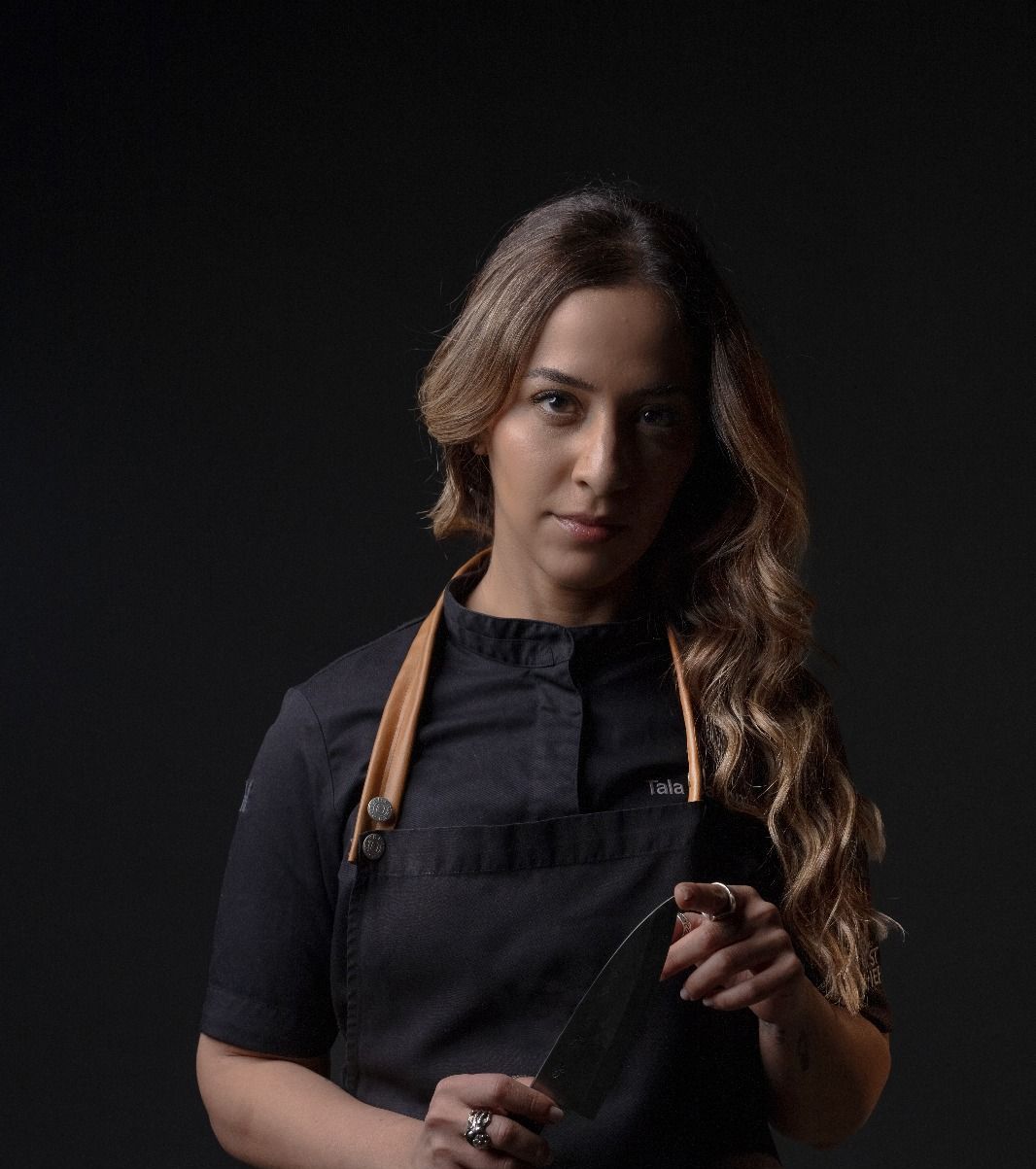
Image context: the cover uses Food & Fun Festival's real photographic portrait of Bashmi from her 2025 guest-chef page. It is a better fit than a restaurant-interior glamour shot because the article is about what remains portable after the Fusions chapter: a chef's vocabulary, not just a venue's lighting or skyline view.[2]
What is Bashmi trying to make visible?
The recurring answer in her interviews is not "Middle Eastern food" in the broad, easy sense. Bashmi keeps narrowing the frame toward Khaleeji, Bahraini, and Gulf food. In 50 Best's 2025 profile, she argues that many local ingredients are known at home, sometimes for medicinal reasons, but have not been studied in a professional culinary way.[1] That distinction is important. She is not merely asking fine dining to accept familiar flavors. She is arguing that the pantry itself has been under-described.
This is why her language around Gulf cuisine feels different from a simple heritage pitch. She tells 50 Best that Gulf countries may share some food habits but do them differently, and she points out that Bahraini food does not naturally divide itself into appetizers and mains; the spread co-exists.[1] That observation is a technical problem for fine dining. A tasting menu normally wants sequence: start, rise, main, dessert, close. A Bahraini table may offer simultaneity: rice, fish, stew, dried seafood, sweet rice, sourness, salt, and family memory all present at once. Bashmi's challenge is to make sequence without pretending the original table was sequential.
That is why her most persuasive dishes are not just updated classics. They are translations of structure. In the 2021 50 Best interview, she explains a version of bamia that turns the long-cooked okra-and-meat stew into wagyu beef cheek, an okra "glass," and tomato rice broth.[4] The dish sounds playful, but the point is not novelty. The old stew's memory remains, while its texture, timing, and visual grammar are rebuilt for a restaurant course. The guest sees something unfamiliar, then recognizes the emotional shape of something older.
How did Fusions matter?
Fusions by Tala gave Bashmi a controlled laboratory. 50 Best Discovery describes the restaurant as a 2020 redesign in the Gulf Hotel with warm lighting, soft wood, and a large open kitchen where guests could watch dishes come together.[3] Bahrain Tourism's updated page similarly presents the venue as a 45-seat dining experience with an open kitchen, theatrical service, indoor and outdoor seating, and Manama skyline views.[5] Those details explain why the room worked as a proving ground. It had enough polish for international attention, but it was not anonymous hotel luxury.
The menu format mattered too. 50 Best Discovery notes that dinner could be ordered a la carte, though the guide recommended trusting Bashmi with the eight-course tasting menu, naming reworked Bahraini classics such as ghoozi and bamia alongside a scallop dish with dashi orange and brown butter.[3] That combination captures the house's useful tension. The restaurant was not rejecting global technique; it was using global technique to make Bahraini references legible to more kinds of diners.
Fusions also exposed the risk of any chef-branded room. Once a chef becomes the story, the restaurant can freeze around that identity. Bashmi's post-Fusions phase prevents that from happening too neatly. Food & Fun's 2025 profile states plainly that she led Fusions to three consecutive top-10 MENA 50 Best rankings before departing in late 2024, then lists her later honors and ambassadorial role.[2] In other words, the restaurant was a chapter, not the whole argument.
What does the post-Fusions menu show?
The clearest current evidence is the Food & Fun guest menu at Smor. It places Bashmi in a Nordic collaboration setting and describes the project as Nordic produce meeting Arabic flavors in a bold, balanced, story-led menu.[2] The dish list is revealing: jireesh, muhammar, scallop molokhiya, leek and clam, rainbow trout, crab saloona, lamb buranniya, triny and jameed, pumpkin and bay leaf.[2]
That list is not a greatest-hits tour of Fusions. It is a portability test. Can crab saloona still carry Bahraini memory in a guest-chef format? Can triny and jameed, with their citrus, dairy, acidity, and preserved depth, survive outside the original room? Can Nordic produce absorb Arabic flavor without turning the collaboration into a theme dinner? The answer implied by the menu is yes, but only if Bashmi's core method is strong enough to separate ingredient from geography without separating flavor from memory.
Her own Food & Fun answers make the method explicit. Asked why she works in the industry, she says it is her language and a way to tell stories, preserve memory, fight for identity, and pass it on.[2] Asked for her food philosophy, she says she reimagines Bahraini and Gulf cuisine through a modern lens rooted in memory, identity, and reinterpretation, preserving tradition by challenging it.[2] Those lines could sound broad in isolation. Beside the menu, they become operational. The dishes are not simply "inspired by" Bahrain. They are built to make Bahrain's food logic work in another kitchen.
Where does the family memory enter?
Bashmi's father appears repeatedly in the public record, and not as sentimental backstory alone. In the 2021 interview, she describes him as a writer, a major food influence, and someone who took her to markets and introduced her to unfamiliar ingredients.[4] In the 2025 profile, crab saloona is tied to fish-market trips with him, and palm pollen becomes a native Bahraini ingredient she remembers from childhood before reworking it into a contemporary preparation with kombucha.[1]
That pattern matters because it keeps the food from collapsing into nationalism. Bashmi's cuisine is not a flag placed on a plate. It is an archive of encounters: markets, family criticism, odd ingredients, old cookbooks, football discipline, Swiss training, hotel kitchens, television pressure, guest-chef collaboration, and a desire to make younger Gulf diners see familiar food with less embarrassment and more curiosity.[1][2][4]
The fine-dining move is to make that archive edible without explaining it to death. A dish like crab saloona can carry fish-market memory, bisque-like intensity, rice, dried scallop, and the salt-heavy register of the Gulf.[1] A dessert built around triny, labneh, saffron, pistachio, and jameed can carry acidity, dairy, preservation, and constant revision rather than a fixed final recipe.[1] The emotional material is old. The final form is allowed to keep changing.
What should diners expect next?
The honest answer is that the next permanent platform is not yet public in the same way Fusions was. 50 Best's 2025 article says Bashmi was planning her next move after leaving Fusions, and quotes her interest in storytelling as a way to showcase local stories from the region.[1] Food & Fun's 2025 page shows one version of that future already happening: guest-chef work that carries Bahraini and Gulf cuisine into another country's fine-dining frame.[2]
That may be the better way to understand her current importance. Some chefs matter because one restaurant becomes an institution. Bashmi now matters because the argument has detached from one address. Fusions proved that modern Bahraini cooking could hold a serious room.[3][5] The post-Fusions record is starting to prove that her cuisine can become mobile: a guest menu, a future book, a possible media project, an ambassadorial role, and whatever restaurant comes next.[1][2]
The risk is obvious. Portability can become dilution. A chef who is suddenly everywhere can become easier to praise and harder to taste. But Bashmi's strongest public statements point against that outcome. She keeps returning to ingredients that require explanation, to dishes that begin at home rather than in luxury fashion, and to a regional identity she describes as under-seen rather than merely under-marketed.[1][2][4]
That is why the profile is worth writing now. Bashmi is between rooms, but not between ideas. The Fusions chapter established her as the chef who could make modern Bahraini fine dining visible. The post-Fusions chapter asks a more difficult question: can Gulf cuisine become a contemporary fine-dining language without needing to be protected by a single dining room? Her current answer is practical, not rhetorical. Take the memory, rebuild the form, collaborate hard, and keep the flavor specific enough that the story can travel without becoming generic.
Sources
- Rory Buccheri, "'Our ingredients are undiscovered' - chef Tala Bashmi on telling the Gulf's untold food stories." The World's 50 Best Restaurants, May 2, 2025 - post-Fusions profile, Chefs' Choice Award 2025 context, Gulf ingredient discussion, crab saloona, palm pollen, and future storytelling plans.
- Food & Fun Festival, "Tala Bashmi" - 2025 guest-chef page covering Bashmi's post-Fusions biography, late-2024 departure, honors, Food & Fun menu at Smor, food philosophy, and portrait photograph used here.
- 50 Best Discovery, "Fusions by Tala - Manama" - venue profile covering the 2020 redesign, Gulf Hotel setting, open kitchen, MENA rankings, tasting-menu recommendation, and reworked Bahraini classics.
- William Drew, "Get to know Tala Bashmi - the first-ever holder of the Middle East & North Africa's Best Female Chef title." The World's 50 Best Restaurants, December 15, 2021 - interview on Fusions, bamia, family and market memories, training, and the goal of reinterpreting Bahraini cuisine.
- Bahrain Tourism, "Fusions" - updated venue page covering Fusions by Tala's Manama setting, 45-seat open-kitchen dining room, local-market sourcing language, skyline terrace, dishes, hours, and tourism framing.