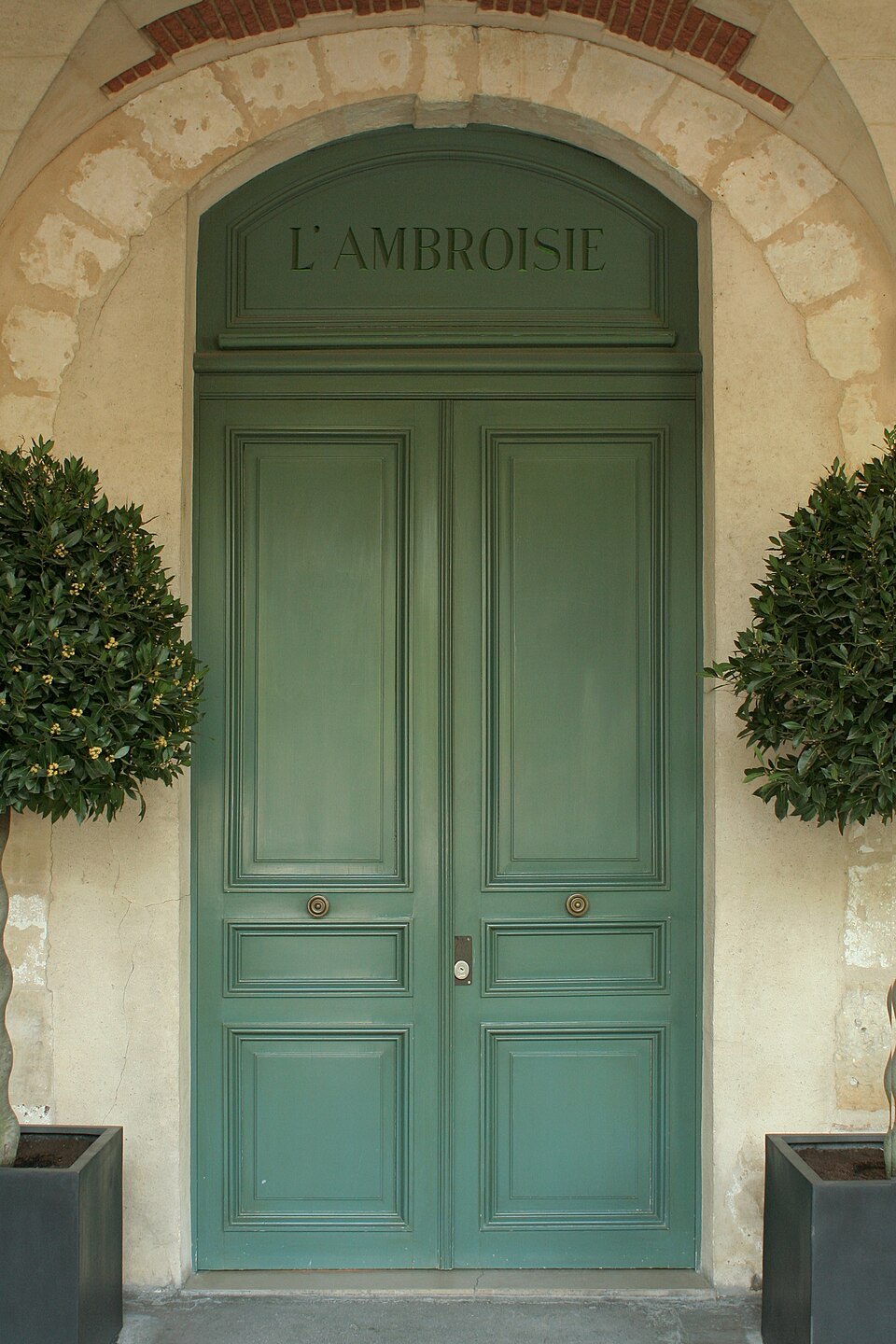
L'Ambroisie has always been easy to admire and hard to update. The Paris restaurant sits at 9 Place des Vosges, under arcades that make even arrival feel like a private threshold.[1][4] For decades, Bernard and Daniele Pacaud's house represented a severe version of French luxury: fewer slogans, fewer visible tricks, more faith in product, sauce, timing, and the silence of a room that did not need to chase attention.
That is exactly why the current moment matters. L'Ambroisie is not merely changing chefs; it is testing whether a famously discreet restaurant can inherit itself without becoming a museum. The official site now frames Shintaro Awa's tenure as a transmission: Bernard Pacaud left in August 2025 after guiding Awa, and the new chef is presented as someone preserving the classics while writing a more personal chapter inside French haute cuisine.[1] The Michelin Guide's current listing identifies L'Ambroisie as a two-star restaurant in the 2026 France guide, which makes the transition visible in public status as well as in house language.[2]
The interesting thing is not the downgrade by itself. Star arithmetic can flatten a restaurant into a scoreboard. The more useful question is whether Awa can make continuity taste active. L'Ambroisie's public materials suggest a clear answer to what the house wants from him: not rupture, not fashionable reinvention, but a subtler rebalancing of inheritance, lightness, and restraint.[1]
The room is part of the argument
Some restaurants can move and keep their identity. L'Ambroisie would be diminished by that thought experiment. The Place des Vosges address is not a postcard around the meal; it is part of the restaurant's operating temperature. The official history emphasizes the 1986 move from Quai de la Tournelle into Paris's oldest royal square, followed by the third Michelin star in 1988 and a 37-year uninterrupted run at that level.[1] Visit Paris Region makes the architectural context explicit, placing the restaurant inside one of the historic buildings of Place des Vosges, near former dwellings associated with major cultural figures.[7]
That setting explains the house's peculiar pressure. A dining room in this kind of frame cannot simply become loose, loud, or concept-heavy without breaking the spell. The building asks for old manners. It asks for composure. But composure can curdle into stiffness if the cooking stops moving. Awa's problem, then, is not how to modernize L'Ambroisie in the abstract. It is how to make the old room feel like a living instrument rather than a preserved object.
The official language around the new era is unusually revealing. Awa writes of culinary heritage interpreted with sincerity, rigor, and passion, and says evolution does not oppose tradition but gives it continuity.[1] That is promotional language, but it is also a useful house contract. L'Ambroisie is telling diners to look for evolution at low volume.
Awa's biography fits because it is not a brand pivot
The safest way to take over an institution is to arrive as a custodian. The riskiest way is to arrive as a statement. Awa's biography sits somewhere more interesting. L'Ambroisie says he was born in Japan into a family of cooks, left for France at 18, trained in major French houses, and spent twelve years with Eric Frechon at Le Bristol Paris.[1] Michelin's listing likewise places him after Pacaud's long career and notes the Le Bristol formation.[2]
That background matters because it makes his difference legible without making it decorative. L'Ambroisie does not need a chef who treats Japanese identity as a garnish on French classicism. The official cuisine page is careful on this point: if a dialogue exists between Awa's two cultures, it lies in the way he approaches each ingredient with respect, care, and sincerity, not in exoticism for its own sake.[1] That is the right boundary. The restaurant's future is not Franco-Japanese fusion as a marketing move. It is a French grammar held by someone whose personal formation may sharpen clarity, proportion, and restraint.
The current menu gives clues. The page lists dishes that still read like L'Ambroisie: langoustine with crispy feuillantine and curry sauce; hot and cold soft-boiled egg with asparagus and caviar; sea bass escalopes with artichoke and Kristal caviar; lobster navarin; golden sweetbreads; milk-fed lamb in two services; roasted Bresse pigeon with devil sauce.[1] These are not attempts to erase the old house. They are product-first, sauce-conscious, and expensive in the old Paris way. Yet the descriptions also suggest a lighter edit: celery candied over wood fire, watercress, wild garlic, horseradish celery juice, agastache with strawberries.[1]
That is where the transition becomes appetizing. The menu still believes in luxury ingredients, but it seems to be searching for lift around them. If Awa succeeds, L'Ambroisie's new signature will not be one viral dish. It will be a change in pressure: the same grand materials, handled with less monumentality.
The new ownership makes the inheritance more explicit
There is also a business story behind the culinary one. CFI's transaction note says Bernard Pacaud and his family sold a majority share of L'Ambroisie to Butler Industries, describing the restaurant as a legendary Place des Vosges house with three Michelin stars at the time of sale.[5] The official L'Ambroisie site now presents Walter Butler's choice of Awa as a deliberate succession, made after reflection and in agreement with Pacaud.[1]
That matters because high-end restaurants often hide succession behind vague words about legacy. L'Ambroisie cannot. Its whole value is bound up with continuity, so the handover has to become part of the guest experience. The restaurant is effectively asking diners to accept a new compact: this is still the house of Pacaud's discipline, but it is no longer Pacaud's daily authorship.
Sortiraparis framed the 2026 Michelin change as one of the notable downgrades ahead of the France guide, pointing out that L'Ambroisie had been one of Paris's oldest three-star institutions before moving to two stars.[6] That public loss may be painful for the house, but it also clarifies the stakes. Awa is not inheriting a sealed triumph. He is inheriting a question.
What to order for the transition, not just the reputation
The wrong way to read L'Ambroisie now is as a nostalgia booking where the point is to confirm that old Paris still exists. The better way is to order for the handoff. Look for dishes where the old grammar and the new hand have to meet.
The sea bass with artichoke and caviar is the obvious test because it belongs to the Pacaud memory of precise luxury: fish, vegetable, caviar, sauce logic, no need for visual shouting.[1] The lobster navarin is another strong signal because navarin implies classical stew structure but requires enough brightness to avoid heaviness.[1] The roasted Bresse pigeon with almond royal icing and devil sauce may be the most revealing meat order: grand product, old sauce vocabulary, and a risk of either stiffness or thrilling concentration.[1]
Dessert looks quieter but may say just as much. A thin cocoa tart with Bourbon vanilla ice cream, wild strawberries with a milky veil and agastache, and a Madagascar vanilla bundle all ask whether the kitchen can end with perfume rather than weight.[1] In a restaurant this formal, the final course is not an afterthought. It decides whether the evening leaves as ceremony or as appetite.
Paris by Mouth's current listing still tags L'Ambroisie as classically French, suited to special occasions, and located in the Marais near Notre-Dame.[3] That is useful practical shorthand, but it undersells the present drama. The reason to go now is not only because L'Ambroisie is classic. It is because classicism is under examination from inside the house.
If Awa makes the transition work, L'Ambroisie will not feel reborn in the loud sense. It will feel re-tuned. The door at 9 Place des Vosges will still matter. The room will still ask guests to lower their voices. The menu will still treat caviar, langoustine, pigeon, lamb, cheese, and vanilla as serious materials. But the best version of the new L'Ambroisie will make inheritance feel less like a burden and more like a line of tension running through the plate: old sauce, clear hand, living room.
Sources
- L'Ambroisie official site, "Ambrosia" - current philosophy, chef biography, cuisine statement, menu, history, opening details, and succession language.
- MICHELIN Guide, "L'Ambroisie - Paris" - current guide listing for the restaurant in the 2026 France guide.
- Paris by Mouth, "L'Ambroisie" - current practical listing, address, opening rhythm, reservations, and style tags.
- Wikimedia Commons, "File:Place des Vosges, Paris, porte du n° 09 (2).JPG" - Coyau's 2010 photograph of the door of 9 Place des Vosges, used as the article image.
- CFI France, "Bernard Pacaud, a three Michelin-star chef, has sold a majority share of his restaurant L'Ambroisie to Walter Butler" - transaction note on the Butler Industries majority sale.
- Sortiraparis, "L'Ambroisie, one of the oldest three-Michelin-starred restaurants in Paris, has lost its third star" (updated March 10, 2026) - report on the 2026 downgrade context.
- Visit Paris Region, "L'Ambroisie" - tourism-board context on the Place des Vosges setting and historic building frame.