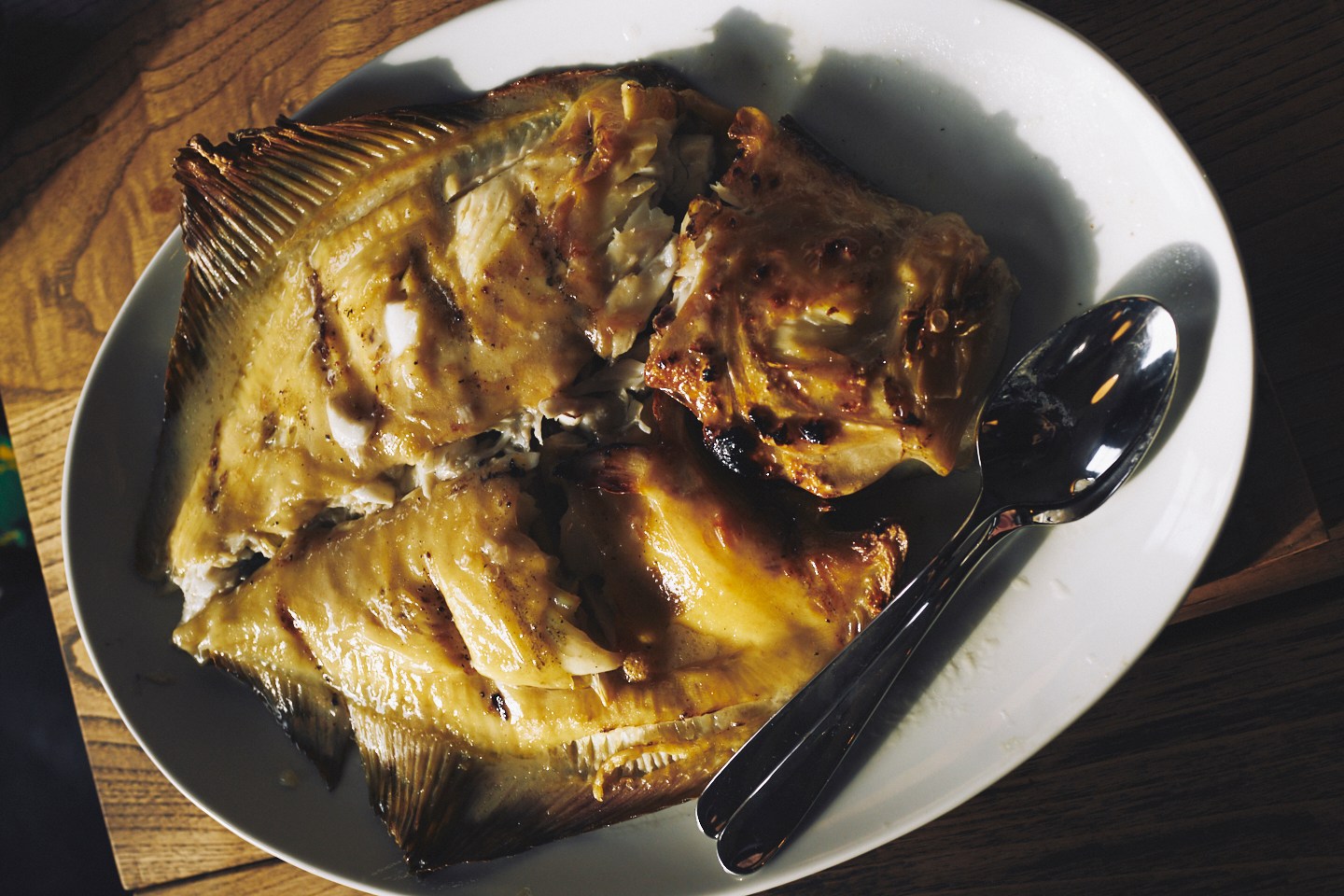
Brat's whole turbot is easy to misread as a flex: a large fish, a famous grill, a Shoreditch dining room, a price that makes the table pause. But the dish is more interesting than spectacle. It works because the restaurant turns a fish into a sequence. Selection, basket, fire, rest, juices, emulsion, carving: each step narrows the gap between cooking method and sauce until the sauce feels like it has been made by the fish itself.
That is why the current menu listing for "Whole Turbot" matters even before anyone tastes it. Brat sells it by size, with 1.8kg and 2.0kg versions on the published food menu, which frames the dish as a shared object rather than a plated entree.[1] The official Redchurch Street site reinforces that this is a restaurant built around the room, the fire, and the address as much as any one plate: first floor, 4 Redchurch Street, open kitchen hours running through the day, menu and reservations presented with almost no explanatory prose.[2] The dish does the explaining.
The fish is the architecture
Turbot is not just "nice white fish." It is a flatfish with enough structure to survive the treatment Brat gives it. The broad body gives the cook a large surface for browning; the skin protects the flesh; the bones and collagen-rich edges create the sticky juices that become the dish's second act. A smaller, leaner fillet would collapse into grill marks and good intentions. A whole turbot can absorb fire without becoming only smoke.
Eater London's early look at Brat is unusually useful here because it records the dish as a working method, not just as a restaurant signature. The piece describes Tomos Parry's first solo restaurant as a Basque-influenced grill room and identifies the turbot as inspired by a version eaten in Getaria, northern Spain.[3] More importantly, it lays out the mechanism: Brat sources whole fish through day boats and suppliers, cooks the turbot gently over lumpwood charcoal to build meatiness and skin char, rests it near the wood oven so the flesh relaxes, then uses the gelatinous roasting juices in a pil-pil-style emulsion.[3]
That last step is the hinge. The dish is not "fish plus sauce." The sauce is a consequence of the fish having been cooked in a way that releases enough gelatin and roasting liquor to be whipped back into itself.
The basket is a cooking decision, not theater
A grill basket can look like a prop because it photographs so well: iron frame, whole fish, fire underneath. But its real value is control. It lets the kitchen move a heavy, delicate, asymmetrical ingredient without tearing the skin or losing the relationship between fish and heat. That control matters because Brat's point is not a hard sear. It is slow pressure.
If the fish is too close to fierce heat, the skin becomes the story and the flesh tightens. If it is too far away, the dish loses the browned edge that makes a whole grilled turbot feel complete. The basket gives the cook a way to turn, angle, and protect the fish while still exposing it to live fire. The result should be skin that carries char without bitterness and flesh that stays broad, pearly, and slightly sticky at the bone.
This is where Brat's Basque influence becomes more than a style reference. The restaurant is not copying a seaside grill in London costume. It is translating a coastal fish-cooking grammar into a city room: product first, fire as a seasoning, rest as an active stage, sauce as an extraction from the main ingredient.[3] The Michelin Guide's current page for Brat still classifies it as a one-star restaurant in the 2026 United Kingdom guide, which suggests that the format has held its standard beyond the opening thrill.[4]
Pil-pil logic without turning the dish into a lecture
The phrase "pil-pil" can tempt writers into making the plate sound more technical than it feels. At the table, what matters is simpler: the juices thicken because fish collagen, oil, heat, and agitation are pushed into a loose emulsion. Brat's published current menu also lists "Squid with 'Pil-Pil'," which shows the restaurant is comfortable naming that Basque sauce language elsewhere on the menu.[1] For the turbot, Eater's account describes a pil-pil-style emulsion made from the fish's own roasting juices, then used to baste the flesh before serving.[3]
That is a small but decisive distinction. A conventional sauce can flatter a fish from outside. This one argues from inside the cooking process. The diner tastes smoke, salt, fat, gelatin, and the memory of the bones, but none of it feels poured on. It feels collected.
This also explains why the dish benefits from being whole. The head, collar, fins, spine, skin, and thick central flesh do not cook identically, and that unevenness is part of the pleasure. A shared whole fish gives the table a progression: first the clean central flakes, then the richer edges, then the more gelatinous scraps that reward patient forks. The dish teaches people to eat it as they go.
Why the room matters
Brat opened with a particular kind of London energy: above Smoking Goat in Shoreditch, led by Parry after Kitty Fisher's, and framed by Eater as one of the city's most anticipated openings of that moment.[3] The Guardian's Jay Rayner review caught the restaurant early and emphasized the force of apparently simple cooking under Parry.[5] That early reception matters because Brat's turbot depends on confidence. A room has to persuade diners that a large fish, plainly presented, is not under-composed.
The physical setting helps. The official Redchurch Street page shows the restaurant through actual food and room photography rather than heavy concept copy; it lets images of fish, bread, and the dining room carry the identity.[2] That restraint mirrors the plate. Brat does not need the turbot to arrive under a cloche, with a server reciting a map of the Bay of Biscay. The fish arrives as an object. The explanation is in the browned skin and the juices below it.
There is a practical reason this dish remains compelling years after the opening wave. Many fine-dining signatures are fragile because they depend on surprise: the first sphere, the first smoke dome, the first tiny tartlet that tastes like a childhood memory. Brat's turbot is not built that way. Its appeal is repeatable because it is anatomical and procedural. A good turbot has the right body; a patient fire creates the right heat curve; a rest releases the right liquor; a loose emulsion returns that liquor to the flesh.
The point is not smoke
The lazy version of the Brat story is "wood fire makes things taste good." That is true but incomplete. Smoke is only one note, and too much of it would flatten the fish. The deeper achievement is that the restaurant uses fire to pull texture, sauce, and ceremony out of a single ingredient.
The dish is expensive because the fish is large, carefully sourced, and shared. It is memorable because its luxury is legible: you can see the whole animal, you can taste the edges, and you can understand why the sauce could not have existed before the cooking happened. In a dining culture often obsessed with invisible prep, Brat's turbot offers the opposite pleasure. It puts the method in front of you and still feels mysterious.
That is the dish's real power. Fire does not decorate the turbot. Fire organizes it. By the time the plate reaches the table, the grill has become seasoning, the rest has become extraction, and the fish has become its own sauce.
Sources
- Brat, "Food Menu" PDF, current Redchurch Street food menu listing whole turbot and related grill dishes.
- Brat, "Redchurch St" official restaurant page, address, hours, reservations, and restaurant imagery.
- Adam Coghlan, "A First Look Inside Shoreditch's Hottest Restaurant," Eater London, 2018, opening context, Brat turbot method, and Ben McMahon turbot photograph.
- The MICHELIN Guide, "Brat - London," 2026 United Kingdom guide listing and inspector information.
- Jay Rayner, "Brat, London: 'The culinary equivalent of an Anthony Hopkins performance' - restaurant review," The Guardian, 2018.