A rice table asks for a different kind of attention from a procession of courses. There is another dish within reach, another combination to try. A spoonful of sauce changes the rice; the next mouthful can begin somewhere else. The pleasure lies partly in having choices left on the table.
Rijsttafel belongs to this generous arrangement. The Dutch heritage inventory describes an elaborate spread drawn from preparations such as rendang, fish, tofu, eggs and vegetables, distinguishing it from the smaller rice meals cooked more often at home.[1] Its history, however, turns on something less easily counted than bowls: who gets to host, who does the work, and whose memories the meal carries.
A family table, with service in the frame
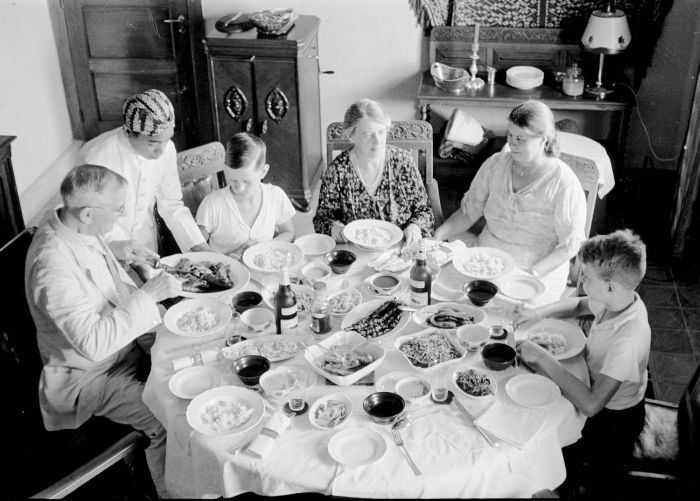
The photograph above records the Japing family with Aunt Jet and Uncle Jan Breeman in Bandung in May 1936. The museum catalogue credits C. H. Japing as photographer.[2] It is an intimate object to begin with: named relatives, a gathering preserved, a table whose dishes invite the eye to wander.
Look around that table as well as across it. Diners sit while a server stands on the left. The arrangement makes service visible inside a family occasion. The photograph cannot tell us the worker's pay, thoughts or relationship with the household; the catalogue description names the family and relatives, but leaves that person unnamed.[2]
That imbalance in the surviving description matters. A meal can become a treasured family image while recording very little about the person helping to make it happen. Reading the photograph carefully means holding both things in view: the sociability of the gathering and the uneven distribution of attention.
Rijsttafel's elaborate colonial form made this relationship especially conspicuous. In its account of an April 2026 lecture by memory scholar Arnoud Arps, UC Berkeley describes Dutch colonial elites shaping Indonesian dishes into lavish dining experiences for European audiences.[3] The food and the social performance became intertwined. Abundance could communicate the host's position as powerfully as it satisfied an appetite.
The journey was slower than the familiar story
There was also substantial culinary work behind the arrangement. The Dutch heritage inventory identifies Indigenous domestic workers and Indo-European women as makers of meals adapted for Dutch eaters, and locates an identifiable Indisch culinary identity in late nineteenth-century cookbooks.[1] A history told only through the diners misses those cooks' decisions.
Nor did a celebrated colonial meal immediately become a Dutch national favorite. Historian Matthijs Kuipers's chapter “Food and Indifference” describes its arrival in the Netherlands around the turn of the twentieth century. Efforts to popularize it had limited success; its audience remained concentrated among former colonial officials and Indo-Dutch families.[4]
That is a useful interruption to the easy story of a delicious meal traveling home and winning everyone over. Kuipers emphasizes the Dutch public's limited interest. A dish can travel much farther than the appetite for it. The rice table's later familiarity should not be projected backward onto its first metropolitan audiences.
A complementary study by Andika Ariwibowo examines restaurants and rijsttafel in the Netherlands from the mid-nineteenth to the mid-twentieth century, using newspapers, cookbooks and culinary guidebooks. Its abstract stresses adaptation to Dutch tastes within a setting of colonial cultural influence.[5] Put beside Kuipers, this gives us two questions worth keeping separate: how a cuisine is adjusted for new customers, and how many customers actually embrace it.
For a dining room, the distinction is practical. Printing a menu, explaining unfamiliar food and choosing a service format are all ways of inviting an audience. None guarantees that the invitation will be accepted. Culinary transmission needs people prepared to cook again after the first encounter.
A meal carried through changed circumstances
Migration made that persistence personal. The heritage inventory recounts how, after arrivals in the Netherlands beginning in 1945, some Indo-Dutch residents of boarding houses cooked secretly on oil stoves amid objections to the smell of their food. Missing ingredients also required substitutions, including endive for familiar leafy vegetables. Access to homes and ingredients later allowed more cooking to resume.[1]
Here the scale of the story changes. Earlier, abundance could advertise standing; now the small stove makes continuity possible. Keeping a cuisine alive may depend on an improvised ingredient and a place to put a pan. The resulting meal carries the effort of adaptation along with the memory of what preceded it.
The restaurant version remains part of that wider life. Ron Gastrobar Indonesia's official English page presents two rice tables alongside individual dishes, including langoustine with peteh beans and tofu with egg and peanut sauce.[6] This is evidence of a contemporary format, rather than a report of a meal tasted: diners can encounter the cuisine through an assembled spread or through particular plates.
The distinction gives the rice table an enduring attraction. An assortment lets a group compare, pass, return and disagree pleasantly over favorites. Its success depends on the individual preparations retaining enough character to reward that movement. A crowded table alone cannot supply it.
The Dutch heritage inventory added the cooking and rijsttafel tradition in November 2022.[1] Recognition, though, does not settle the question of ownership. Berkeley's lecture report records Arps's concern with nostalgic colonial imagery and competing claims to the meal.[3] Remembering the cooks, migrants and unequal relationships gives a fuller account of what reaches the dining room.
The next spoonful can still be pleasurable. Knowing this history makes the table more populated: by the people in the photograph, the person its caption overlooks, and the cooks who found ways to continue elsewhere. Between one small dish and the next, there is room to notice them.
Sources
- Kenniscentrum Immaterieel Erfgoed Nederland, “Indisch koken en de Indische rijsttafeltraditie” — heritage inventory, culinary practice, migration and November 2022 inscription; Dutch.
- Collectie Wereldmuseum, TMnr 10030167, Japing family rijsttafel in Bandung, May 1936 — photograph credited to C. H. Japing; Wikimedia Commons, CC BY-SA 3.0.
- Sinem Erdem, UC Berkeley Institute of European Studies, report on Arnoud Arps's lecture about rijsttafel and shared colonial heritage, April 17, 2026.
- Matthijs Kuipers, “Food and Indifference,” in A Metropolitan History of the Dutch Empire, Amsterdam University Press, 2022, pp. 37–68 — publicly accessible chapter summary and opening discussion.
- Andika Ariwibowo, “Pendidikan Selera dalam Perkembangan Restoran Hindia Belanda dan Rijsttafel di Belanda pada Periode Kolonial,” Paradigma 14(1), 2024 — English abstract, research scope and adaptation argument.
- Ron Gastrobar Indonesia, official English restaurant page — rice tables and individual dishes described by the restaurant; accessed September 21, 2026.