Imagine a small plate of smoked pork, a crisp edge of rye bread and a spoonful of mustard. Beside it sits an amber beer with barely a collar of foam. The temptation is to wait for the bubbles to arrive and make the next bite feel lighter. With sahti, the pleasure may lie in a different direction: letting the glass extend the grain and warmth already on the plate.
Finland’s traditional farmhouse ale is a useful challenge to the idea that beer earns its place at dinner through brisk refreshment. The Beer Judge Certification Program describes a substantial, sweetish drink with low bitterness, often banana-and-clove aromas, and carbonation ranging from nearly still to modest. Its guideline gives a strength of 7–11% ABV.[1] Those characteristics suggest a deliberate course pairing, with attention to portion and texture.
The combinations below are proposals drawn from documented brewing and flavor characteristics, rather than a report of a restaurant tasting. Their starting point is simple: give this unusually full glass something specific to do.
Read the row of cups
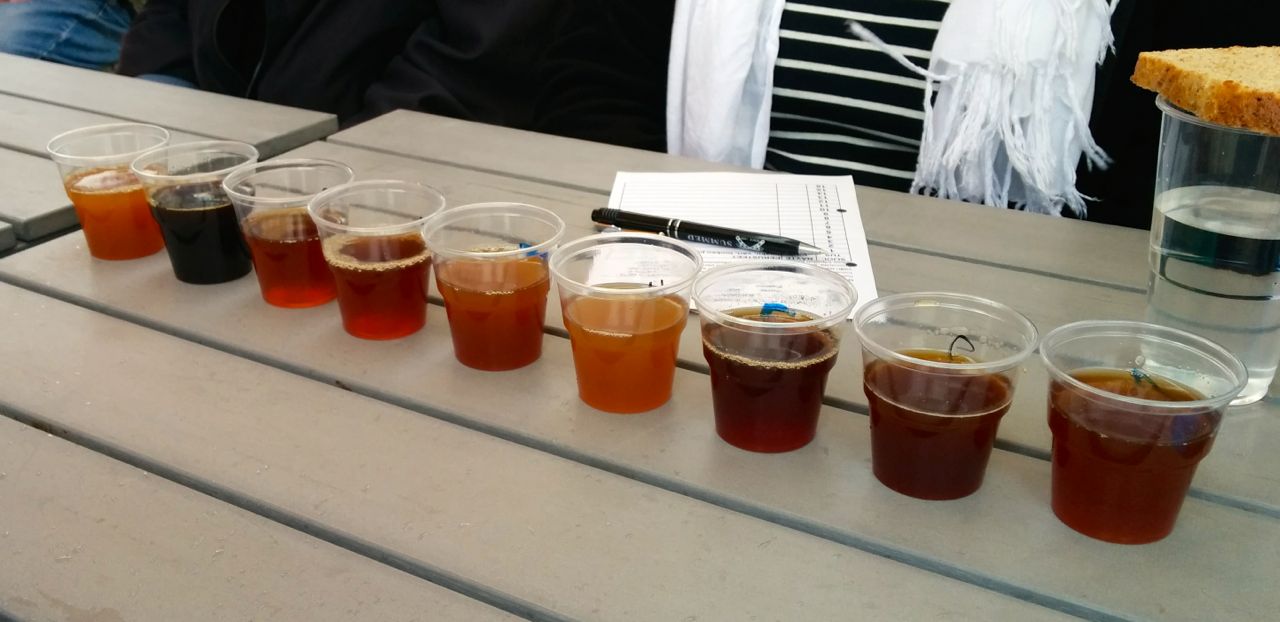
The photograph from a 2016 sahti competition in Lahti offers a better introduction than a single polished bottle. The samples vary in color and cloudiness. In his accompanying account, Finnish brewer and writer Mika Laitinen describes a tradition with considerable room for preference: paler malt expressions, darker bread-and-toffee flavors, and examples whose fruitiness is more or less pronounced.[2]
That variation matters at the table. A menu saying only “sahti” leaves a cook with much the same problem as a menu saying only “white wine.” The name opens a conversation; tasting the actual batch supplies the useful detail.
Juniper needs similar care. Laitinen’s brewing guide distinguishes the woody, needle-like character of branches from the flavor of berries. He also notes that some Finnish brewers omit juniper, and that a juniper-free example has won the national competition.[3] A pairing built entirely around an imagined mouthful of forest could miss the drink in front of it.
Give the malt a savory companion
There is an everyday food context to begin with. Finlandia Sahti’s own description of its brewery bar in Putaja lists savory snacks including steamed sausage and panini.[4] This is an account of the producer’s setting, rather than evidence for one perfect pairing. Still, bread and sausage provide an inviting place to start thinking.
For a more composed plate, I would test a small portion of smoked pork with crisp rye and a restrained mustard dressing. The idea is to keep the bite savory and give the glass recognizable partners. Mustard can supply a pointed interruption; the bread adds something to crunch. A sticky glaze would be a less promising first experiment, because it adds another sweet element before the balance has been established.
The useful test is the second bite. Does the beer invite it, or does the combination begin to feel weighty? If it is the latter, reducing the sauce or the pour may do more than adding another garnish. A pairing succeeds at the scale at which someone actually eats it.
A browned vegetable can carry the course
Meat need not be the organizing ingredient. Laitinen’s account describes malt flavors ranging from honey-like and grassy to darker bread and toffee.[2] That range suggests another trial: roasted celeriac with a browned surface, a little cultured cream and a scattering of toasted grain.
Here the proposed connection is between the vegetable’s browned exterior and the drink’s malt character. The cream should remain an accent. If everything on the plate becomes soft and rich, there is little reason to expect a nearly still beer to restore the contrast by itself.
A thin, crisp element would give the mouthful a change of texture. The cook could then taste a small amount of tart dressing with the finished combination, adjusting it to the chosen batch. This is where a pairing becomes a piece of cooking: the food can respond to the glass, just as the glass is selected for the food.
Banana does not automatically mean pudding
The banana and clove language in the BJCP description is tempting shorthand for dessert. Yet the same guide describes a grainy, full-bodied beer, with sweetness and alcohol contributing to its impression.[1] An aroma that recalls baking does not settle how a drink will behave beside a heavily sweetened dish.
I would first test that aromatic possibility at the quieter end of dessert: a modest baked-apple preparation with a crisp pastry edge, holding back on caramel sauce. This is a suggestion to investigate, not a claim that all sahti belongs with apples. The amount of sweetness in both glass and plate still has to be tasted together.
The refrigerator belongs in the pairing
Freshness is part of the service. Laitinen advises keeping sahti cold until serving and drinking it within weeks; he also explains that it is not intentionally carbonated, though residual fermentation can leave a little fizz.[3] Finlandia likewise stresses cold storage.[4] A restaurant considering a pairing therefore needs to know how the beer has been handled, as well as how it tastes on arrival.
The tradition has its own demanding audience. The Finnish Sahti Society describes annual national championships preceded by local selection competitions, with only one representative from each participating sahti locality.[5] That makes the varied samples in the photograph feel especially apt: they belong to a culture of comparison and judgment.
At dinner, the same attention can happen on a smaller scale. One fresh batch, one carefully proportioned plate, one quiet glass. The pairing becomes interesting when the next bite gives the diner a reason to return to it.
Sources
- Beer Judge Certification Program, “Historical Beer: Sahti,” 2021 Beer Style Guidelines — sensory profile, strength and carbonation.
- Mika Laitinen, “Sahti and Related Ancient Farmhouse Ales,” Brewing Nordic — variation among brews and source of the Lahti competition photograph.
- Mika Laitinen, “Sahti Recipe and Farmhouse Brewing Tips,” Brewing Nordic — juniper choices, carbonation and cold storage.
- Finlandia Sahti, brewery and brewery-bar description — savory snacks, production and storage guidance; in Finnish.
- Finnish Sahti Society, “Suomen Sahtiseuran toiminta ja tehtävä” — the society’s purpose and local-to-national competition structure; in Finnish.