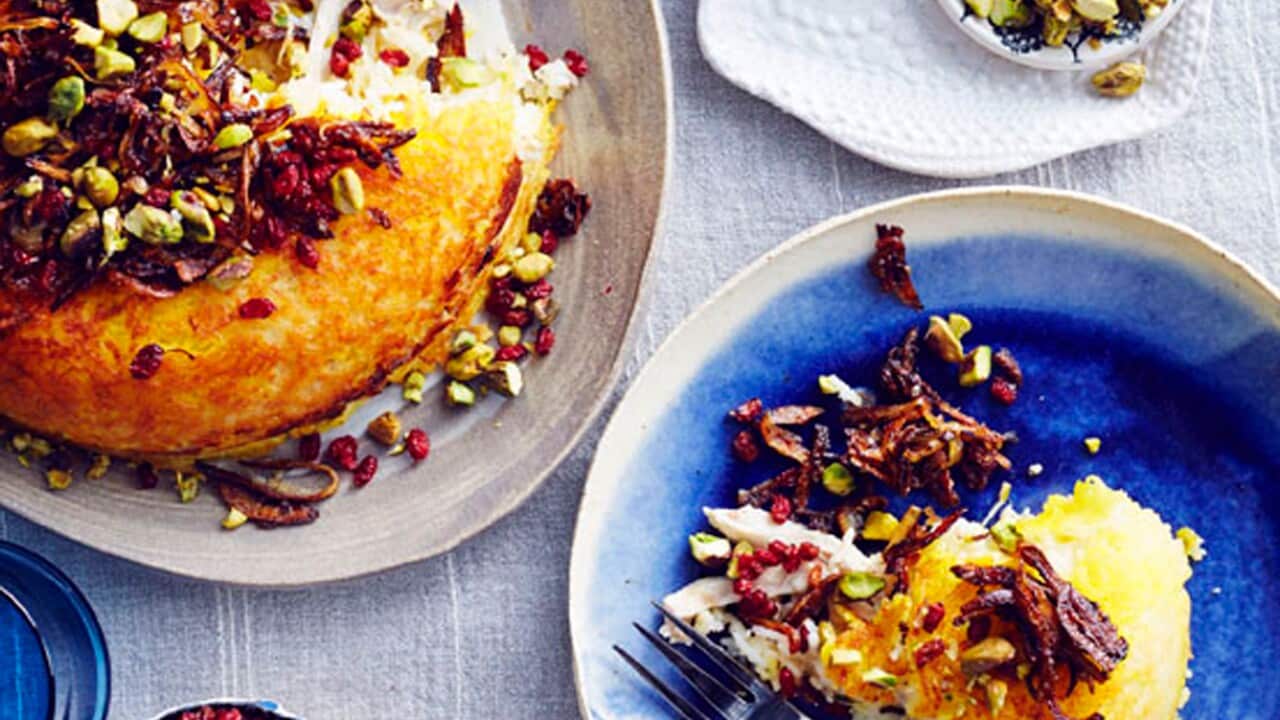
The most theatrical part of tahchin happens before anyone takes a bite. A platter covers the cooking vessel; the two turn together; the hidden underside becomes the dish’s face. Rice that has spent its cooking time against the pan arrives as a golden crust. The suspense is built into the method.[1]
Then comes the more interesting test: the slice. It should give the diner something crisp to break and something tender behind it. That relationship makes this Persian rice dish compelling on a shared platter or a carefully composed restaurant plate. The garnish can catch the eye, but the cross-section explains the cooking.
Tahchin is often described as a savory rice cake. That is a useful invitation, provided “cake” does not persuade us that every version should have the same interior. The placement of the yogurt mixture changes what the fork will find.
Decide what the middle should be
Omid Roustaei’s Caspian Chef method folds all the parboiled rice into yogurt, eggs, saffron and oil. The coating runs through the dish. His basic version needs no meat filling, though he offers chicken and eggplant variations.[1]
Homa’s Persian Mama recipe takes another route. She identifies it as a Tabrizi, or Azeri, version: only the bottom rice layer receives the yogurt, egg and saffron mixture. Above it sit plain rice with Persian rice spice, cooked chicken, and another rice layer. Reduced chicken broth helps steam the interior while the base develops its crust.[2]
The distinction matters more than the silhouette. A neatly cut square can contain a relatively continuous bound rice mixture, or conceal loose, aromatic grains above its foundation. Neither appearance alone tells you which you are eating. For a cook planning a small plated portion, deciding the desired interior comes before choosing the mold.
Let the rice finish in the cake
Roustaei begins with soaked basmati and a brief boil, stopping when the grains have only slightly softened. He drains and cool-rinses them before gently combining them with the yogurt mixture.[1]
The sequence gives rice two separate jobs: first absorb water and begin softening, then finish inside the assembled dish. It also explains why folding deserves a lighter hand than stirring a batter. The grains remain part of the texture; turning them into paste would erase a pleasure the finished slice is supposed to preserve.
Phoebe Wood’s SBS recipe uses egg yolks and Greek-style yogurt, whereas Roustaei uses whole eggs.[1][3] These are choices inside complete recipes. Taking one author’s rice quantity, another’s dairy and a third’s cooking time would create a new formulation that still needs testing.
For restaurant development, I would start by cutting an ungarnished trial portion. Does it hold together when lifted? Does the fork still encounter rice? A polished surface answers neither question.
Read the heat from the edge
Tahchin makes its most important surface where the cook has the least direct view. Wood’s stovetop method begins at medium heat, then drops to low; she checks for a golden underside by lifting the rice slightly.[3] The heat has to finish the interior while developing the crust below.
Homa uses a glass baking dish, making the lower edges visible. Her warning is precise: the base browns more deeply than the sides. She also allows for oven variation rather than treating her published time as an absolute.[2]
That is a useful lesson in what a timer can tell you. It records elapsed time; it cannot inspect the part of dinner pressed against the pan. A cook needs the endpoint described by the chosen method as well as the clock.
Nor is the darkest possible crust necessarily the goal. The pleasure lies in a contrast the diner can comfortably cut and chew. A crust that dominates every bite would defeat the tender rice it was made to accompany.
The vessel divides the pleasure
In her Sofreh recipe, excerpted by Epicurious, Nasim Alikhani favors a broad casserole because it gives each serving a generous share of crust. She also chooses jasmine rice for a more cohesive cake texture.[4]
Those decisions belong together: how firmly the portion holds and how much browned surface accompanies it. Changing the vessel is therefore a change to the eating experience, even before a kitchen changes the seasoning.
Wood finishes her version with pistachios, fried onion and barberries; SBS describes the berries’ sourness.[3] Against rich rice, a little tart fruit gives the next mouthful a different direction. But a jewel-like scatter cannot repair an underdeveloped base or an overworked middle.
At the table, I would want a serving that lets both parts remain legible: enough unadorned crust for its texture to register, enough exposed rice to show what lies beneath. Tahchin has already performed its grand reveal when the pan came away. The first forkful should make that reveal worth the wait.
Sources
- Omid Roustaei, “Tahchin – Crispy saffron rice cake,” The Caspian Chef — whole-rice coating, parboiling, stovetop method and variations.
- Homa, “Tahchin Morgh,” Persian Mama — Tabrizi layering, chicken broth and visual checks through a glass baking dish.
- Phoebe Wood, “Tahchin,” SBS Food — yolk-and-yogurt mixture, stovetop heat, garnishes and Brett Stevens’s photograph for Feast magazine.
- Nasim Alikhani with Theresa Gambacorta, “Tachin Ba Morgh,” excerpt from Sofreh, Epicurious — rice choice and the crust-to-filling ratio.