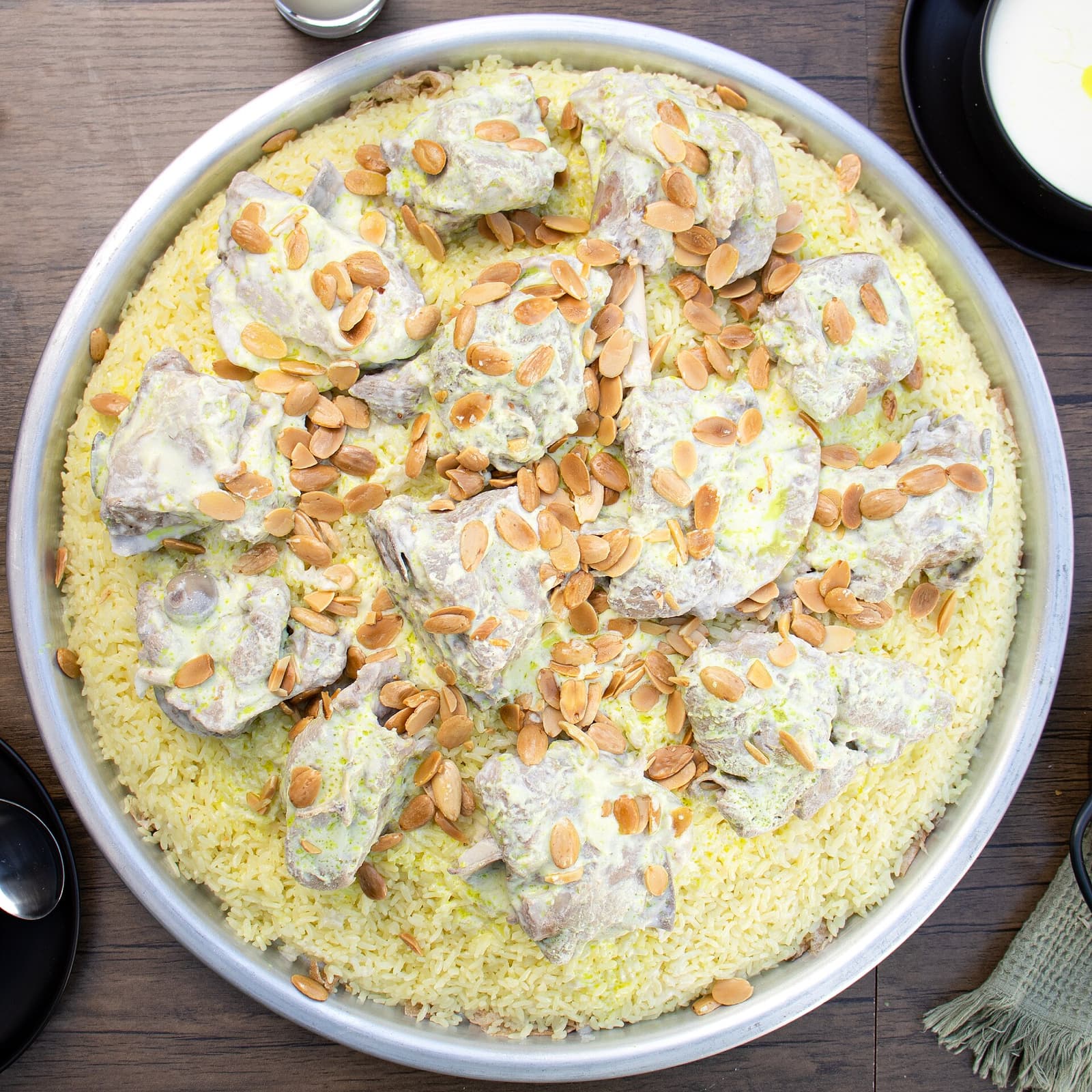
Mansaf arrives as a landscape rather than a plate. A wide round tray carries thin bread, rice or bulgur, large pieces of sheep or goat meat, a scattering of almonds, and enough yogurt sauce to make the grains glisten. The ingredients are arranged in layers, but the pleasure comes from their refusal to stay separate.
In Abdulla aljammal's overhead photograph, pale jameed does not sit politely at the edge. It coats large pieces of lamb, runs into the yellow rice, and waits in a bowl for a second pour.[7]
The sauce runs downward. Rice takes on its salt and acidity. Bread softens beneath the rice, becoming both foundation and reservoir. Meat cooked in the same dairy broth returns that flavor with fat and depth. Around the platter, diners work inward from different edges. The dish is assembled once and completed many times.
That structure is easy to flatten. Mansaf can be described as lamb and rice with yogurt, which is accurate in the way that a cathedral is stone with a roof. The ingredient that gives the dish its working logic is jameed: sheep's or goat's milk fermented, drained, salted, shaped and dried until it becomes hard enough to store. Before the feast, that concentrated dairy has to be made liquid again. Mansaf therefore begins with preservation and ends with generosity. A scarce season of milk is compressed into a durable object, then opened back into broth for a crowd.[1][3][4]
First, remove almost everything that makes milk pour
There is no single mechanical recipe for jameed. The Jordanian Ministry of Culture's national inventory records regional practice rather than a factory specification, and even its two accounts from Mafraq differ in timing. One begins with sheep's or goat's milk that is boiled, cooled, cultured, strained in cotton bags under weight for a week or more, salted, formed into discs and dried in the sun. Another describes churned dairy drained for at least a week, heavily salted, shaped and sun-dried for roughly two weeks.[3]
The Food and Agriculture Organization's older technical catalogue documents another traditional sequence: naturally acidified sheep's or goat's milk is churned, the butter is removed, the sour buttermilk is heated and concentrated, then salt and drying turn it hard. Its reference profile lists jameed at about 12 percent moisture and 12 percent salt, but those figures should be read as a technical description, not a universal promise about every handmade ball.[4]
Across the variations, the direction of travel is consistent. Fermentation creates acidity. Churning may remove butter. Cloth and pressure remove whey. Salt assists preservation and supplies the assertive flavor that will later season an entire pot. Drying removes still more water. What began as an immediately perishable liquid becomes a dense, pale store of protein, acid and salt.
The Jordanian inventory makes the seasonal purpose explicit: jameed was prepared when milk was available so it could be eaten in winter, when the sheep were no longer giving milk.[3] That detail changes the taste of mansaf. Its sourness is not a fashionable streak of cultured dairy added for brightness. It is the flavor of a storage system being reversed.
There is labor inside the hard surface too. ICARDA describes jameed as an important small-ruminant product and a source of household income, with women doing much of the dairy processing. Its improved small-scale method replaces prolonged churning with a lower-powered fat separator, allowing the removed fat to become saleable ghee while the skimmed milk continues toward yogurt, concentration, salting, shaping and drying. In ICARDA's reported trials, the change reduced water and energy use and raised net income.[6]
That intervention is useful precisely because it is not a story about rescuing an inert relic. Jameed is a working product whose fat separation, hygiene, drying, flavor and economics can change. Tradition here is a chain of decisions, not a rock that happens to be edible.
Then make the stone pour again
Before jameed can season mansaf, the cook has to undo its most visible achievement. The Mafraq inventory describes soaking or rubbing the dried dairy with warm water until the water becomes milk-like, then bringing it to the heat with the meat.[3] The Jordanian heritage account calls the resulting sauce marees and places it in the pot after the meat has first boiled.[2]
This is more consequential than dissolving a stock cube. A ball of jameed carries fermentation strength, salt, residual fat and the effects of its drying. Reconstitution decides how loudly all of those qualities speak. Too little water can make the broth punishingly saline and pasty; too much can reduce the cultured depth to a thin white wash. The cook is not merely restoring liquid. The cook is calibrating the seasoning medium for the meat, rice and bread that follow.
The sauce also needs to behave like a broth without losing its dairy identity. It must surround large pieces of meat, remain pourable enough to travel across the finished platter, and carry sufficient flavor to survive absorption. In mansaf, "sauce on the side" is not a neutral service choice. The flow of jameed through the dish is what lets several separate preparations taste as if they belong to one pot.
That is the first boundary for a restaurant interpretation. A neat swipe of cultured-yogurt purée beside a lamb loin may echo the ingredient list, but it removes jameed from its structural job. The dairy should be allowed to cook, season, travel and soak. Restraint can reduce the quantity; it should not cancel the exchange.
Bread is the first plate, not the last garnish
UNESCO's account of al-mansaf describes a recognizable assembly: thin bread, rice or sometimes bulgur, large pieces of meat cooked with spices in yogurt sauce, and fried dried almonds. The Jordanian record adds pine nuts among common finishes and emphasizes the broad round platter.[1][2] Read from above, the hierarchy appears obvious—meat is the crown, rice the field, nuts the glitter. Read from below, bread is doing the quietest and most important service.
Thin shrak or related flatbread makes a permeable floor. It catches the jameed that passes through the grain, receives meat juices and turns soft enough to join a handful or spoonful rather than remaining a detached accompaniment. Rice extends the feast and keeps individual grains in play; bread prevents the deepest flavor from simply pooling against metal. What looks like support is an edible record of everything placed above it.
The layers also prevent luxury from residing in the meat alone. A fine piece of lamb matters, but mansaf's satisfaction depends on distribution: cultured broth in the rice, broth and grain in the bread, nuts against softness, meat divided across the platter. The best bite is relational. Isolate each component in its own precise zone and the dish becomes a tasting diagram of itself.
The familiar platter has a recent history too
Calling mansaf timeless would deny it the capacity to change. Ammar Abdelkarim Ali Alobiedat's oral-history study in Hartha, a village in northern Jordan, reconstructs a local sequence within living memory. In that account, rice grew popular around 1945 and gradually overtook bulgur; almonds and then pine nuts joined later; jameed became central in the mid-1960s; and shrak declined sharply by the mid-1970s.[5]
Alobiedat is careful about the boundary: Hartha's chronology is not automatically the history of mansaf everywhere in Jordan.[5] That caution is the valuable part. A national dish can look settled from a distance while ingredients, trade routes, farming, utensils, household budgets and local preferences keep editing it. UNESCO's current description still allows rice or bulgur and includes thin bread, while one village memory records those components moving in and out of prominence.[1][5]
This makes "authenticity" a poor excuse for freezing one restaurant version. The stronger question is whether a change understands the relationships it is changing. Replacing rice with a local grain may continue an old flexibility. Removing the bread because it looks untidy may erase the layer that receives the broth. Serving jameed as a delicate dot may preserve its name while abandoning its function.
The platter is a piece of service equipment
UNESCO records five to seven people around a platter. Traditionally, diners eat with the right hand while the left stays behind the back, though plates and spoons are also used today. The preparation is social before the first bite: cooks talk, tell stories and sing; relatives carry the finished platters into the reception space.[1] The Jordanian heritage record likewise treats mansaf as feast food for weddings, births, religious holidays and honored guests, with shared cooking and carrying folded into the event.[2]
Those practices turn the platter into more than oversized crockery. Its diameter establishes a temporary table. Its center creates a common destination. Its abundance gives the host something visible to offer, while the shared edge asks diners to notice one another's pace and space.
Eating by hand is especially revealing because the broth changes the required gesture. The diner works rice, meat and softened bread into a manageable portion; the jameed that unified the cooking now helps unify the bite. A spoon changes the mechanics but need not cancel the social structure. An individual plate changes more: the kitchen becomes the only allocator, and the diner no longer negotiates a shared field.
A fine-dining room does not need to imitate a family feast, instruct strangers to stand shoulder to shoulder, or claim intimacy it has not earned. It can, however, preserve some agency and some movement. A smaller platter for two, jameed poured at the table, bread deliberately placed to catch it, or a second pour offered by the server can keep hospitality active. The point is not spectacle. It is to let service complete what cooking began.
Mansaf's deepest refinement happens before anything looks refined. Milk is fermented, relieved of water and often butter, pressed with salt and dried for a season when it will be needed. At the feast, that hard store is patiently made fluid. It tenderizes and seasons meat, enters rice, disappears into bread and finally reaches several diners from one tray.
The dish does not turn scarcity into a tiny precious portion. It turns preservation back into flow.
Sources
- UNESCO Intangible Cultural Heritage, "Al-Mansaf in Jordan, a festive banquet and its social and cultural meanings" — 2022 inscription record covering ingredients, assembly, transmission, shared preparation and communal service.
- Jordanian Ministry of Culture, "Al-Mansaf: A festive banquet and its social and cultural meanings" — national heritage account of marees, platter assembly, occasions, carrying and dining practice.
- Jordanian Ministry of Culture, "Jameed Making" — Arabic-language national inventory records from Mafraq documenting two local sequences for culturing, draining, salting, drying, storing and reconstituting jameed.
- Food and Agriculture Organization of the United Nations, The Technology of Traditional Milk Products in Developing Countries, section 4.2, "Jemid, Eqet" — process and composition reference for Jordanian dried fermented sheep's and goat's milk.
- Ammar Abdelkarim Ali Alobiedat, "The Sociocultural and Economic Evolution of Mansaf in Hartha, Northern Jordan," Humanities 5, no. 2 (2016) — bounded village oral history of changing grains, jameed, bread, nuts, equipment and communal labor.
- International Center for Agricultural Research in the Dry Areas, "Jameed production innovations improve women's income" — small-scale processing intervention, fat separation, resource use, product yields and livelihood outcomes.
- Abdulla aljammal and إبراهيم الجمال للمناسف والمأكولات العربية, "Mansaf 1," Wikimedia Commons (January 9, 2024) — source page, Jordan location, attribution and metadata for the real photograph of local-lamb-and-jameed mansaf used as the article image.