A place set for one looks complete from the chair: one folded napkin, one water glass, one clean line of sight to the pass. From the reservation book, the same setting can look like a hole. The diner buys one menu; the neighboring chair may earn nothing for the rest of the night.
That tension is getting harder to hide behind a booking widget. OpenTable's 2024 U.S. data found that solo dining on its platform rose 8 percent year over year. Its solo guests spent an average of $84 per person—48 percent more than the average across party sizes—and 60 percent of surveyed consumers said they had eaten alone at a sit-down restaurant during the previous year.[1] Those figures cover the platform, not fine dining specifically, and they do not erase the economics of a tiny tasting room. They do establish that a party of one is neither eccentric nor negligible demand.
The argument, then, is not that every restaurant must accept every solo booking at every hour. It is that the solo diner is often treated as the problem when the constraint was created by the room. A rigid two-top, a single long seating, and reservation software that begins counting at two turn one guest into apparent waste. Better hospitality starts by separating the actual cost of an empty chair from the old suspicion that a serious meal requires company.
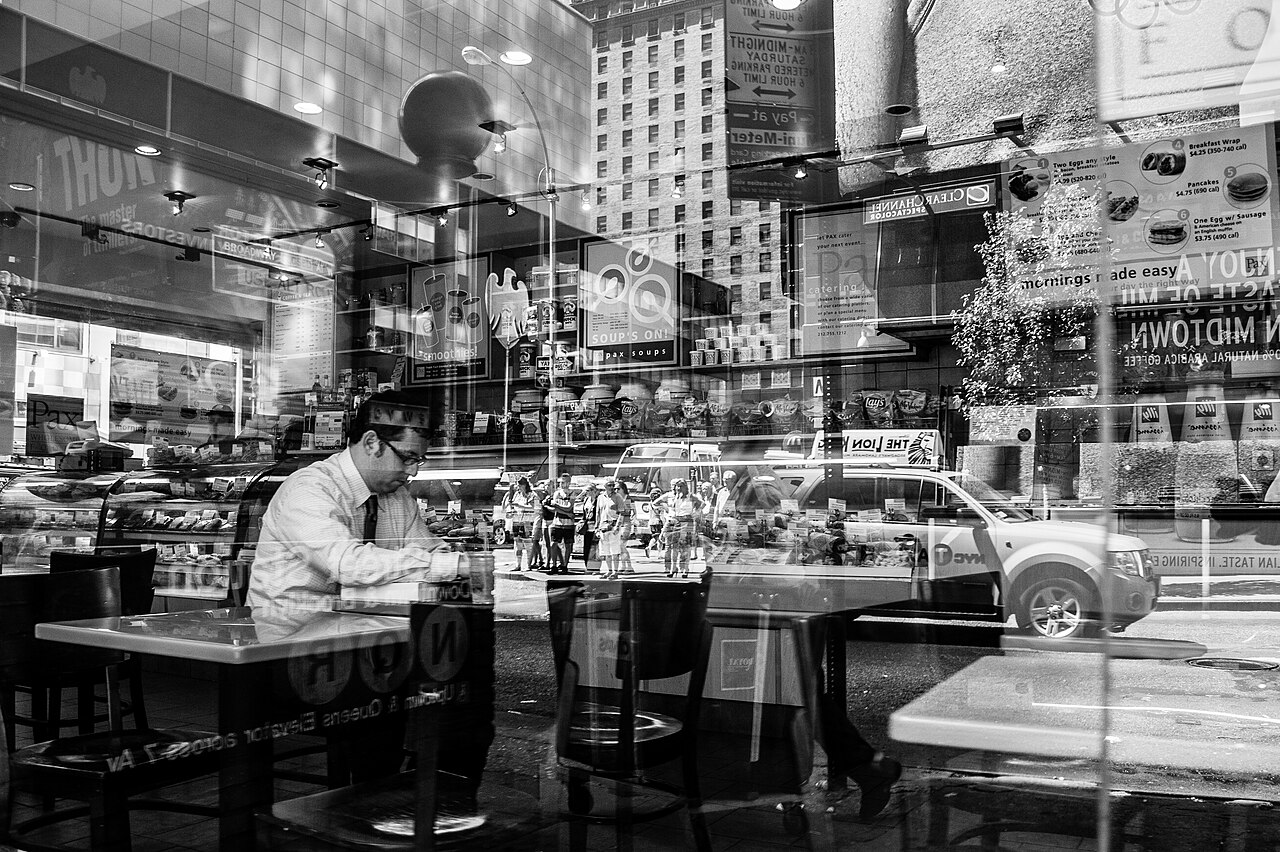
The cover photograph makes that separation visible. Jim Pennucci's 2012 Manhattan street photograph is not a tasting-menu fantasy: a man sits alone in a bright, ordinary restaurant while taxis, pedestrians, shelves, and signs fold over him in the window's reflection.[7] He is private without being removed from the city. The scene captures what a good solo meal can feel like—attention held inside a room that continues moving around it.
The chair that expires at 7:30
Fine dining sharpens a problem familiar to any table-service restaurant. Seat one person at a two-top and the kitchen plates one sequence instead of two, but the table still consumes the same patch of floor. If the house sells only one long dinner seating, that unused chair cannot be turned later. Rent, much of the brigade, the sommelier, the flowers, and the room's heating do not halve because the reservation did.
This is a real opportunity cost, not a villain invented by restaurateurs. But opportunity cost is not the same thing as a second meal. The distinction matters because a restaurant can respond in at least three different ways: redesign capacity, release single seats when the risk is lower, or charge a clearly disclosed minimum. Silently removing “1” from the party-size menu is a fourth response, but it turns an operating decision into an opaque inventory policy.
The sharpest public example came from London in 2023. Alex Dilling at Hotel Café Royal told The Caterer that its dining room then held only 11 tables and a maximum of 34 covers, supported by 20 to 25 employees. Management said solo requests could occupy half the available tables. Its revised policy allowed a minimum spend equal to two base menus when solo demand exceeded the seats allocated to it, while letting beverages count toward that minimum; solo guests booking within 48 hours could be admitted without it when space remained.[3]
That policy made the trade explicit. It also made the inequity explicit. A solo diner might drink the difference, pay for air, or wait until the room's risk had decayed. The restaurant's numbers explain why management acted; they do not magically make two-person pricing feel like one-person hospitality. The useful lesson is the time valve: a chair that looks expensive months ahead may become perishable inventory two days before service.
One guest is not half an experience
The cultural case for solo dining is more interesting than “me time.” Sami Koponen and Pekka Mustonen interviewed 12 Finnish restaurant enthusiasts who enjoyed dining alone, many in upmarket rooms. Their small, self-selecting sample cannot represent all diners, but it reveals a recognizable motive: eating alone can intensify attention to food, room, and service. Participants described a form of togetherness built through brief conversations with staff, awareness of other diners, and membership in a community of people who care about restaurants—even without sharing a table.[2]
That mode of attention is unusually compatible with a tasting menu. A solo guest can notice the temperature change between a chilled bowl and warm sauce, hear the pass tighten as the room reaches a main course, and follow the sommelier's explanation without also managing a companion's pace. Conversation is not an enemy of taste, of course. The point is that its absence does not leave half a meal behind.
OpenTable's spend figure adds a useful boundary to the stereotype. Across its data, the solo guest's average check per person was higher, not lower.[1] A single diner still cannot produce two checks from two seats, so the metric does not solve a room's capacity constraint. It does show why “small party” and “low-value guest” should not be treated as synonyms. The person willing to book a long menu alone may be the person most deliberately there for the cooking.
The floor plan can move first
Restaurant economics often gets presented as if the furniture arrived from nature. It did not. A Cornell study by Sheryl Kimes and Gary Thompson examined a 230-seat Chevys restaurant whose main room had 53 four-tops and only three six-tops, even though more than half its parties contained one or two people. Peak seat occupancy rarely exceeded 50 percent. After simulation, redesign, extra equipment, and staffing changes produced a room with 39 two-tops, 35 four-tops, and two six-tops, the researchers attributed a net 5.1 percent revenue increase to the revenue-management project.[4]
That was a large casual-upscale restaurant remodeled in 2002, not an eight-seat omakase counter in 2026. Its percentage should not be transplanted into a tasting room. Its mechanism travels well: when the mix of furniture does not match the mix of parties, the room manufactures empty seats. Charging the customer is one way to price around that mismatch; altering the supply is another.
A counter is the cleanest version. Michelin describes Madrid's Playing Solo as eight seats facing the kitchen, with every diner beginning the restaurant's single seasonal menu at the same time.[6] There, one reservation consumes one unit of inventory, not an entire island of furniture. An odd final seat can even make a solo booking more useful than another pair.[5] The counter also gives the guest something a stranded two-top cannot: cooks in motion, dishes crossing the pass, and natural opportunities for small exchanges.
Counters are not a universal cure. A stool may be uncomfortable or inaccessible; some guests want privacy rather than performance; some rooms depend on tableside work that needs space on every side. The broader solution is flexibility: narrow two-tops that can separate or join, banquettes that allocate places rather than islands, a small communal table, and a booking system that knows the difference between a seat and a table. The physical design and the digital inventory have to tell the same story.
The reservation screen is already a policy
Michelin's own advice to solo diners quietly exposes the gap. Its inspectors note that some booking platforms do not permit a reservation for one even when a telephone call or email reveals that the restaurant can accommodate it. They recommend counters, early meals, waiting lists, and flexible timing; inside the room, they advise placing a solo guest with a view into the action rather than marooning them in the center.[5]
Those are useful survival tactics. They are also extra labor imposed on the guest. A couple sees availability, clicks, and pays. A solo diner is told to demonstrate enthusiasm by email, negotiate a time, and hope a human overrides the machine. For a sector that obsesses over frictionless handoffs from host to sommelier to captain, that is a remarkably clumsy first course.
An honest policy would show the shape of the inventory. A restaurant might release two single seats at lunch, open early and late slots to parties of one, or hold counter places until a stated deadline. If a minimum spend is unavoidable on Friday night, publish the amount and what counts toward it. If single guests are welcome only by phone because the floor plan changes daily, say so on the booking page. “Not offered in this seating” is a boundary; an empty calendar engineered by a minimum party size is a brush-off.
The same clarity should continue at the door. Do not ask a confirmed solo guest whether someone else is coming. Remove the second place setting before arrival instead of performing its absence at the table. Offer the view, the counter, or the quiet corner as choices. Let the diner set the social temperature: some want to talk through every sauce; others want the luxury of uninterrupted attention. A tasting menu is already an exercise in reading a guest over time. Party size should be one signal, not the whole personality.
Sell the seat you actually have
There will be nights when the arithmetic wins. A tiny dining room on a holiday, built entirely from two-tops and already facing more demand than it can serve, may rationally protect tables for pairs. Hospitality does not require pretending that an empty chair has no cost. It does require naming the limit, testing whether design can reduce it, and refusing to dress exclusion up as inevitability.
The best compromise is not universal access at any price. It is specific access: individual counter seats, flexible furniture, visible off-peak releases, last-minute inventory, and minimums that are exceptional and legible. These tools let a restaurant protect revenue without asking every solo guest to recruit a second appetite.
Fine dining likes to say it offers one singular vision of a meal. It should be able to recognize one person who wants to see it. The two-top is a design decision. So is everything the restaurant chooses to do with the chair beside you.
Sources
- OpenTable and KAYAK, “Table for one” — 2024 U.S. solo-dining growth, spend, consumer survey, counter advice, and methodology.
- Sami Koponen and Pekka Mustonen, “Eating alone, or commensality redefined? Solo dining and the aestheticization of eating (out),” Journal of Consumer Culture 22(2), 2022 — peer-reviewed study record, scope, and full-text access.
- Jungmin Seo, “Alex Dilling at Hotel Café Royal to charge minimum spend to solo diners,” The Caterer, July 21, 2023 — room capacity, staffing, demand, minimum-spend policy, and late-booking exception.
- Sheryl E. Kimes and Gary M. Thompson, “Restaurant Revenue Management at Chevys: Determining the Best Table Mix,” Decision Sciences, 2004 — table-mix simulation, implementation, limits, and measured revenue effect.
- The MICHELIN Guide, “The MICHELIN Inspectors' Top Tips for Solo Dining” — booking friction, counter and timing strategies, and dining-room placement.
- The MICHELIN Guide, “Playing Solo — Madrid” — eight-seat counter, synchronized service, and single seasonal-menu format.
- Jim Pennucci, “Eating Alone,” Manhattan, August 2, 2012, via Wikimedia Commons — source page for the article's documentary cover photograph.