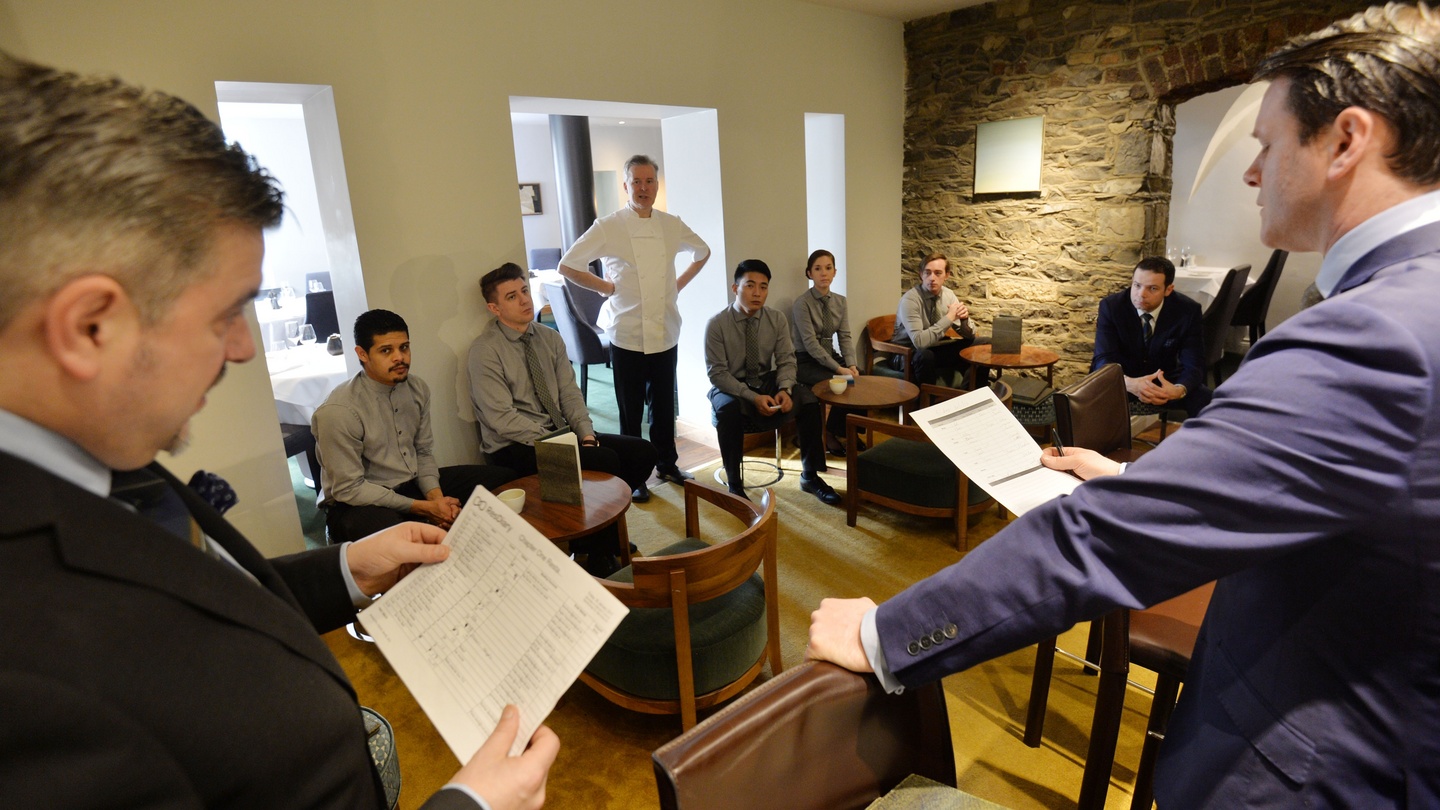
The tablecloths have been pressed, the sauces tasted and the first guests are half an hour away. In a small room at Chapter One in Dublin, restaurant manager Darren Campbell and general manager Danny Desmond hold printed sheets while the front-of-house team sits around them. Chef Ross Lewis stands at the back in white. The room is ready for lunch but briefly belongs only to the people who will run it.[6]
That circle is fine dining's least decorative piece of mise en place. Call it lineup, pre-shift, briefing or huddle: it is the short interval in which a reservation book, a changing menu and a roster of individuals have to become one shared version of tonight. The meeting works not because it contains every service rule, but because it identifies what is different this time.
An excellent briefing is therefore closer to an exception map than a pep talk. It marks the table with a serious allergy, the fish that arrived in smaller quantity than expected, the new wine by the glass, the server covering an unfamiliar section, the couple who asked for a quick departure and the eight-top whose first guests may appear one by one. When the doors open, those facts stop being notes and start becoming timing.
The manual stays still; tonight does not
The Culinary Institute of America's sample day for a restaurant manager places a pre-shift meeting immediately before opening. Its agenda is compact: reservations, expected covers, VIPs, specials, procedure changes and service guidance.[1] The clock in that example—3:30 p.m. briefing, 4 p.m. service—is illustrative rather than universal. The important part is the order. Long-term standards should already have been trained. The briefing is for conditions that will expire with the shift.
The National Restaurant Association's ManageFirst training text gives the meeting a more explicitly fine-dining shape: scheduled staff gather; the maître d' reviews the previous service, reservations, special guests and requests; the chef explains ingredients and promoted dishes; and the floor has a chance to ask questions.[2] The sequence moves from what happened, to what is expected, to what still needs clarification. It does not confuse being brief with being one-way.
This distinction protects the meeting from becoming a recitation. There is little value in reminding a polished team to be hospitable in the abstract. There is great value in saying that the six-top at 7:15 has become a seven, that one chair must preserve a clear route to the door, that the turbot yields only nine portions, and that the new server will shadow the first tables in the north section. Each fact changes somebody's next move.
The cover count alone is not enough. Fifty guests arriving evenly are a different service from fifty guests arriving in two waves. A room with four open tables at eight o'clock may still be under more pressure than a full room at seven if those later tables share a tasting-menu rhythm. The briefing turns a number into a shape: arrivals, sections, course lanes, handoffs and places where help will be needed before anyone has to ask for it.
A reservation note has to cross the room
The Irish Times' day inside Chapter One shows how much transformation can occur between booking and table. Restaurant manager Darren Campbell described reservation notes that might identify a birthday, anniversary or type of occasion; the order system carried each diner's table position so plates could arrive without a server asking who had ordered the fish. At noon, the team reviewed the menu, wine list, reservation count and notable guests together.[6]
The useful word is not personalization. It is handoff. A note that remains inside reservation software cannot protect a guest or make an evening warmer. A note broadcast without judgment can become gossip. The briefing is where the team decides who actually needs the information and what action follows from it.
A birthday might require nothing more than course timing and a discreet candle. A promised early finish changes when the table is greeted, when the order reaches the kitchen and whether the sommelier can afford a long detour through the cellar. A returning guest's old bottle preference is an invitation to ask a better question, not permission to perform memory at them. Good service makes recognition feel voluntary. The briefing should give the team enough context to respond, not enough biography to make the guest feel studied.
This is also why status should be handled carefully. A critic, owner or celebrity may change who watches a table, but a lineup that turns one guest into a spectacle steals attention from the rest of the room. The practical information is the same kind every table deserves: pace, needs, promises and any exception the restaurant has agreed to honor.
Taste gives the room a common language
Information about a dish becomes brittle when it arrives as a sentence to memorize. A server can recite that an olive oil is peppery or a fish is cooked over coals without knowing where either quality appears in the mouth. Pre-service tasting closes that gap.
Chef Tomos Parry describes the daily briefings at Brat, Mountain and Brat x Climpson's Arch as whole-team tastings shaped by what came from fishermen and farmers that morning. The kitchen may compare a lean fish cooked quickly on the plancha with a fattier fish cooked slowly over coals; the wine team chooses a bottle in advance; different team members can present a dish and discuss how that day's service should be managed.[3] In one briefing, four olive oils become four finishing decisions rather than four labels: buttery for vegetables, peppery for beef, citrus-led for raw seafood, rounded for ice cream.[3]
At Chapter One, sauces, purées, vinaigrettes and garnishes were lined up on the pass at 11:45 a.m. for a final kitchen tasting; fifteen minutes later, the menu and wine list were being carried into the staff briefing.[6] None of this requires a theatrical seminar every afternoon. One spoonful can be enough if it answers the questions the dining room will face. What is the ingredient? What changed? What should the guest notice? What modification is possible, and which change would break the dish?
The tasting also lets language be corrected before it reaches a table. If the sauce is sharp rather than merely “bright,” say so. If the wine's tannin is gentler with the food than on its own, let the staff experience the difference. Shared vocabulary does not mean every server must deliver the same speech. It means the kitchen and dining room are describing the same object.
Allergy information is not a flourish
The most consequential line in briefing may be the least glamorous. Allergy information has to travel from guest to reservation, from reservation to the dining room, from the dining room to the kitchen, and back to the person who presents the plate. Every handoff is a place where vagueness can become danger.
Food Standards Agency research on allergen communication makes the systems boundary explicit. Menus, labels and matrices are not a silver bullet; safe service also depends on staff having the knowledge and time to communicate, restaurants maintaining allergen-management processes, and verbal information remaining clear, accurate, comprehensive and consistent.[4] The U.S. Centers for Disease Control and Prevention reaches the same problem from restaurant-practice studies. Its current summary recommends training, accessible ingredient lists or recipes, and a defined plan for serving guests with allergies; staff working in restaurants with such a plan knew more about allergies.[5]
The scale of the gap matters. CDC reports that more than half of the staff interviewed in its underlying studies had never received food-allergy training, while one in three people with food allergies reported having experienced a reaction in a restaurant.[5] A fine-dining room's polish does not exempt it from that ordinary risk.
But the briefing cannot become the entire safety system. A manager reading “nut allergy at table four” aloud is not a substitute for a current ingredient matrix, cross-contact procedure, trained decision-maker or clear plate identification. The meeting should confirm tonight's exception, the safe route and the person authorized to answer. It should never ask a server to improvise certainty because the room is about to open.
There is an equally important language boundary between allergy, intolerance, preference and dislike. A guest should not need to exaggerate a preference to be heard, and a kitchen should not flatten a dangerous allergy into the same operational category as an omitted garnish. Clarifying that distinction before service protects both hospitality and attention.
The circle should expose pressure, not conceal it
A weak briefing can produce the appearance of control while transferring every hard problem into service. “We are short a runner, so help each other” is not yet a plan. Which sections lose a dedicated hand? Who carries the first synchronized course? Who watches the door while the host resets a table? At what point does the manager slow seating rather than demand invisible labor?
The meeting is useful when it names those decisions while there is still room to disagree. It is harmful when it becomes a ritual of managerial confidence that junior staff are expected to applaud. Parry's most important observation is not about fish or wine; it is that the briefing should be a place where the whole team can ask questions and contribute without judgment.[3] If nobody ever asks one, the room may be perfectly prepared—or the hierarchy may have made uncertainty too expensive to admit.
Some subjects do not belong in the circle. A performance review, a conflict between colleagues, a new policy that needs real discussion, or criticism intended for one person should not be staged in front of the shift. The briefing is short because its job is narrow. It synchronizes work that is about to happen. It cannot repair chronic understaffing, replace training or turn an unsafe culture kind through daily encouragement.
Its best ending is not a slogan. It is a quick return path: questions answered, ownership named, one last correction sent to the menu or floor plan, then everyone back to station. The team disperses with less information than exists in the restaurant, but with the right information in motion.
Look again at Alan Betson's photograph from Chapter One. The room is visually finished, yet the people inside it are still comparing what they know.[6] That is the hidden order of hospitality. The dining room opens twice: first to the team, while uncertainty can still be spoken plainly; then to the guest, when all that preparation should feel like ease.
Sources
- The Culinary Institute of America, “What Do Restaurant Managers Do?” — restaurant-management overview whose sample day places reservations, covers, VIPs, specials and procedure changes in the pre-shift briefing before service.
- National Restaurant Association, ManageFirst: Customer Service, chapter 6 sample — fine-dining pre-shift example covering attendance, the previous service, reservations, special requests, promoted dishes, ingredient explanations, expectations and staff questions.
- Tomos Parry, “Our Daily Team Briefing & Tastings at Brat, Mountain and Brat x Climpson's Arch,” March 7, 2025 — chef's firsthand account of whole-team dish and wine tastings, rotating presenters, service discussion and question-friendly briefings.
- Basis Social, “Improving Allergen Communication in SME Food Businesses in Out-Of-Home Settings,” Food Standards Agency Research and Evidence, 2024 — evidence review and user testing on written information, staff capability, operational processes and clear, accurate verbal communication.
- U.S. Centers for Disease Control and Prevention, “Food Allergy Reactions,” May 7, 2024 — plain-language synthesis of EHS-Net studies on restaurant allergy training, ingredient information, response plans, knowledge gaps and reported reactions.
- Marie Claire Digby, “The secret life of a Michelin-starred restaurant,” The Irish Times, February 25, 2017 — daylong report from Chapter One covering its noon menu, wine, reservation and VIP briefing, with Alan Betson's real daily-briefing photograph used as the article image.