Le Louis XV is easy to misread because the room is so famous. Place du Casino, the Hotel de Paris, Alain Ducasse, three Michelin stars, and the Monaco gloss can all blur into one gold-leaf postcard before the first plate arrives.
That postcard is not the restaurant's most interesting argument in 2026. The stronger reading is that Le Louis XV - Alain Ducasse a l'Hotel de Paris remains useful because it treats the Riviera as a working system rather than a mood board. Ducasse Paris describes the address as a fully renovated table inspired by the French Riviera, while Monte-Carlo SBM's current chef page says Emmanuel Pilon has led the kitchen since May 2022, bringing curiosity, respect for ingredients, and a Mediterranean field of attention to one of the resort's key restaurants.[1][2] The continuity matters. This is not a palace trying to freeze old grandeur. It is a palace restaurant trying to keep a regional grammar alive under a new chef's hand.
The current evidence supports that reading. Monte-Carlo SBM's gourmet lunch page names a four-dish Riviera route built from San Remo prawns, rockfish gelee, caviar, farm carrots with elderberry wine, smoked goat cheese, Mediterranean bass over wood fire, tomato, and sea cucumber "al pil pil."[3] Michelin's current listing keeps Le Louis XV at three stars and ties its historical prestige to an astonishing early standard under Ducasse.[4] Ducasse Paris' own chronology gives the deeper baseline: Ducasse took over the Louis XV in 1987, and the restaurant earned three Michelin stars three years later.[5] That combination creates the real profile. Le Louis XV is neither a new discovery nor a museum piece. It is a long-running Riviera machine that keeps asking how much lightness, product clarity, and ceremony can still do.
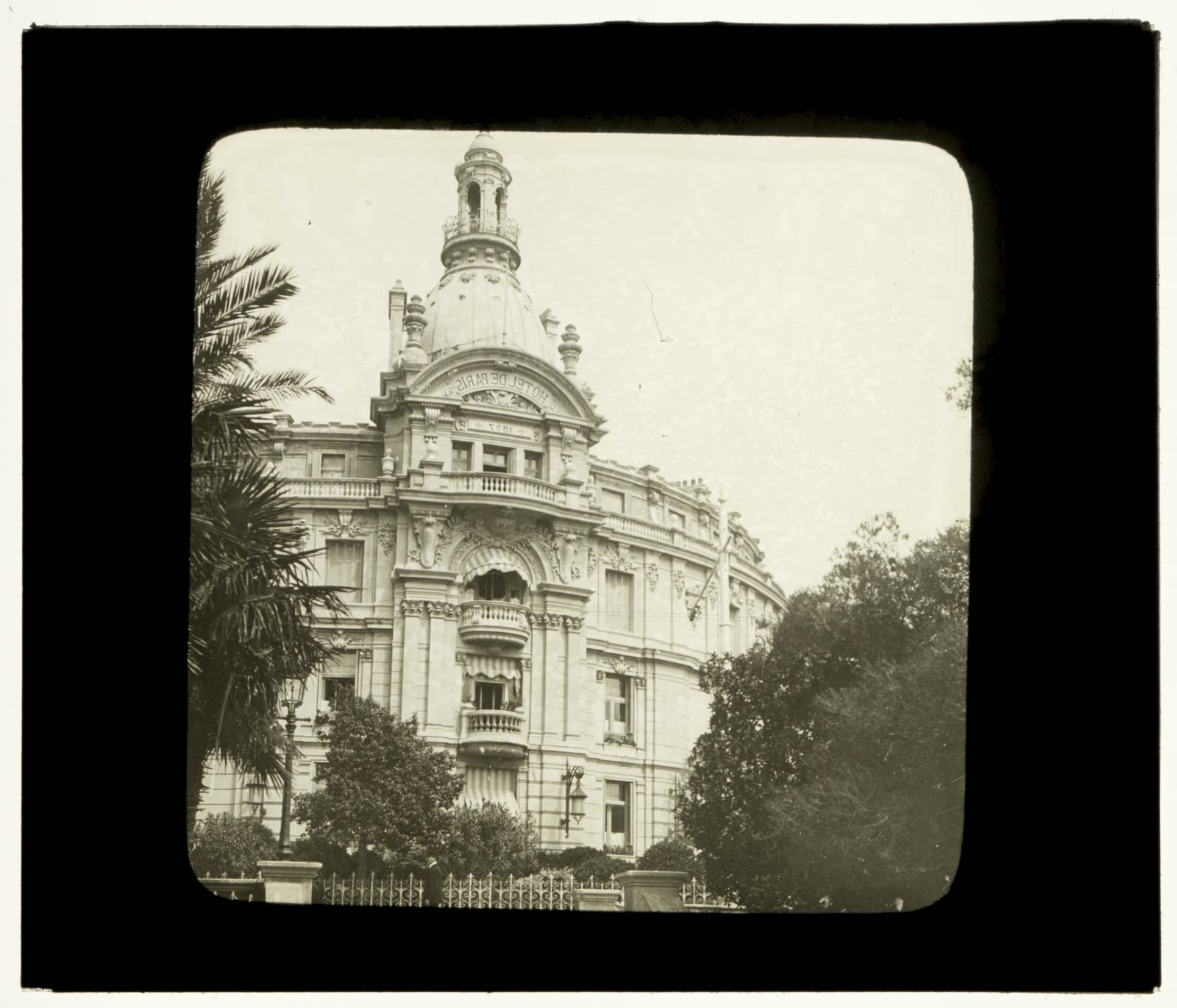
Image context: the cover image is a real archival photograph by Eugene Trutat, dated between 1859 and 1910, showing the Hotel de Paris before contemporary luxury learned to market itself through restraint. It is useful here because the article is about continuity: Le Louis XV's food now has to speak inside a building whose symbolic weight arrived long before modern tasting-menu culture.[6]
The palace is the constraint, not only the backdrop
The Hotel de Paris gives Le Louis XV a problem most restaurants would envy and many would mishandle. A dining room this loaded with history can make food feel secondary. The guest walks in already expecting theatre, hierarchy, and the kind of service language that announces expense before flavor. If the kitchen simply amplifies that setting, the meal risks becoming an expensive reenactment.
Le Louis XV's better move is to let the palace remain visible while refusing to cook like a sealed palace. The public language around the restaurant keeps returning to the Riviera: the address page calls the experience Riviera-inspired, the Monte-Carlo inspiration article describes seasonal cooking that sings of regional and back-country producers, and the chef page frames Pilon's work around the many facets of the Mediterranean.[1][2] Those sources are not saying the room has become rustic. They are saying that the grandeur has to be ventilated by product and climate.
That is why the terrace and Place du Casino matter. Monte-Carlo SBM describes the restaurant as having an elegant terrace looking onto the square, and the gourmet lunch page sells the Riviera through color, fish, vegetables, service, and wine rather than through monumentality alone.[3] In practical terms, the palace becomes a frame for sun, market, cellar, and water. The room can stay formal because the food keeps pulling it back toward the coast.
This balance is the reason Le Louis XV remains more interesting than a generic old-master address. Its luxury is inherited, but its cooking cannot rely only on inheritance. The restaurant has to make ceremony feel aerated course by course.
Emmanuel Pilon gives continuity a younger pulse
The chef transition is the clearest reason to revisit the restaurant now. Monte-Carlo SBM says Pilon has been leading Le Louis XV's kitchen since May 2022 and presents him as a chef whose curiosity and openness are central to the current table.[2] The 2022 Ducasse/Monte-Carlo press release gives the handoff more texture: Pilon entered Maison Ducasse in 2009 at Le Louis XV, later spent eight years in Paris beside Romain Meder at Alain Ducasse au Plaza Athenee, worked through the "naturalite" project, and returned to enrich the Louis XV's Mediterranean proposition.[2][5]
That background matters because it avoids a crude succession story. Pilon is not presented as an outsider brought in to modernize a tired landmark, and he is not framed as a custodian who merely repeats the archive. His biography makes him both local to the house and marked by the post-Plaza Athenee Ducasse vocabulary of vegetables, lightness, and naturality.[5] He can therefore adjust the restaurant from inside its own grammar.
The current lunch examples make that adjustment legible. San Remo prawns and Mediterranean bass could sit inside a conventional luxury seafood script; elderberry wine with carrots, smoked goat cheese from the Monteiro family, sea cucumber in a pil pil register, and rockfish gelee make the route more specific.[3] The ingredients still carry prestige, but they are being organized through brightness, texture, and Riviera adjacency rather than through heaviness.
That is the useful thing about Pilon's current role. At a younger, more anxious restaurant, Mediterranean lightness can sound like branding. At Le Louis XV, it reads as a way to keep the palace from hardening.
The cellar and service keep the food from becoming casual
Lightness does not mean informality here. The restaurant's public materials keep returning to service and wine with almost choreographic language. Monte-Carlo SBM says the Riviera lunch is delivered with deftly orchestrated, ballet-like service, and the inspiration article describes attention to the customer as a subtle, exacting art while pointing to the cellar as one of the setting's guarded treasures.[2][3]
This is where Le Louis XV's old-world machinery still matters. A restaurant can cook with vegetables, fish, herbs, and acid and still lose force if the room behaves too lightly around it. Le Louis XV has the opposite advantage: the service architecture supplies gravity, then the food supplies lift. The guest is not being asked to confuse simplicity with casualness. The meal can be stripped of heaviness without being stripped of occasion.
The wine program sharpens that distinction. The 2022 transition placed Maxime Pastor in the head sommelier role, and the current gourmet lunch page explicitly frames the meal around wines selected by the sommelier team.[3][5] That matters because Mediterranean cooking at this level depends on tension: citrus, shellfish, tomato, olive oil, smoke, herbs, and garden vegetables need a cellar that can support delicacy without flattening it. The dining room's seriousness gives those quieter flavors enough stage.
This is also why the restaurant can survive its own reputation. The stars and the palace draw attention, but the operating question is smaller and harder: can a room trained for ceremony still make freshness feel alive? The best current evidence suggests Le Louis XV knows that this is the job.[2][3][4]
Why the restaurant still has a role in 2026
Fine dining in 2026 has plenty of louder tools. Restaurants can build immersive rooms, laboratory menus, radical foraging narratives, social-media plate reveals, and compressed counter formats. Le Louis XV does almost the opposite. It argues that a palace restaurant can still matter if it keeps the product line clean, the service exact, and the regional premise active.
That premise has to be defended because prestige restaurants age in public. The danger is not that Le Louis XV lacks history; the danger is that history can become the main course. Ducasse's 1987 takeover, the three-star breakthrough three years later, and the continuing Michelin status form an imposing archive.[4][5] But the archive only helps if it keeps pressure on the present. Pilon's tenure, the Riviera lunch structure, and the ongoing emphasis on Mediterranean produce are the mechanisms that keep that pressure alive.[2][3][5]
The best way to read Le Louis XV now is therefore neither as a bucket-list trophy nor as a nostalgic Ducasse shrine. It is a restaurant about controlled renewal. The setting supplies weight, the Riviera supplies air, the cellar supplies depth, and Pilon's kitchen has to keep all of that moving in the same direction.
For a diner, that means the restaurant is best suited to a specific appetite. If the goal is shock, category refusal, or a room that feels stripped down to the chef's counter, Monaco will feel too polished. But if the goal is to see how an old palace can still produce living Mediterranean luxury without pretending to be new, Le Louis XV remains a serious address. Its most persuasive luxury is not excess. It is continuity that still has circulation.[1][2][3][4][5]
Sources
- Ducasse Paris, "Le Louis XV - Alain Ducasse a l'Hotel de Paris," official address page describing the renovated Riviera-inspired restaurant and Monaco address.
- Monte-Carlo SBM, "Chef Emmanuel Pilon in Monaco," official chef page covering Pilon's May 2022 leadership and current Mediterranean direction.
- Monte-Carlo SBM, "Gourmet Lunches & Dinners at Le Louis XV - Alain Ducasse," current dining offer page describing the Riviera menu route, dish examples, and sommelier framing.
- MICHELIN Guide, "Le Louis XV - Alain Ducasse a l'Hotel de Paris," current Monaco listing for the three-star restaurant.
- Ducasse Paris, "Our story," chronology noting Ducasse's 1987 takeover of Louis XV and the restaurant's three-star recognition three years later.
- Wikimedia Commons, "Hotel de Paris, Monte-Carlo - btv1b10578496w.jpg," archival Eugene Trutat photograph of the Hotel de Paris, dated between 1859 and 1910.