
Thomas Keller's 2009 Talks at Google appearance is not a kitchen tour in the usual food-media sense. There is no fast montage of tweezers, no luxury-table glamour, and no attempt to make The French Laundry look mysterious by hiding how it works. The video is useful for a better reason: Keller speaks about craft as a system of behavior. When he talks about repetition, standards, mentorship, or the way a restaurant grows around one flagship address, the subject is not nostalgia. It is the daily machinery that lets a small dining room in Yountville keep behaving like an important restaurant after the headlines have settled.[1]
That makes the talk especially good for an annotated viewing. The French Laundry has plenty of public mythology: three Michelin stars, the salmon cornet, the garden across Washington Street, the famous old building, and Keller's role as a mentor to American fine dining. The more interesting question is how a restaurant keeps those symbols from turning brittle. MICHELIN still describes the restaurant as a three-star destination and singles out its carefully determined kitchen space, fresh ingredients, and classic French technique in a California setting.[3] The World's 50 Best, writing from its Best of the Best archive, frames Keller as an American culinary mentor and emphasizes the restaurant's three-acre garden, renovation, touchstone dishes, and long consistency.[4] The video gives those claims a human operating grammar.
Watch the conversation as a quiet answer to a loud fine-dining problem. Luxury restaurants often sell rarity: rare ingredients, rare seats, rare access. Keller's deeper argument is that rarity only survives if ordinary actions are repeatable. A commis cuts the same way each day. A service team learns when to appear and when to disappear. A chef de partie checks the same station until the check becomes instinct. A restaurant group expands only if the original standard becomes teachable, not merely charismatic.[1][2]
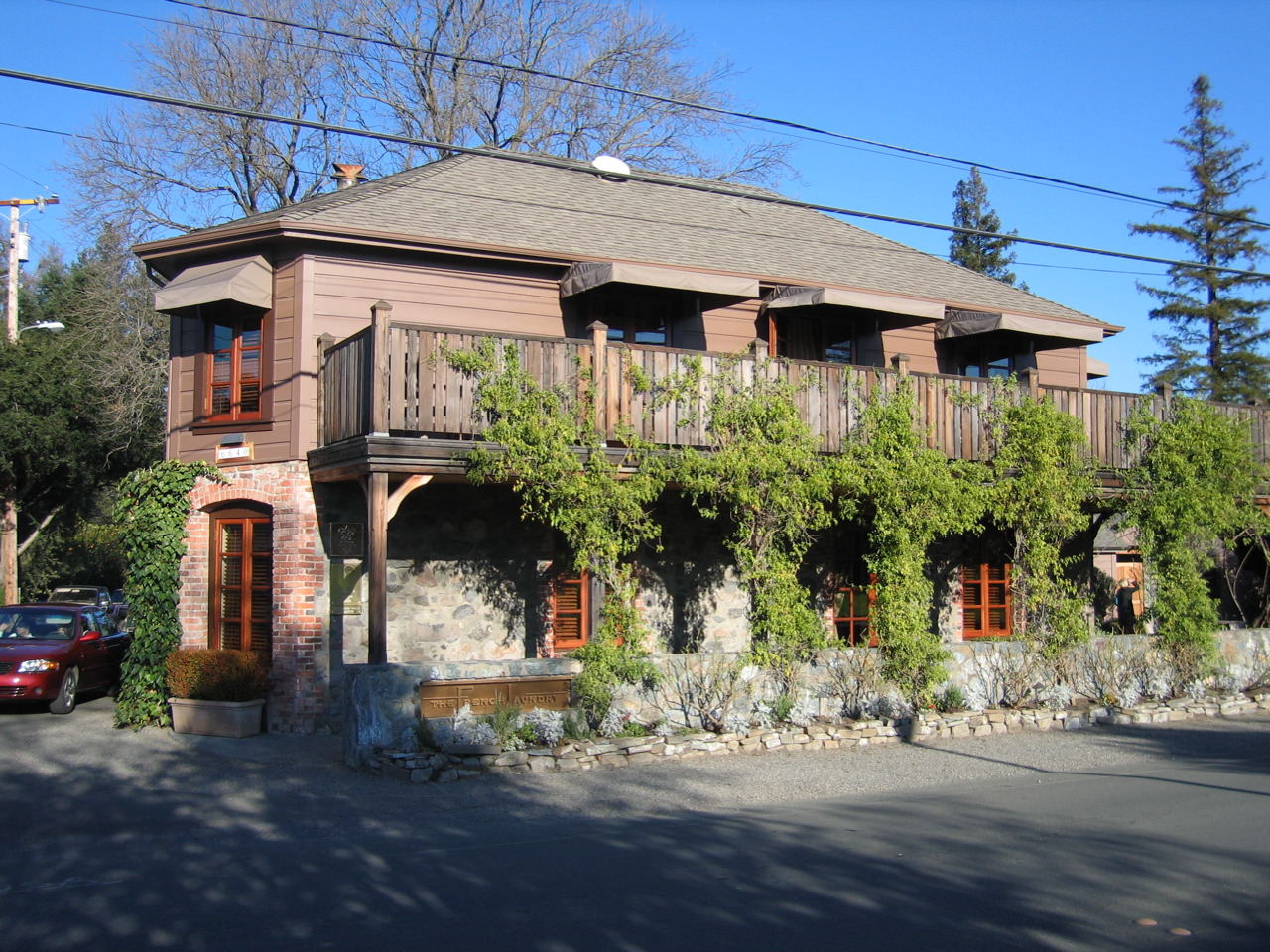
Image context: the cover uses a real 2005 photograph of The French Laundry's Yountville exterior by Peter Merholz, hosted by Wikimedia Commons.[5] The image matters because the article is about an institution with a physical clock: an old stone building, a street, a garden nearby, and a dining room whose reputation depends on repeating careful work inside a recognizable place.
The talk begins with biography, but the real subject is formation
The opening stretch gives the expected career frame: Keller as the chef associated with The French Laundry, Per Se, Bouchon, and a broader restaurant group.[1][2] The temptation is to treat that biography as a ladder. Keller worked, failed, found the right place, then built prestige. The better reading is formation. The talk keeps circling how cooks become the kind of people who can repeat excellent work when nobody is applauding the tenth repetition.
That point matters because The French Laundry is small enough to feel personal and famous enough to feel symbolic. The official Thomas Keller Restaurant Group site presents the restaurant through its Yountville identity and routes readers into history, reservations, private dining, and the culinary garden rather than presenting it as a detachable brand.[2] The restaurant's public shape is local before it is global: a Napa Valley address, a building, a garden, and a reservation system. Keller's video language fits that shape. He talks less like someone selling novelty and more like someone protecting a house style from drift.
Around the early career portions, listen for how often Keller turns prestige back into apprenticeship. The point is not that every cook needs the same path. The point is that fine dining transmits itself through modeled standards. Young cooks learn speed, economy, cleanliness, restraint, and urgency partly through recipes, but mostly through rooms where those values are enforced every day.[1] If the famous restaurant is only a trophy, it goes dead. If it is a training environment, its reputation can keep moving through people.
Repetition is the opposite of stasis
One of the video's most useful ideas is that repetition does not flatten a restaurant. It sharpens it. Keller's public reputation often attaches to fixed icons: the salmon tartare cornet, "Oysters and Pearls," white linens, pressed service, and the French-Californian balance that made The French Laundry feel both classic and American.[3][4] Those icons can look conservative from outside. Inside the operating logic, they are calibration tools.
MICHELIN's current page points to the restaurant's kitchen space as part of the achievement, describing a cooking environment where counter height and ceiling lines are carefully determined.[3] That detail is more revealing than a generic compliment. A serious kitchen is a body machine. The height of a counter changes posture. The line of a pass changes communication. Storage, refrigeration, pickup routes, sight lines, and station boundaries decide whether service feels graceful or strained. Keller's talk gives the human half of that architecture: repetition as a way to make the room's intentions enter the cook's hands.[1]
This is why the phrase "sense of urgency," often associated with Keller's kitchens, should not be reduced to speed. Urgency without discipline produces fluster. Discipline without urgency produces museum food. The French Laundry's best public case is that it has made urgency quiet. A diner should feel calm precisely because dozens of small pressures have already been absorbed backstage: timing, station readiness, ingredient condition, plate temperature, wine pacing, guest notes, and the choreography of courses.[1][3]
The garden keeps luxury accountable
The most important external fact in the restaurant's modern story may be across the street. The World's 50 Best notes that Keller expanded the modest kitchen garden into a three-acre smallholding; MICHELIN's sustainability section quotes Keller saying much of the restaurant's produce comes from the three-acre Culinary Garden across Washington Street.[3][4] In a lesser restaurant, "garden" can become decoration. At The French Laundry, it is a restraint on abstraction.
Garden proximity changes the meaning of fine dining because it makes seasonality visible as labor. Someone has to plan the beds, harvest at the correct moment, receive the produce, adjust the menu, and keep the dining room's language honest about what is actually coming from the ground.[3][4] The video does not need to linger on a lettuce leaf to make this point. Keller's talk about standards and formation gives the garden a management frame. The garden is not a romantic escape from the kitchen. It is another station in the same system.
That also explains why The French Laundry can be both deeply formal and locally grounded. French technique gives the restaurant grammar: stocks, sauces, butchery, refinement, sequence. Napa gives it weather, produce, wine context, and a reason for guests to travel with appetite already tuned to place.[3][4] Keller's operating discipline sits between those forces. The restaurant has to prevent French classicism from becoming imported ceremony, and it has to prevent California seasonality from becoming casual abundance. Repetition is the bridge.
Expansion only works when the original can teach
The talk becomes most interesting when Keller discusses growth beyond one address.[1] Fine-dining expansion is always risky because the original restaurant's aura can be easier to export than its habits. A name travels faster than a standard. A recipe travels faster than judgment. A dining room image travels faster than the thousands of corrections that made the image possible.
The French Laundry's public afterlife is unusually large because Keller's restaurants and alumni helped shape American luxury dining far beyond Yountville.[4] The useful lesson from the video is that mentorship is not a sentimental add-on to that influence. It is the operating core. If a restaurant wants to matter beyond one room, it has to turn private excellence into teachable behavior. That means vocabulary, correction, repetition, and a shared sense of what counts as finished.
This is also the boundary for diners reading the restaurant in 2026. The French Laundry is not the newest format, the loudest room, or the most radical tasting menu. Its interest lies in a different kind of contemporary relevance: the pressure to maintain standards after a restaurant has become canonical. The harder task is not winning attention once. It is keeping the work alive when everyone arrives with an idea of what the restaurant already means.
What the video leaves on the table
The best reason to watch Keller's Talks at Google conversation is that it makes The French Laundry less marbleized. The restaurant becomes a daily practice rather than a shrine: people learning, repeating, correcting, teaching, and entering the same building again tomorrow with the same seriousness.[1][2] The written sources then supply the hard frame around that practice: the Yountville address, MICHELIN's three-star listing, the garden across the street, the carefully built kitchen, the 50 Best hall-of-fame status, and the long American influence.[2][3][4]
That combination is more interesting than a simple celebration. The French Laundry endures because it treats luxury as disciplined recurrence. The old building gives the restaurant a face. The garden gives it a seasonal conscience. The kitchen gives it a physical system. Keller's talk gives it a vocabulary of formation. Together, they show why a serious restaurant is never only the best dish it served once. It is the culture that can make tomorrow's version worth trusting.
Sources
- Talks at Google, "The French Laundry | Thomas Keller," YouTube video.
- Thomas Keller Restaurant Group, "The French Laundry" official site, including Yountville restaurant context, history navigation, reservations, and Culinary Garden links.
- MICHELIN Guide, "The French Laundry - Yountville," current guide listing, restaurant description, and sustainability note.
- The World's 50 Best Restaurants, "Best of the Best | The French Laundry," restaurant profile, Keller influence, garden context, and hall-of-fame framing.
- Wikimedia Commons, "File:The French Laundry.jpg," Peter Merholz photograph of the restaurant exterior, 2005.