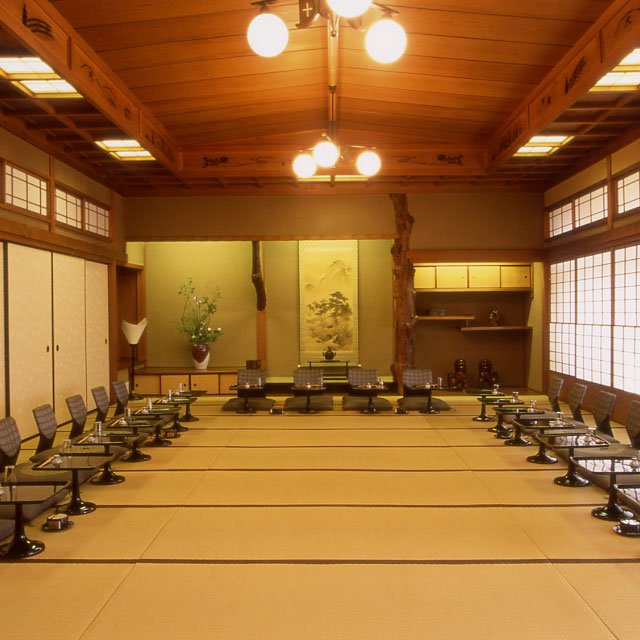
The most revealing image of Kikunoi Honten is not a plate.
It is a room: tatami stretched cleanly across the floor, low black tables placed with enough air between them, shoji light at the edges, a painted hanging scroll in the alcove, flowers held in a single vertical accent, and cushions waiting with the stillness of a stage before the actors enter.[1] That room explains the restaurant better than any isolated course can. Kikunoi's luxury is not built only from rare ingredients or Kyoto prestige. It is built from a system that makes the guest feel time passing with unusual clarity.
As of April 22, 2026, Kikunoi's public English site presents the Honten as a three-star Michelin Kyoto restaurant open for a narrow lunch window from 12:00 to 12:30 and dinner last-order window from 17:00 to 19:30, with reservations routed through My Concierge and TABLEALL.[1] TABLEALL's current Kikunoi page lists course prices from ¥47,500 to ¥139,500, including its booking fee, and describes ten private rooms ranging from two-person rooms to large spaces for about fifty guests.[2] Those numbers are not incidental. They describe an operation built around compression: few arrival bands, carefully assigned rooms, and an environment that can make one seasonal story feel complete before the next party's story begins.
Image context: the cover image is a real official photograph of a Kikunoi Honten dining room. It is the right visual anchor because the article is about service architecture rather than a single dish: the room, table spacing, tatami, alcove, and tableware are part of the meal's timing mechanism.[1]
The room is the first course
At a contemporary counter restaurant, attention usually begins with the chef's hands. At Kikunoi, the room gets there first.
TABLEALL's account of the Honten describes the guest passing plants, art, seasonal motifs, hanging scrolls, and private rooms before the food becomes the center of attention.[2] It also notes the garden views, the raked sand garden designed like waves, and the mix of tatami rooms with some sunken hori-kotatsu seating.[2] This matters because the restaurant's service system starts by slowing the diner down. Shoes come off. The floor changes texture. The garden enters the field of view. The guest is not simply seated; the guest is converted from city pace into room pace.
That conversion is a form of hospitality technology. Kikunoi does not need the room to shout. It needs the room to reset the diner's clock. Once the guest is inside, the meal can ask for a different kind of attention: slower looking, quieter listening, and a willingness to read plate, vessel, flower, scroll, and garden as one composition.
This is why the ryotei format still has power even for diners fluent in global tasting-menu grammar. A tasting menu can easily become a runway of dishes. The Kikunoi room resists that. It says: the meal is not moving only forward, course by course. It is also moving outward, into the season, the art objects, the view, and the behavior expected of the guest.
The season is managed, not merely described
Fine dining loves the word "seasonal." Kikunoi makes seasonality look operational.
The public descriptions are unusually concrete. TABLEALL writes that Murata and his wife select new pieces each month and each season, including flowers arranged by the proprietress, and that tableware is rotated so the vessels match the setting and cuisine.[2] It describes a collection that includes antique Baccarat and about fifty Rosanjin pieces, with some tableware occupying two whole rooms.[2] The point is not collector's vanity. The point is inventory discipline: the seasonal argument of a kaiseki meal has to be supported by physical objects that appear at the right time and disappear before they turn generic.
UNESCO's washoku entry frames the tradition around respect for nature, fresh ingredients, nutritional balance, presentation that expresses natural beauty and seasonal transition, and links to annual events.[4] Kikunoi's public room and tableware descriptions make the same idea spatial: vessels, flowers, scrolls, garden views, and guest placement all become part of the seasonal composition.[1][2] The service system turns that cultural language into daily mise en place. The kitchen is only one department of seasonality. The room is another.
That is why the room photograph matters. If the food were moved to a neutral hotel table, part of the meaning would leak away. In Kikunoi's grammar, the scroll does not decorate the meal from outside. The vessel is not a container after the "real" cooking has happened. The garden is not a view added for atmosphere. Each element helps the diner understand what kind of time the course is trying to enter.
Murata's innovation is institutional
Yoshihiro Murata is often discussed as a chef of continuity, which is true but incomplete.
Kikunoi's official biography says Murata was born in 1951, opened what became Roan Kikunoi after returning from training, took charge of the main restaurant in 1993 as the family's third-generation head chef, and later opened Akasaka Kikunoi in 2004 and Salon de Muge in 2017.[1] Tokyo Updates adds the formative Paris story: as a student, Murata encountered a French peer who dismissed Japanese cuisine as heavy on carbohydrates and nutritionally thin; Murata answered by pointing to kaiseki, then made it his life work to show Japanese cuisine's depth abroad.[3]
That backstory helps explain why Kikunoi's operations feel both conservative and outward-facing. Murata did not preserve Kyoto cuisine by hiding it. He built channels for transmission. The Kikunoi site credits him as a major contributor to washoku's UNESCO recognition and notes his work with the Japanese Culinary Academy, testing and evaluation systems, foreign chefs in the kitchen, and staff able to serve in English and Chinese.[1] Tokyo Updates records that he launched the Japanese Culinary Academy in 2004 as an NPO dedicated to Japanese and Kyoto cuisine's future.[3] The academy's own English overview says it was established in 2004 to promote global understanding of Japanese cuisine and contribute to the next generation of Japanese food chefs, with Murata listed as honorary director.[5]
This makes Kikunoi more interesting than a preserved old house. It is a headquarters. The private rooms protect the old ryotei mood; the training and certification work push the cuisine outward.[5] The restaurant's luxury therefore sits in a productive tension: intimacy at the table, institutional scale behind the scenes.
What the money buys
The value question at Kikunoi is easy to flatten into star chasing. That misses the more useful question: what exactly is being purchased when the meal climbs from a serious dinner into a rarefied Kyoto experience?
On the visible level, the guest buys food, service, room, tableware, and access to a famous address near Maruyama Park and Yasaka Shrine.[1][2] On the operational level, the guest buys coordination. Short arrival windows reduce drift. Private rooms let the restaurant control temperature, pacing, privacy, and speech level more precisely than a single open dining room. Seasonal tableware and flowers mean the house has to maintain storage, care, selection, and daily installation routines. Multilingual service and overseas trainees mean tradition is being translated in real time without being reduced to a museum label.[1][2]
The highest version of this meal is not just "beautiful Japanese food." It is a full-stack system for making seasonality feel inhabited. The guest sits in a room that has already been tuned before arrival. The courses then enter a space prepared to receive them. If a spring shoot, autumn mushroom, winter crab, or New Year gesture appears, it is not alone. It arrives with the room, vessel, timing, and guest behavior already pointing in the same direction.
That is also the trap for visitors. Kikunoi is not the best choice for someone who wants constant novelty, loud kitchen theatre, or a chef-counter conversation every three minutes. It asks the diner to enjoy repetition with variation: the way a room changes by month, the way vessels alter the temperature of a dish, the way quiet service can carry authority without spectacle. For the right diner, that restraint is the thrill.
The old form stays alive by moving
The most persuasive thing about Kikunoi in 2026 is that its traditionalism is not frozen.
Murata's own public language, as reported by Tokyo Updates, is explicit that tradition survives by identifying what has changed and what has not, then continuing to innovate.[3] That is a useful way to read the Honten. The tatami room, scroll, tableware, and kaiseki sequence keep Kyoto's old grammar legible. The booking channels, multilingual service, overseas cooks, academy work, and global UNESCO framing keep that grammar in circulation.[1][3][5]
Many restaurants talk about storytelling. Kikunoi makes storytelling logistical. A guest does not merely hear that a course has a season. The guest enters a room that has been made seasonal in advance. The service does not merely explain tradition. It lets tradition govern arrival times, shoes, seating, vessels, floral choices, and the silence between courses. That is why the room is the right first image. It shows the restaurant before the food appears, already cooking with time.
Sources
- Kikunoi official English site, including Honten hours, address, Michelin 2024 listing, official room photography, Yoshihiro Murata biography, and company background.
- TABLEALL, "Kikunoi Honten," including current reservation windows, course prices, private-room description, seasonal room/tableware notes, and guest logistics.
- Tokyo Updates, "A Renowned Chef on the Excellence of Japanese Cuisine, a UNESCO Intangible Cultural Heritage" (May 16, 2025), interview with Yoshihiro Murata.
- UNESCO Intangible Cultural Heritage, "Washoku, traditional dietary cultures of the Japanese, notably for the celebration of New Year."
- The Japanese Culinary Academy official English overview, including 2004 establishment, mission, programs, and Yoshihiro Murata as honorary director.