The easiest way to flatten LEO is to call it a biodiversity restaurant and stop there.
That description is true, but it leaves out the more important mechanism. What separates LEO in 2026 is that Colombian biodiversity is carried through the glass as deliberately as it is carried on the plate. The restaurant's current tasting structure offers five-, eight-, and twelve-course menus, and each one can be read through three different liquid paths: no pairing, a botanical non-alcoholic pairing, or a Territorio pairing with alcohol.[1] Once you notice that architecture, LEO stops looking like a chef's tasting menu with drinks attached at the end. It reads as a two-lane sensory system.
That is why the beverage story matters more than a conventional sommelier note. Leonor Espinosa's food gives the restaurant its territorial ambition, but Laura Hernandez Espinosa gives that ambition tempo, contrast, and aftertaste.[1][3][4][5]
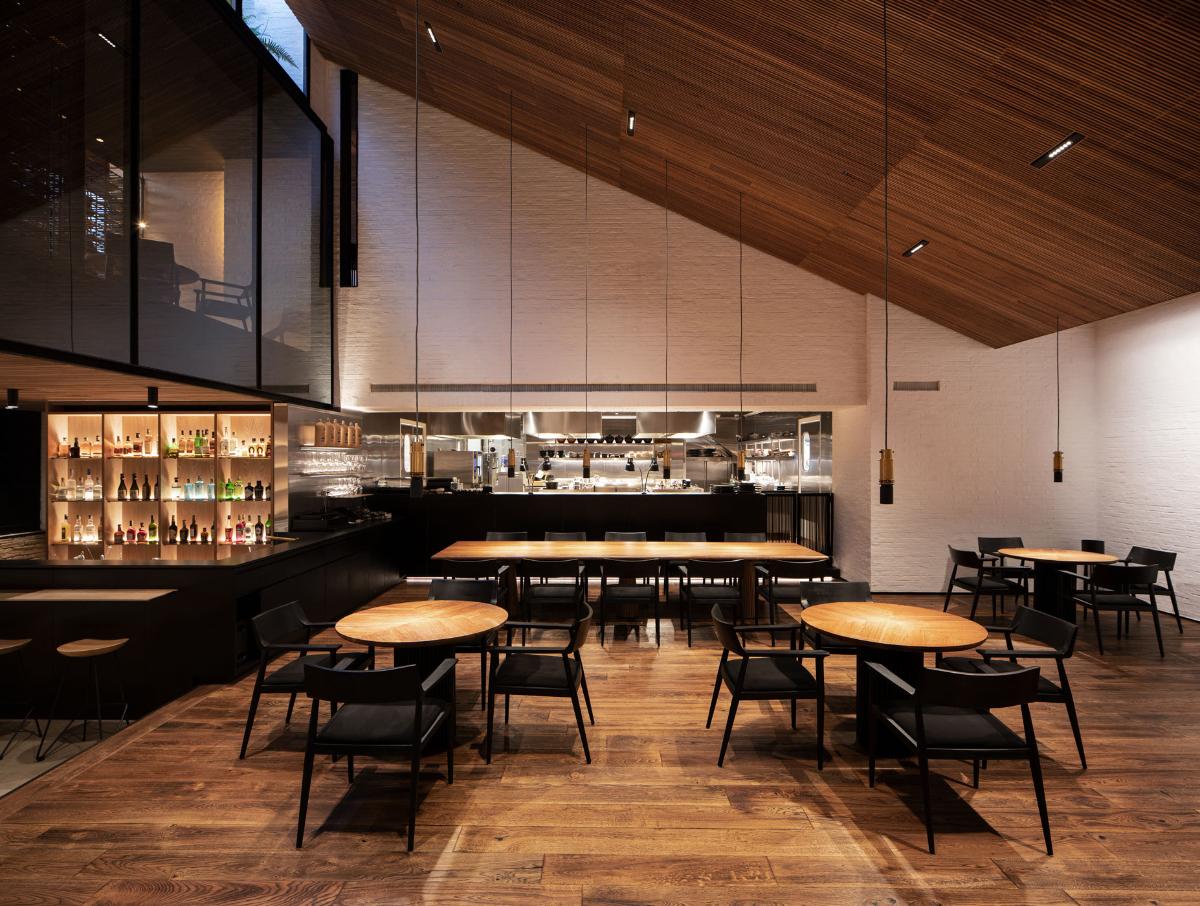
Image context: the lead photo comes from LEO's official site and shows the main room in Bogota. It is the right visual anchor because this article is really about atmosphere under discipline: the restaurant wants intensity, but it delivers it through curation rather than overload.[1]
The menu prices reveal the hierarchy of the house
LEO's official page is unusually useful because it shows the restaurant's priorities in public numbers. The five-course menu is listed at COP 410,000 without pairing, COP 540,000 with the botanical pairing, and COP 670,000 with the Territorio pairing. The eight-course menu runs COP 650,000, COP 840,000, and COP 1,000,000 on the same ladder. The twelve-course menu runs COP 840,000, COP 960,000, and COP 1,300,000.[1]
Those prices tell you beverage is not being treated as a polite supplement. The pairing choice is one of the biggest economic decisions in the whole booking. More important, the house does not frame alcohol as the only serious lane. The botanical option exists at every menu length, with pricing high enough to signal authorship rather than concession.[1] In fine dining, that distinction matters. Plenty of restaurants now offer no-alcohol pairings; far fewer present them as a central reading of the meal instead of a health-minded backup plan.
At LEO, the structure suggests something sharper. The meal is built to be interpreted through different liquid grammars, and the diner is expected to decide which grammar they want before the first course lands.
Ciclobioma needs a liquid grammar, not just a plate grammar
LEO describes itself as a sensory journey that redefines the narrative of Colombian gastronomy by celebrating the country's biodiversity.[1] The restaurant names its proposal CICLOBIOMA, and explains it through the interconnection between human beings, cultural heritage, and the natural environment, with attention to sustainability and local economies.[1] Latin America's 50 Best compresses the same idea into plainer service language: a tasting menu that moves across the sea, the land, and the soil, using little-known ingredients and a commemorative lunch tied to the restaurant's early dishes.[3]
That kind of ambition can easily become muddy. If a menu wants to move across coastlines, forests, highlands, and agricultural histories, the kitchen can overwhelm the guest with sheer conceptual density. This is where beverage becomes structural rather than ornamental. Drinks can reset the palate, narrow the emotional frame of a course, or keep one ecosystem from bleeding messily into the next. LEO's three-lane menu design suggests the restaurant understands that biodiversity is only compelling when it stays legible.[1][3]
The same point becomes even clearer in Laura Hernandez Espinosa's own public framing. In the 2025 50 Best profile on her work, she says she has been stubborn about building a "liquid universe" where wine does not hold the only starring role, and the piece describes how she expanded LEO's pairings to include Territorio distillates, fruit fermentations, cocktails, gastronomy-inspired drinks, and specialty coffees.[5] That is not a decorative bar program. It is a second language for the same territory.
Laura Hernandez is not support staff to the idea; she is half of the idea
The strongest source for that claim is not an interview flourish. It is the physical organization of the house. Latin America's 50 Best describes LEO as two dining rooms under one roof: one centered on Leonor Espinosa's cooking, and the second overseen by her daughter and sommelier, Laura Hernandez Espinosa.[3] Upstairs, La Sala de Laura extends the argument through cocktails and spirits tied to Colombian biospheres.[3][4]
The World's 50 Best Bars page is direct about what that means. It describes La Sala de Laura as drawing on Colombia's biodiversity through Territorio, a line of craft spirits that embraces biology, anthropology, and sustainability while expressing biospheres.[4] The drinks are not standard luxury cocktails with local garnish. They are supposed to function as liquid territory. The food upstairs remains important, but even the 50 Best Bars writeup treats the bar's real novelty as Hernandez Espinosa's ability to push Colombian distillates and cocktail logic into a fine-dining-adjacent format.[4]
Her 2025 50 Best profile pushes the point further. Hernandez Espinosa has served as head sommelier at LEO since 2009, has directed FunLeo for nearly 15 years, won the Beronia Latin America's Best Sommelier Award 2024, and opened La Sala de Laura in 2021 as a place where cocktails could be designed first and food matches built around them.[5] That sequence matters. It suggests the house did not bolt on a fashionable bar once the restaurant became famous. The liquid work had already become foundational.
FunLeo gives the drinks program real territorial weight
Restaurants love talking about producers, landscapes, and memory. Most mean it sincerely. Many still drift into menu poetry once the guest sits down.
FunLeo is one reason LEO feels denser than that. The foundation describes more than a decade of work with Colombian communities, international cooperation agencies, government organizations, and NGOs to highlight gastronomic traditions alongside the country's biological and intangible heritage.[2] It frames gastronomy as social and economic development and promotes a food culture grounded in traditional cuisine, biodiversity, and national identities.[2]
That does not automatically turn every pairing into ethical proof. It does give the restaurant a deeper institutional base for talking about territory. When Hernandez Espinosa builds a beverage program around Colombian distillates and biospheres, the claim lands inside a longer research-and-community framework rather than floating as a clever luxury narrative.[2][4][5] In practical dining terms, that makes the pairings feel less like "what goes with the dish" and more like an attempt to keep cultural context alive while the meal moves through high-end technique.
How to order LEO if the beverage program is your main reason for going
For a first visit, the eight-course menu looks like the clearest entry point.[1] It is long enough for the restaurant's liquid logic to establish rhythm, but it still sits below the full endurance test of the twelve-course format. The twelve-course option makes more sense if your purpose is immersion and you want the house's full geographic spread. The five-course option looks better suited to curiosity, lunch energy, or a guest who wants the idea without the long-form commitment.[1][3]
If your real interest is Laura Hernandez Espinosa's authorship, the Territorio pairing is the sharpest move. Source after source describes her contribution through distillates, cocktails, and a broadened liquid universe rather than through a classic wine-first script.[3][4][5] Choose the botanical pairing if you want to see whether LEO can carry all that territorial ambition through non-alcoholic structure alone. Given the restaurant's public emphasis on the botanical lane, that choice does not read like a compromise; it reads like a serious alternate interpretation.[1][5]
That is why LEO is worth booking now. The restaurant's strongest claim is not simply that Colombia contains a huge pantry. It is that a fine-dining meal can make that pantry drinkable as well as edible, and that the beverage sequence can do as much explanatory work as the plate itself.[1][3][4][5]
Sources
- LEO official English page, including CICLOBIOMA framing, menu lengths, and current no-pairing, botanical, and Territorio pricing.
- FUNLEO official English page, describing the foundation's work with Colombian communities, heritage, and gastronomy as social and economic development.
- Latin America's 50 Best Restaurants 2025, "Leo | Ranked No. 23," including the two-room format, tasting-menu structure, commemorative lunch, and Laura Hernandez Espinosa's role.
- The World's 50 Best Bars 2025, "La Sala de Laura | Ranked No. 44," including the Territorio spirits concept and the bar's biodiversity-focused cocktail program.
- 50 Best Stories, "The award-winning Colombian sommelier transforming the liquid landscape" (2025), on Laura Hernandez Espinosa's liquid-universe approach, FunLeo leadership, and pairing philosophy beyond wine.