Tulum is one of those places that can make a serious restaurant harder to see. The strip is overloaded with beach-club mood, ritualized nightlife, and the kind of destination marketing that turns every dinner into a backdrop. That is exactly why Arca feels worth separating from its setting in 2026. Michelin's current page goes out of its way to warn readers not to be fooled by the busy tourist road outside: inside, Arca is a can't-miss open-air venue with three seatings a night, a menu that keeps changing with the freshest produce and suppliers, and a kitchen where everything is cooked over live fire.[2] The point lands quickly. Arca is not trying to escape Tulum. It is trying to make Tulum legible.
The official site gives the restaurant's own version of that claim. It calls Arca a contemporary expression of Mexican cuisine rooted in Tulum's Mayan jungle, guided by fire and seasonality, with micro-seasonal food shaped by the region's flora and fauna and built in collaboration with small-scale farmers and fishermen.[1] That is unusually clear positioning. Plenty of restaurants in resort towns talk about place. Arca defines place as a working constraint: jungle humidity, Yucatan produce, smoke, acid, and the daily reality of what local suppliers can actually deliver.
What makes the room compelling is that it does not stop at culinary seriousness. The 50 Best Discovery page describes Arca as a restaurant-bar hybrid literally built around the trees overhanging the dining area, with drinks that represent the diversity of the Yucatan Peninsula and a microseasonal approach that pushes big flavors through both small plates and cocktails.[3] That detail matters because Arca is not a temple of silence. It is livelier than that, more porous, half dining room and half nocturnal social engine. The achievement is that the kitchen still stays in charge.
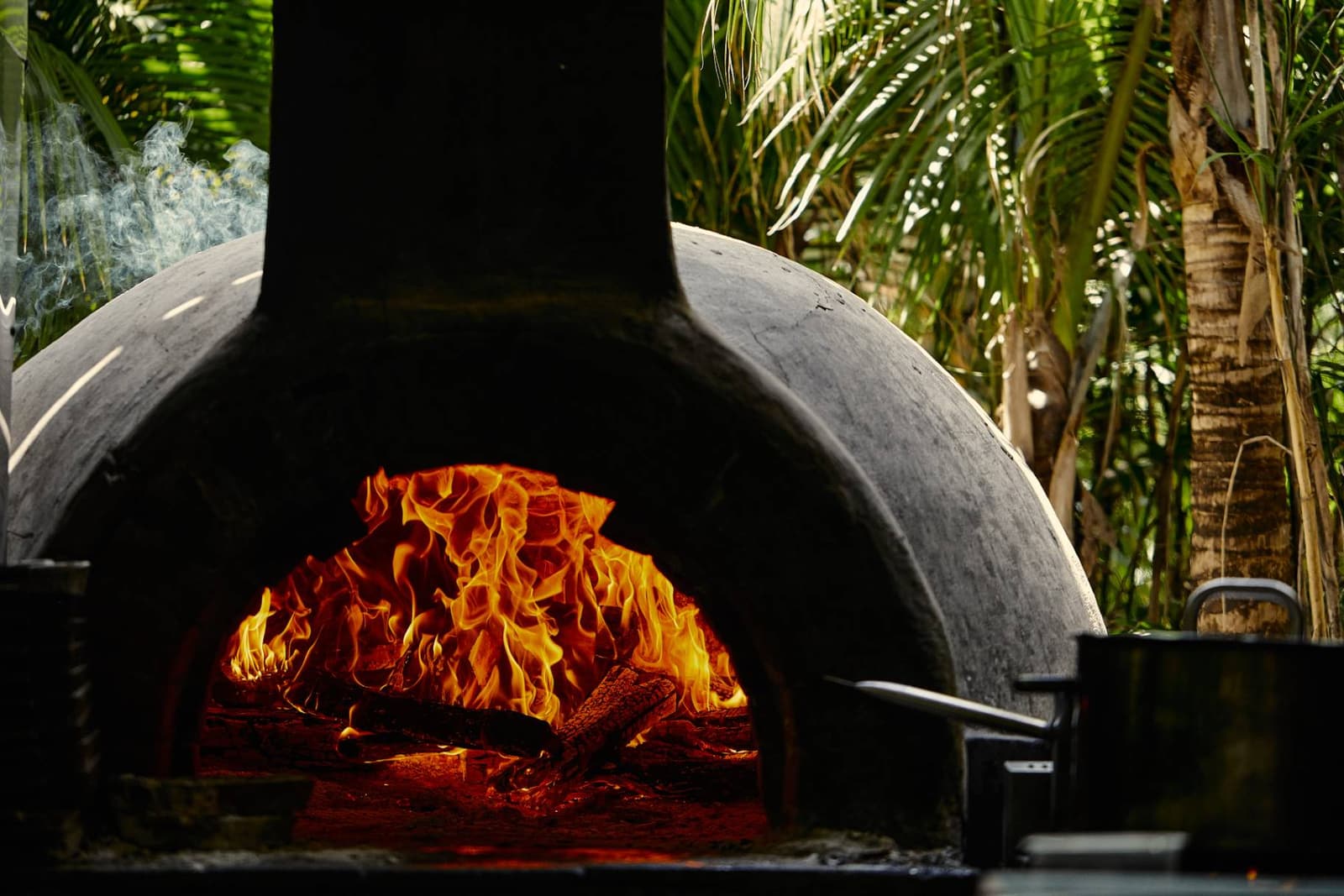
Image context: the cover uses Arca's official kitchen-and-wood-oven photograph rather than a polished dining-room shot because this profile turns on method. Before the palms, the candlelight, or the cocktails, the restaurant first asks you to understand the work line: wood, heat, and the open visibility of the fire itself.[1]
The room works because it stays open to its surroundings
Many destination restaurants try to protect fine dining from the outside world by sealing the room off. Arca takes the opposite route. Michelin describes it as an inviting open-air venue; 50 Best Discovery emphasizes that the room is situated around trees; Reporter Gourmet writes about a dining room under palms with a rustic open-fire kitchen and a mezcal-forward bar folded into the same experience.[2][3][4] None of that sounds defensive. The room does not pretend Tulum is not there. It keeps the humidity, darkness, wood, and plant life close enough that dinner still feels tied to the peninsula rather than transplanted onto it.
That openness changes how the food reads. In a tightly controlled luxury box, the meal could turn precious. At Arca, the slight roughness of the setting gives the menu more permission to be sharp, smoky, and high-acid. Reporter Gourmet's best observation is that the place has the energy of a roller coaster of pungent, sour, salty, iodine-rich, and fruity flavors.[4] Even when the prose is a little overexcited, the basic point holds. Arca is not about polished neutrality. It wants sensory pressure in the room and on the plate.
This is also where the bar matters. The 50 Best Discovery entry focuses heavily on cocktails, and that is not a side story.[3] The room's identity depends on guests moving through drinks, bites, and longer plates without the space splitting into two incompatible personalities. Arca's success is that the bar energy makes the restaurant feel more awake, not less serious. In a town where plenty of places can deliver atmosphere first and food second, that balance is a harder achievement than it sounds.
Fire is not macho spectacle here. It is the restaurant's editing tool.
The official site's most useful phrase is "guided by fire and seasonality."[1] Read next to Michelin's note that everything is cooked over live fire, it becomes the key to the whole restaurant.[2] Fire at Arca is not there to make dinner feel primitive, nor is it used as a generic luxury cue in the modern open-kitchen style. It functions as the main editing device. Smoke removes softness. Char gives sweet ingredients a darker outline. High heat tightens seafood. The menu ends up tasting more defined because fire keeps trimming away vagueness.
Michelin's current examples make that visible. The inspectors single out expertly seared octopus with an xcatic-based salsa, lentils, pickled radish, and epazote, then close on a mamey brulee with caramel, pixtle ice cream, and amaranth granola.[2] Even from a short description, the structure is clear: live-fire cooking is paired with ingredients that bring heat, herbaceousness, fermentation, bitterness, and nutty sweetness. Arca is not composing plates around a single luxury product. It is organizing contrast.
Reporter Gourmet pushes this further by describing a menu shaped by Yucatan pushiness: sauces with strong acidity, smoky notes, rich reductions, tropical fruit, and ingredients that keep revealing new layers rather than settling into one clean line.[4] The rhetoric is dramatic, but it helps explain why Arca does not feel like a minimalist restaurant. Fire does not simplify the food into bluntness. It gives the kitchen a backbone sturdy enough to carry sauces, ferments, herbs, and fruit without collapse.
That is why the official kitchen image works so well for this piece.[1] The wood oven is not a decorative relic. It is a statement of process. Arca's plates make more sense when you imagine them beginning in a room where heat is physical, visible, and slightly unruly, then being narrowed into something deliberate by a team that understands when to stop.
The Noma connection only matters because Hinostroza turned it back toward Mexico
It would be easy to flatten Arca into a familiar global story: chef with elite Nordic credentials returns to a beach town and opens the local outpost of international fine dining. The sources point somewhere more interesting. The official site notes that chef Jose Luis Hinostroza worked with Rene Redzepi's team and was part of the research and development group for Noma Mexico at the Tulum pop-up, before building a product-driven Arca menu around bold Mexican flavors.[1] Reporter Gourmet adds that Arca was built on that 2017 Noma-Tulum legacy and that the research phase dug deeply into Mayan and Yucatecan ingredients and techniques.[4]
The important part is not the prestige transfer. It is the direction of travel after the prestige. Reporter Gourmet argues that the pop-up forced Mexican chefs on the Noma team to look back at their own country differently, and presents Hinostroza's return as a move toward Mexico rather than away from it.[4] Supper Magazine reinforces the same idea from a later angle. In its December 1, 2025 interview, it describes Arca as the place where Hinostroza's open-fire cooking and ingredient-driven approach became his signature, then quotes him describing a style rooted in Mexican coastal cuisines, local ingredients, bold street-food flavors, and contemporary fire cooking.[5]
That reading makes more sense than the lazy Nordic one. Arca feels less like a tropical Noma echo than like a restaurant where international training is useful because it sharpens local reading. Precision comes from abroad. The flavor logic stays Mexican. The official site's about section and chef section fit neatly with that split: the food is grounded in tradition yet driven by fearless creativity, and the chef's biography is framed as a route back through Tulum rather than past it.[1]
Why Arca still feels current in 2026
Arca feels current because it offers a stronger answer to Tulum than either of the obvious ones. It is not trying to be a pure anti-resort refuge, and it is not surrendering to the area's pleasure economy either. It uses that pleasure economy. The room is seductive. The bar matters. The palms matter. The open air matters. But the official site's micro-seasonal sourcing, Michelin's emphasis on long supplier relationships and nightly seatings, and 50 Best Discovery's framing of the place as both bar and restaurant keep pointing to the same conclusion: Arca has a real operating center.[1][2][3]
That center is discipline disguised as ease. You can feel it in the fact that Michelin highlights frequent menu change rather than signature repetition.[2] You can feel it in the official emphasis on small-scale producers and region-shaped ingredients.[1] You can feel it in the way 50 Best Discovery turns the drinks list into a parallel expression of Yucatan identity rather than an unrelated party program.[3] And you can feel it in Hinostroza's own language about local ingredients, fire, and coastal Mexican cooking as a serious grammar rather than a mood board.[5]
So the real reason to write about Arca now is not that Tulum suddenly became a food capital. It is that one of the strip's strongest restaurants has figured out how to keep its food from dissolving into the destination. Fire does the editing. Microseasonality keeps the menu from going slack. The bar keeps the room socially alive. And the kitchen, somehow, still makes the last argument.
Sources
- ARCA official website, including the About and Chef sections on fire, seasonality, micro-seasonal sourcing, small-scale producers, and Jose Luis Hinostroza's Noma/Tulum background.
- MICHELIN Guide, "Arca - Tulum - a MICHELIN Guide Restaurant" - current inspector description, three nightly seatings, live-fire cooking, and sample dishes.
- 50 Best Discovery, "Arca - Tulum - Bar" - restaurant-bar hybrid framing, Yucatan-focused drinks, microseasonal approach, and venue context.
- Alex Husic, "Arca in Tulum: The New Hub of World Cuisine with Rene Redzepi's Prodigy." Reporter Gourmet, covering the Noma Tulum legacy, rustic open-fire kitchen, mezcal-forward bar, and research into Mayan and Yucatecan produce.
- Hannah Currie, "Interview: Jose Luis Hinostroza on bringing the Mexican coast to life at Hotel El Ganzo." Supper Magazine, covering Arca as the place where Hinostroza's open-fire, ingredient-driven approach became his signature and outlining his coastal-Mexican cooking philosophy.