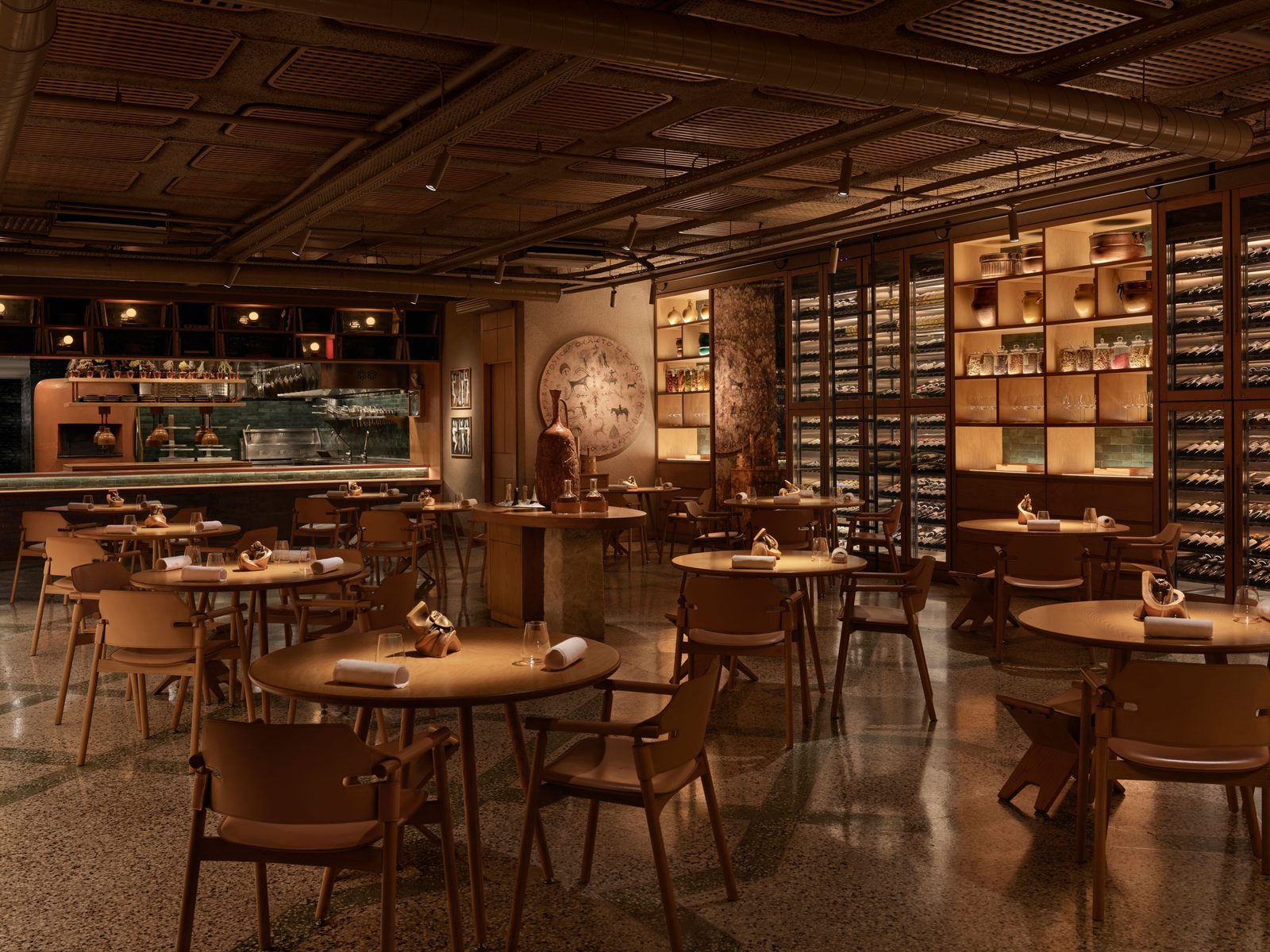
As of April 19, 2026, TURK's reservation page lists a 14-course tasting menu at 16,500 TL and asks diners to give the restaurant roughly 200 minutes for a slow-dining sequence, while Michelin's 2026 Türkiye selection keeps the house at Two Stars and newly adds a Green Star.[2][5] Those are the current credentials. The more interesting way to read the restaurant, though, is historical. TURK Fatih Tutak makes the most sense as a return route: an Istanbul dining room built from years spent abroad, then sharpened by a long trip back through Turkish ingredients, techniques, and family memory.[3][4][5][6]
That matters because the restaurant's lineage is easy to flatten. On the surface, TURK can look like one more contemporary tasting counter translating national cuisine into luxury form. Michelin's current listing emphasizes Turkish terroir, daily sourcing from local traders, delicate acidity, smoke, and a wine list rich in Turkish bottles.[3] The official site speaks of purity, simplicity, and cultural heritage.[1] Those are true descriptions, but they are incomplete on their own. They do not explain why the room feels authored rather than merely patriotic. The stronger answer is that Tutak did not build TURK by moving directly from "tradition" to "fine dining." He built it by leaving, learning, and then deciding what deserved to come back with him.[4][6]
1. The decisive lineage runs outward first, then home
National cuisines often get narrated as inheritance only: one chef, one grandmother, one archive, one region. TURK's story is more mobile than that. Michelin's 2023 Istanbul launch note described Tutak as a chef whose international career had crossed some of the world's biggest names before he returned to Turkey in 2019 to open the restaurant.[4] National Geographic fills in the route more concretely: training across Turkey first, then major kitchens in Tokyo, Copenhagen, Beijing, Singapore, Hong Kong, and finally Bangkok, where he ran The Dining Room at The House on Sathorn before deciding he needed to express his own country more directly.[6]
That return was not conceptual only. National Geographic reports that Tutak traveled more than 2,500 miles across Turkey to deepen his understanding of local ingredients and regional cuisines before and around the opening of TURK.[6] Read next to Michelin's language about Turkish terroir and daily product from local traders, that journey changes the meaning of the dining room.[3] The restaurant is not a museum of Ottoman grandeur, and it is not generic global technique wearing Turkish garnish. Its lineage is the route itself: outward technical apprenticeship, then inward geographic re-reading.[3][4][6]
That is why the food often carries both compression and breadth. Michelin describes familiar flavors given a new dimension and centuries-old practices tailored to the zeitgeist.[3] The 2023 Michelin launch text said much the same in a more dramatic register, calling the room a modern, chic theater for brilliantly reinterpreted Turkish flavors.[4] Neither description is really about novelty for novelty's sake. They point to a chef trying to make many regions, memories, and product cultures pass through one disciplined vocabulary.
2. Manti matters because private memory became the house key
Every serious fine-dining restaurant needs one point where philosophy stops sounding public-relations clean and starts sounding personal enough to risk sentiment. At TURK, that point is manti. Michelin's 2023 launch note says the manti made in homage to Tutak's mother became iconic almost immediately.[4] National Geographic provides the missing hinge: while in Bangkok, he created what became his signature dish, "From My Mom," a reinterpretation of traditional Turkish manti, for a private client from Turkey, and the reaction helped clarify how strongly he needed to cook from his own roots.[6]
That sequence is more revealing than it first appears. Tutak did not discover Turkish memory while standing still in Istanbul. He recognized it most sharply from a distance, after years inside other systems of excellence.[6] Manti therefore matters not just because it is beloved or familiar. It matters because it marks the moment when biography stopped being background and became method. The dish is not functioning as nostalgia theater. It acts as proof that family memory can survive refinement, pacing, and international technique without losing its emotional temperature.[4][6]
Once you see that, TURK's style becomes easier to read. The restaurant's official language about recalling cultural heritage through purity and simplicity is not arguing for rustic literalism.[1] It is arguing for selective concentration. Memory enters the room after being edited, tightened, and re-sequenced. That is the same move that lets a tasting menu stay elegant while still carrying the density of kebab cultures, Black Sea fish, Anatolian spice, Aegean produce, or mother-sauce memory inside it.[1][3][6]
3. Anatolia becomes sequence here, not sampler
One of the smartest things about TURK is that its Turkishness is expressed through staging as much as through ingredient choice. The official homepage describes AVLU as the prelude to the meal, the main dining room as the core 30-guest experience, and the open kitchen as another focal point of the night.[1] National Geographic makes the structure even clearer, describing the restaurant in three acts: small bites, cocktails, and Turkish wines in the courtyard; savory courses in the dining room; then a move into the kitchen for dessert and a direct explanation of the philosophy.[6] Michelin's 2023 launch note also singled out dessert served in the heart of the open kitchen.[4]
That three-act structure matters because it keeps TURK from reading like a sampler of regional references. Instead of saying "here is the Black Sea course, here is the southeast course, here is the Aegean course," the restaurant turns national breadth into movement, atmosphere, and pacing.[1][4][6] The room teaches the diner how to travel through the meal. First social looseness, then concentration, then a closer, more intimate finish. The geography is not only on the plate; it is embedded in the night's rhythm.
The drink program reinforces that same logic. Michelin specifically praises the abundance of Turkish labels on the wine list.[3] The reservation page currently offers a seven-wine pairing designed to highlight the diverse terroirs of Turkey, alongside a non-alcoholic artisanal pairing and a deep cellar of local and international bottles.[2] That means the restaurant is not using Turkish wine as a symbolic appendix. It is using it as a second route through the country, one that runs parallel to the food rather than trailing behind it.[2][3]
Operationally, the same national confidence shows up in the insistence on tempo. The reservation page asks guests to accept slow dining, says faster experiences will not be accommodated, and ties pre-payment and cancellation rules directly to fresh daily ingredients and waste avoidance.[2] Michelin's 2026 article adds another layer by awarding TURK a Green Star for its sustainability work alongside the continued two-star rating.[5] Taken together, these details suggest a restaurant that has moved past the stage of proving Turkish fine dining can exist at the top end. It is now proving it can hold a strict standard on sourcing, pacing, and environmental responsibility without losing warmth or amplitude.[2][5]
Why TURK still matters in 2026
The simplest prestige read is now outdated. TURK is no longer a lone novelty in a market waiting for validation. Michelin's 2026 selection makes clear that it now shares Türkiye's two-star tier with Vino Locale, while keeping its own place in Istanbul and adding the Green Star.[5] That shift actually makes TURK more interesting, not less. The restaurant no longer needs to stand in for the entire idea of ambitious Turkish fine dining by itself. It can be judged on the precision of its own answer.
That answer is unusually coherent. Tutak's international apprenticeship gave him range.[4][6] The return journey across Turkey gave him content.[6] Manti and maternal memory gave him an emotional key.[4][6] The courtyard-to-dining-room-to-kitchen progression gave him a spatial grammar.[1][4][6] Turkish wine and local traders gave him a supply-chain and beverage spine strong enough to keep the idea from floating off into abstraction.[2][3] What emerges is not a nostalgic national restaurant and not an anonymous luxury room. It is a modern Turkish table built from the logic of going away and deciding what deserves to come home.
That is why TURK's lineage is the return route. The restaurant's deepest inheritance is not one static archive. It is the act of carrying Turkish memory back through world-class technique, then arranging it so the diner can move through it in stages: public, focused, intimate; courtyard, table, kitchen; region, memory, present tense.[1][3][4][6]
Sources
- TURK Fatih Tutak official homepage, covering the restaurant's purity-and-simplicity philosophy, cultural-heritage framing, AVLU courtyard prelude, dining-room structure, and the official photograph used here.
- TURK Fatih Tutak reservation page, covering the current 14-course tasting menu, 16,500 TL pricing, 200-minute slow-dining format, seven-wine Turkish pairing, and reservation policies.
- MICHELIN Guide, "TURK FATİH TUTAK – Istanbul," covering the restaurant's current two-star status, Turkish terroir, local traders, acidity-and-smoke signature, chef's-table format, and Turkish wine list.
- MICHELIN Guide Istanbul 2023 launch press release, covering TURK's immediate two-star entry, Fatih Tutak's return to Turkey in 2019, the iconic manti homage to his mother, and dessert served in the open kitchen.
- MICHELIN Guide, "The MICHELIN Guide Türkiye Reveals its 2026 Restaurant Selection," covering TURK's continued two-star status, new Green Star, and its position alongside Vino Locale in Türkiye's two-star tier.
- National Geographic, "This restaurant is Istanbul's trendiest—here's why," covering Tutak's international training, the Bangkok origin of "From My Mom," his 2,500-mile journey through Turkey, and the restaurant's three-act dining structure.