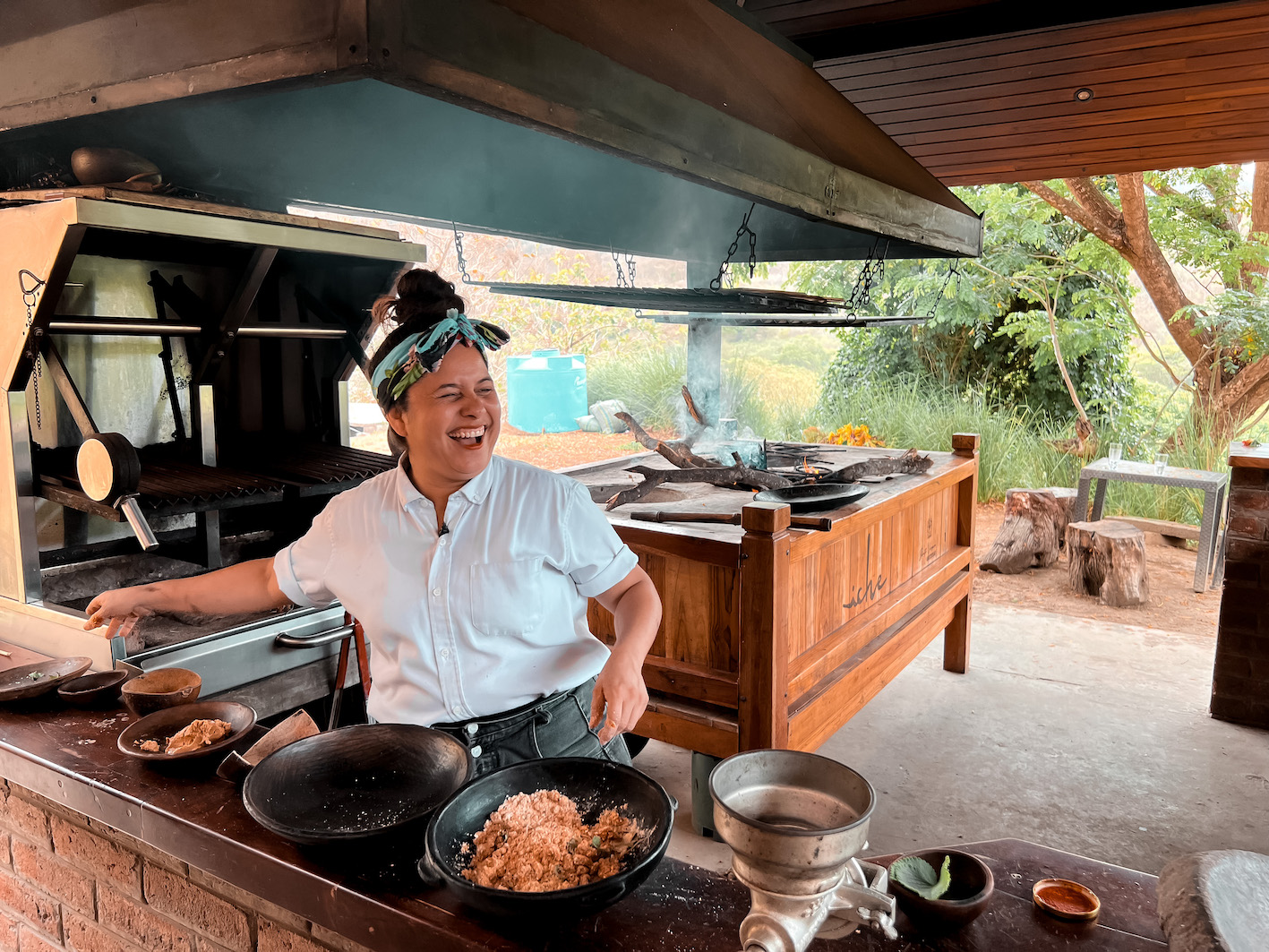
The argument began with the rice that wasn't there. At Iche in San Vicente, Ecuador, chef Valentina Álvarez served seco de gallina, a hen stew, with jerén de maíz, a yellow-maize preparation she associated with her grandfather's table. Some customers objected: without rice, it didn't seem Manabí enough. Álvarez recalled the exchange in a 2023 interview with Mónica Ramírez.[1]
It is a deliciously awkward problem for a restaurant devoted to regional identity. The cook reaches into memory; the diner recognizes a gap on the plate. Both bring an idea of home to dinner. Iche's interest lies in making room for that conversation—and in training the people who will carry it into other kitchens.
A restaurant with adjoining ambitions
Iche occupies a hilltop in coastal Manabí, in a building of wood and glass that Food Inspiration described during its 2023 visit as a contemporary interpretation of a local home. The project was founded in 2021, emerging from efforts to rebuild opportunity after the region's devastating 2016 earthquake.[2]
Its organizational chart is unusually revealing. Alongside the restaurant sit a food-and-hospitality school, a culinary laboratory and an enterprise incubator. Iche's own team page lists Felipe Salas as executive chef and Álvarez as both head chef and the school's gastronomic coordinator.[3] Her two roles place the connection between teaching and feeding guests inside the kitchen's daily leadership.
That arrangement gives the dining room a double responsibility. A dish must make sense to the person eating it, while its preparation gives another cook something worth learning. A compelling story can introduce a plate; the plate still has to sustain attention after the explanation ends.
The oven is a working inheritance
At the outdoor kitchen, the equipment makes that relationship tangible. The horno manabita holds ceramic pots within a clay-filled wooden structure. Álvarez describes a succession of uses across the day: stronger heat for early cooking, gentler heat for later dishes, and retained warmth for slow cooking into the night. Its management depends on observation and knowledge passed between cooks.[1]
Food Inspiration's visitors encountered this knowledge through their hands. They ground corn and peanuts repeatedly for sal prieta, the local seasoning, and prepared cheese-filled cassava bread. Their tour moved through the herb garden to the oven, with Álvarez encouraging them to smell and taste along the way.[2]
The appeal is easy to picture: floury hands, a warm hearth, the work of grinding before the pleasure of eating. For a school, these tasks also make inherited expertise teachable. Students can see a sequence, repeat an action and ask the cook beside them why it matters. The oven gives instruction a place to happen.
What reaches the table
The menu PDF linked from Iche's restaurant website, checked on October 27, 2026, brings the maize accompaniment back into view: it lists confit hen with jerén. Elsewhere, Jipijapa-style ceviche combines the day's fish with peanut, avocado and chillangua; pesca prieta pairs smoked fish with sal prieta sauce and oven-cooked vegetables.[4]
Read together, those dishes suggest a kitchen comfortable moving between familiar forms and different treatments. A seasoning made through grinding can return as a sauce. Hen can arrive through confit cookery while keeping maize beside it. These are observations about the published combinations, rather than tasting judgments.
The sweet courses extend the pantry's reach. One dessert assembles peanut ice cream, peanut cream with chocolate, a rolled sponge and a peanut biscuit. Another, Todo Coco, presents coconut through several textures, including granita, marshmallow and foam.[4] The repetition gives a diner several encounters with one ingredient: cold, soft, airy, crisp.
The PDF has no clear publication date, so these dishes are evidence of Iche's repertoire; their availability needs confirmation when booking. Their interest here is the way regional ingredients organize the meal from fish to dessert.
Learning travels beyond the dining room
FUEGOS, the foundation behind the school, describes a course divided equally between conceptual study and practical work. Students train in the restaurant under its chef and employed staff. Its account also specifies paid placements, addressing the pressure to earn that can keep prospective students out of education.[5]
The teaching continues beyond Iche. During a month of community placements, students exchange knowledge with people who maintain local food traditions. The foundation presents this as mutual learning, bringing technical training into contact with experience already present in the surrounding communities.[5]
That direction of travel matters. A regional restaurant can accumulate knowledge at one celebrated address. A school can help cooks use it elsewhere. Iche's structure makes both possible, though its stated ambitions should not be confused with a measured account of every graduate's livelihood.
This October brought a larger audience to that structure. Iche hosted the inaugural Americas Young Chef Award, whose October 8–12 programme brought together competitors from seven countries. They prepared both traditional dishes and innovative interpretations; Peru's Giacomo Centurión Mego won with Los Castigos. An accompanying research meeting also took place at Iche.[6]
The pairing of an inherited dish with a new interpretation fits the restaurant's own unresolved conversation. The absent rice shows how even a return to an older family practice can surprise a guest.[1] At Iche, the most interesting lesson may arrive with the accompaniment: a cuisine remains alive partly because its cooks and diners keep discussing what belongs on the plate.
Sources
- Mónica Ramírez, interview with Valentina Álvarez, Gastrofeminas, 2023 — the hen-and-maize anecdote, construction and use of the Manabí oven, and the chef's educational aims; in Spanish.
- Moniek de Jongh, “Food as a catalyst to rebuild a community,” Food Inspiration, April 21, 2023 — reported visit to Iche, its origins, garden and cooking activities; photographs credited to Sander Wijsman.
- Iche, “Nosotros,” accessed October 27, 2026 — the project's four units and published kitchen and school leadership.
- Iche, restaurant menu, undated PDF linked by its official restaurant website, accessed October 27, 2026 — documented dishes and ingredients, without a guarantee of current availability.
- Fundación FUEGOS, “Escuela” — the school's teaching model, supervised restaurant work, paid placements and community exchange.
- Fundación FUEGOS and Iche, Americas Young Chef Award 2026 official retrospective — October programme, competition format, results and accompanying research meeting.