The egg in bún thang arrives as a tangle of yellow threads. Beside it sit pale strips of pork sausage, shredded chicken and green herbs, with rice vermicelli underneath. Hanoi's MyHanoi guide describes the careful cutting and preparation behind this colorful soup; the bowl's apparent ease begins with considerable work at the chopping board.[1]
The intriguing thing is what that work makes possible. Egg, chicken and sausage can share a mouthful without a large piece of topping dominating the bite. Their shapes bring different textures into reach of the same pair of chopsticks. Bún thang rewards looking closely, then disturbing the arrangement.
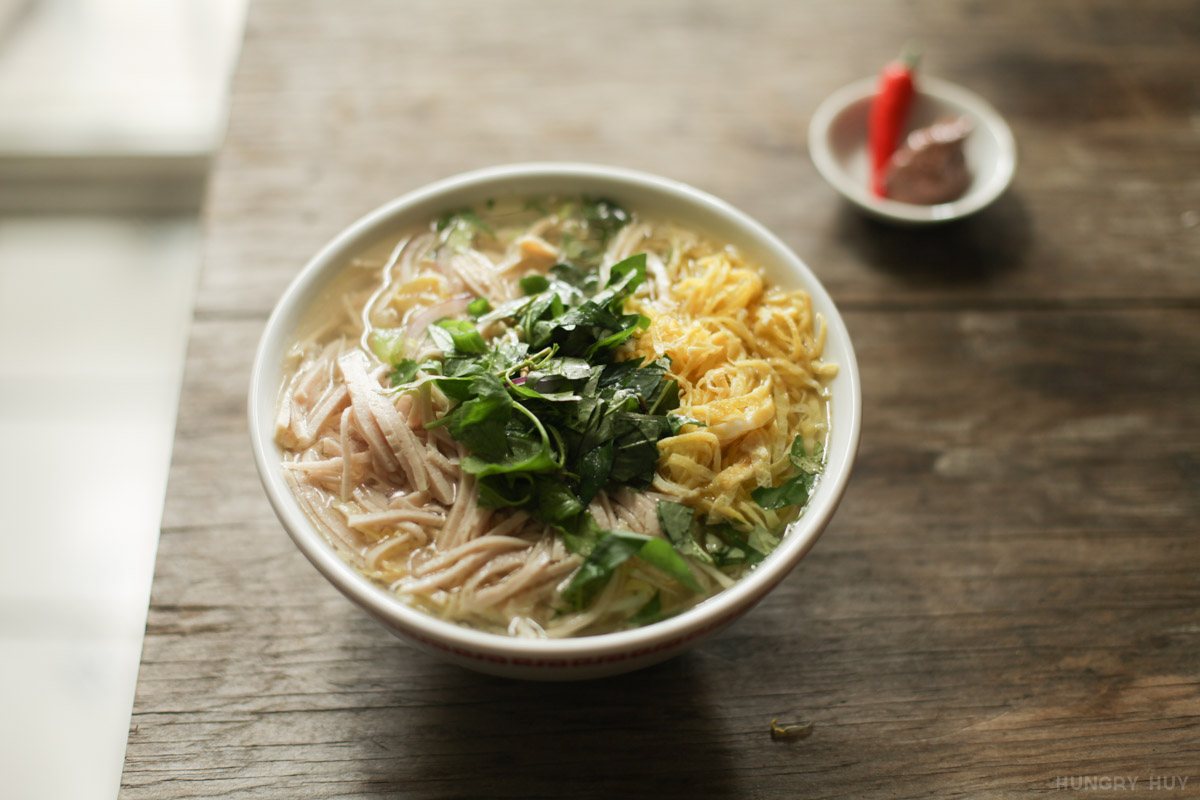
A bowl made at the chopping board
In Phùng Thơm's recipe, published by VnExpress in 2021, beaten egg is spread into a thin sheet in the pan. Once cool, it is sliced into fine strands. Giò lụa, the smooth Vietnamese pork sausage, receives a similarly fine cut. The chicken can be sliced or pulled apart. Those are separate preparations, brought together only when the bowl is assembled.[3]
Thinness starts before the knife. A thick omelette cut narrowly still produces substantial pieces; spreading the egg thinly first gives the cook a different material to work with. It is a small distinction with a visible result: yellow ribbons that can mingle with noodles instead of sitting above them as a separate serving.
The value of that skill emerges in VietNamNet's reporting on the family behind Bà Ẩm's bún thang. Đoàn Văn Lai learned to make especially thin egg crepes as part of the family craft. Recalling his mother's modest market stall, he described an orderly display in which chicken, egg, sausage and herbs each had their place.[4] The beauty was already there among the bowls and benches.
MyHanoi places bún thang after Tết, when it offers a welcome change from meals of rice cake, pork sausage and bamboo-shoot soup.[1] Familiar foods return in a different form. Cutting is part of that renewal: the sausage that could be served in a substantial slice becomes one pale strand among many.
The clear broth has plenty inside it
Vietnam Tourism's home-cooking booklet gives a useful account of the liquid beneath the toppings. Its recipe starts with chicken bones, then adds dried shrimp, shiitake, aromatics and fish sauce. Chicken breast is cooked in the broth, removed and shredded for serving. The noodles and toppings are arranged before hot broth is poured over them.[2]
That sequence makes the chicken do two jobs. Its flavor enters the liquid, while its meat returns as something the diner can pick up. Dried shrimp and mushrooms add further savory ingredients without requiring a thick sauce to hold the bowl together. A clear-looking soup can contain a substantial amount of preparation.
There is room for disagreement within that clarity. Phùng Thơm's preparation uses ginger and combines chicken and pork bones, skimming foam as they simmer.[3] The Bà Ẩm family, by contrast, specifically avoids ginger in its broth of chicken, pork bones, dried shrimp and shiitake.[4] These accounts describe particular cooks' choices. Treating either as a universal formula would flatten the differences they carefully preserve.
For the eater, this makes the first spoonful useful. Before adding condiments or gathering every topping, taste the liquid on its own. It gives you a reference for what happens when the bowl starts to mix.
A little pungency changes the next spoonful
Mắm tôm, fermented shrimp paste, introduces a stronger register. MyHanoi describes a tiny addition carried on the end of a chopstick. It also mentions cà cuống essence, an aromatic ingredient associated with the giant water bug, used in a similarly minute quantity.[1] At Bà Ẩm, both are optional additions; pickled radish supplies another, sharper accompaniment.[4]
The scale matters. These seasonings can change the aroma of a bowl whose surface looks gentle. Adding a little, tasting, then deciding whether to add more lets the diner follow that change. The egg's yellow and the broth's pale appearance do not tell the whole flavor story.
Huy Vu's recipe offers a useful perspective from a Vietnamese family kitchen in the United States. His grandmother preferred Vietnamese coriander underneath the noodles; he wanted its fragrance immediately accessible. His mother, meanwhile, thought his bowls carried far more meat and toppings than those she remembered from childhood in Vietnam.[5]
That observation also helps read the photograph here. Its generous topping is one cook's version, not a fixed measure of how much every bowl should contain. An abundant bowl and a sparer one place different demands on each mouthful.
The fine cuts give both something to work with. Lift a little egg with the noodles, catch a strip of sausage, then return to the broth. Bún thang's careful arrangement offers a succession of combinations. The cook has done the patient work of making them easy to find.
Sources
- MyHanoi, “Bun thang” (January 14, 2018) — preparation, post-Tết context, herbs and small aromatic additions.
- Vietnam Tourism, Home Cooking: 5 Recipes to Try in Your Kitchen, “Bún thang,” PDF page 6 — broth ingredients and assembly sequence.
- Phùng Thơm, “Bún thang chuẩn vị Hà Nội,” VnExpress Cooking (August 27, 2021; Vietnamese) — a named cook's egg, sausage, chicken and broth preparation.
- Linh Trang, The Bang and Do An, “Hanoi’s famed bun thang serves nostalgia with a side of global fame,” VietNamNet — reporting on the Bà Ẩm family's egg technique, broth and optional seasonings.
- Huy Vu, “Bún Thang – Vietnamese Noodle Soup with Chicken, Pork, & Egg,” Hungry Huy (May 18, 2015; updated April 6, 2020) — family preferences, topping proportions and the photographed preparation.
- HungryHuy, “Bowl of vietnamese soup with pork and egg,” Wikimedia Commons — photograph provenance and CC BY 2.0 license.