Before Kampot pepper reaches a grinder, someone has to decide which berries belong together. At La Plantation in southern Cambodia, pickers revisit the vines as the bunches mature. The harvest then passes to selectors, who separate the red berries by hand. Some will dry with their skins; others will be soaked and peeled for white pepper.[1]
That sorting table is a useful place to begin a fine-dining story. A menu can name an origin in two words. The ingredient arriving in the kitchen carries a longer sequence of decisions: how far to let the fruit ripen, which parts to retain, how to dry it and what to discard. Those decisions help explain why four peppers bearing the same place name can invite quite different dishes.
Four colors, several moments of picking
Kampot's product specification identifies two permitted varieties of Piper nigrum. Its green, black, red and white peppers are distinguished by harvest maturity and subsequent processing. Green pepper is picked young and offered fresh or preserved in brine or vinegar. Black pepper is harvested as the berries begin changing from green to yellow, then dried. Red pepper comes from fully ripe berries. White starts with ripe fruit too, but soaking allows the outer skin to be removed.[2]
The transformation is easier to grasp if the peppercorn is thought of as fruit. Red means the grower has waited for ripeness. White means a part of that ripe fruit has been taken away. The color on the label records a choice made before a cook ever opens the packet.
The specification describes black pepper in terms of deeper, sometimes floral aromas, red as fruitier, and white through grass and lime notes.[2] These are descriptions of the product's expected character, rather than a tasting verdict on every batch. For a kitchen, they offer a reason to compare the colors separately.
The harvest keeps asking for hands
La Plantation's September 2023 account gives this work a rhythm. Pickers make repeated passes during its harvest period. After preparation, the berries spend two or three days drying on nets in the sun. Workers turn them every two hours and bring them indoors each evening to avoid overnight dampness.[1]
Even then, the pepper is unfinished. Dried berries undergo another hand selection to remove small or broken grains and remaining pieces of stem. The producer describes this sorting as work that continues throughout the year.[1]
A spoonful of dried pepper can look wonderfully undemanding. It occupies little space, waits quietly in a cupboard and releases its aroma with a turn of the wrist. The production account restores the repeated handling that the finished object conceals. Drying requires attention to time and weather; sorting requires someone to keep looking at individual berries after the harvest's more photogenic work is done.
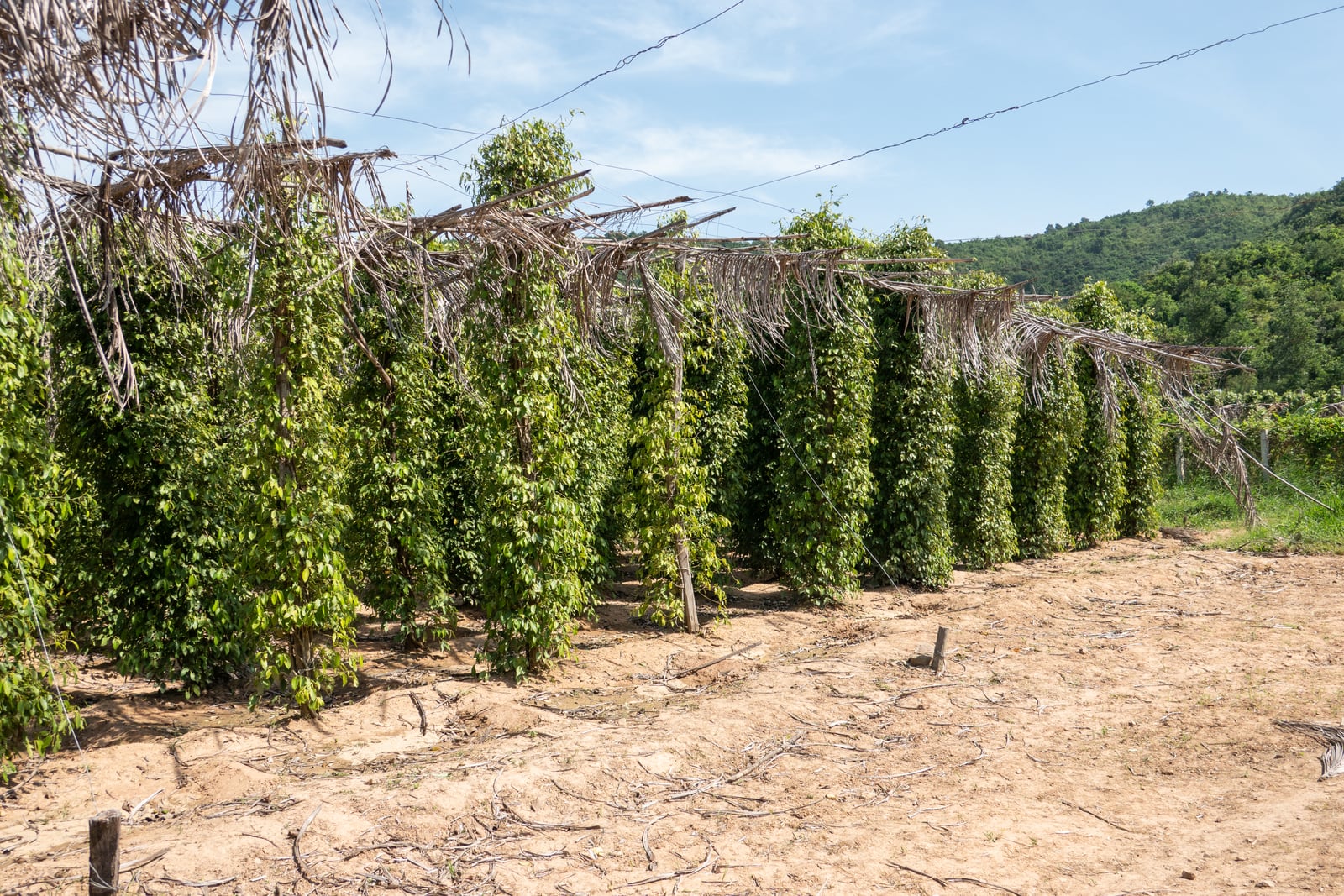
The photograph above shows La Plantation in December 2019.[5] It supplies a view of the crop's setting; the timings here come from the farm's later written account. Neither establishes the size or quality of the 2026 harvest.
Water, soil and a number on the packet
The protected production area includes designated districts in both Kampot and neighboring Kep. The specification requires suitable drainage, so a place name alone does not make every parcel eligible.[2]
The Kampot Pepper Promotion Association describes cultivation through ordinary, demanding tasks: propagating cuttings, adding natural fertilizers and supplying water in the dry season. Heavy rain brings the opposite problem, requiring growers to protect the vines from waterlogging. Its production guidance prohibits chemical fertilizers and recommends natural pest repellents.[3]
This makes the landscape more interesting than a backdrop to a luxury product. The grower must manage both shortage and excess of water. Good drainage and access to irrigation belong in the same account of the farm.
The association also says that the packet's lot number allows pepper to be traced to its farmer. KPPA validates plots, manages the specifications and carries out internal controls.[3] For a restaurant buying a named origin, that is useful evidence to retain alongside the supplier's invoice.
A sensible purchasing conversation can therefore begin with the producer and lot, then move to the harvest year and processing style. Asking those questions is an editorial recommendation drawn from the sourcing evidence. The name provides a starting point for understanding the ingredient; sampling tells the cook how this particular delivery behaves.
Let the color reach the plate
La Plantation suggests black pepper with meat, white with fish and red with desserts, while explicitly encouraging cooks to follow their own preferences. Its production account also points to fresh green pepper served with Kep blue crab.[4]
These suggestions open up several textures of pleasure: a grinder over meat, pale pepper in a fish preparation, whole green berries among pieces of crab. Red pepper's place at dessert is especially revealing. The fruit has been allowed to ripen before drying; the kitchen can give that fruitier character room beside sweetness.
Preservation adds another choice. La Plantation describes a salted fresh pepper developed to carry some of the appeal of green pepper beyond its immediate surroundings.[4] Fresh, salted and dried versions deserve separate trials in a dish: a purchasing order should specify which experience the cook wants to deliver.
For a dining room, the most persuasive explanation can be brief. Tell the guest which pepper was chosen and what it contributes. Behind that small sentence sit the repeated visits to a vine, the nets brought indoors at dusk and the hands that sorted the berries. The pleasure is in allowing enough of that work to remain perceptible on the plate.
Sources
- Nicolas Deroualle, “How do we harvest Kampot Pepper?”, La Plantation, September 15, 2023 — repeated picking, separation, drying and final hand sorting at this producer.
- Kampot Pepper Promotion Association, “Product Specification of the Protected Geographical Indication: Kampot Pepper,” hosted by Cambodia's Ministry of Commerce — product types and sensory descriptions, pages 7–10; geographical area and drainage, pages 10–11.
- Kampot Pepper Promotion Association, “Behind the quality process,” accessed October 27, 2026 — cultivation, irrigation, association controls and lot-number traceability.
- Nicolas Deroualle, “How do we produce Kampot Pepper?”, La Plantation, October 14, 2023 — processing choices, salted pepper and the producer's culinary suggestions.
- PsamatheM, “La Plantation Pepper Farm, Kampot Province,” photograph taken December 3, 2019, Wikimedia Commons — image provenance and CC BY-SA 4.0 license.