Plenty of fine-dining restaurants talk about terroir when they really mean a short drive from the kitchen. Gustu means something larger and harder than that. As of May 2, 2026, its official menu still describes the restaurant as a place that celebrates Bolivia's richness through "hundreds of native Bolivian products," pairs that food with a cellar entirely dedicated to Bolivian wines, singanis, spirits, and beers, and builds two tasting menus out of exploration trips and research conducted with scientists and other specialists.[1] That is not ordinary localism. It is a national pantry project.
The rest of Gustu's public record keeps pointing in the same direction. The official site presents gastronomy as a tool for socio-economic progress and says the team sees itself as a communicator of Bolivian land and tradition.[2] Its "Us" page explains that, in 2018, Gustu began a deeper collaboration with the Wildlife Conservation Society that led to Sabores Silvestres, a project designed to understand Bolivia's food culture and natural pantry more completely.[3] The restaurant's current 50 Best Discovery profile then shows what that looks like from the dining-room side: chefs Kenzo Hirose and Jairo Michel now lead the kitchen, the menu sources from the Andes to the Amazon, and the house continues to run research trips aimed at finding unknown produce and building relationships with small-scale producers.[5] Put simply, Gustu is not using sourcing as a moral garnish. Sourcing is the format.
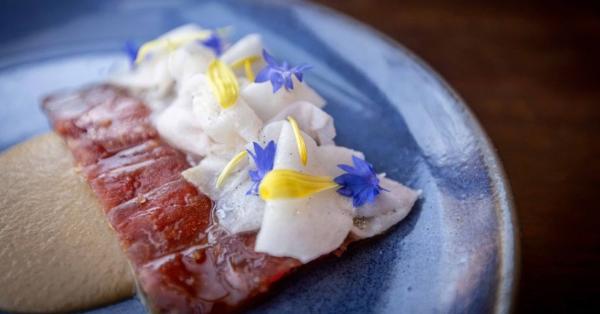
Image context: the cover uses 50 Best Discovery's dish photograph rather than a chef portrait or a mountain landscape. That choice fits the article because Gustu's strongest argument is translational. The meal has to show how products from very different Bolivian ecologies can be edited into one coherent plate, not merely displayed as raw biodiversity.[5]
1. Gustu treats Bolivia's vertical geography as kitchen structure
The useful way to read Gustu is not as a restaurant that happens to buy locally. It is a restaurant that cooks inside Bolivia's altitude gradient. The official menu page frames the food as a "sensorial journey through the natural, cultural, and geographical diversity" of the country, and the LAB page says the project exists to discover new culinary uses for traditional Bolivian products while conducting research across different ecoregions.[1][4] Sabores Silvestres states the same premise more plainly: Bolivia's wide altitudinal range creates distinct ecological floors and therefore an unusually broad range of ingredients.[7]
That matters because a Bolivian tasting menu can easily collapse into folklore on one side or imported fine-dining grammar on the other. Gustu tries to avoid both failures. The menu's current examples already show the spread: alligator with copoazu and green papaya, llama with black garlic and roses, Amazonian fish and yuca, corn with white peanuts and callampa mushroom, desserts built around kiswara flowers, macambo, and seasonal fruit.[1] None of that reads like a single valley or one familiar luxury basket. The point is that the country's larder is not flat.
50 Best's 2024 ranking page sharpens the guest-facing effect. It says diners move across Bolivia's biodiverse landscape "in just a few mouthfuls," citing trout with green papaya and mangaba fruit, duck with Andean lucuma, and hearts of palm with banana balsamic and chancaca sauce.[6] What sounds decorative at first is actually operational. Gustu needs a menu structure capable of carrying highland, valley, and lowland ingredients without turning the meal into an encyclopedic list. The restaurant's answer is compression: fewer signals per plate, stronger territorial contrast.
2. The hidden mise en place is field research
This is the part that makes Gustu more than a patriotic ingredient showcase. The restaurant's own materials insist that research is upstream of service. The current menu page says the tasting menus come out of exploration trips and studies done with researchers and scientists.[1] The "Us" page dates the current phase of that work to 2018, when Gustu and WCS expanded their effort to understand Bolivia's natural pantry and food culture, leading to Sabores Silvestres.[3] The I+D page adds the functional goal: identify products with culinary potential, understand them properly, and spread usable knowledge about Bolivian food heritage.[4]
Sabores Silvestres makes the producer side more concrete. Its mission page says the project seeks deeper understanding of the Bolivian pantry so products can be respected, preserved, and turned into sustainable livelihoods for rural communities, productive associations, and indigenous peoples.[7] That is a much more serious claim than "farm to table." It implies that menu development, conservation logic, market creation, and storytelling are entangled.
The older 50 Best profile of Marsia Taha remains useful here because it shows how those expeditions behave in practice. The article describes Sabores Silvestres trips with cooks, biologists, agronomists, scientists, and journalists moving through the Amazon, the Andes, and the Altiplano, bringing products such as tuyu tuyu larvae and paiche into wider culinary circulation while working with communities and conservation partners.[8] Even if leadership has changed since then, the current official pages and Discovery profile show the structure still standing: research travel feeds sourcing; sourcing feeds menu language; menu language feeds demand.[3][5][8]
3. The all-Bolivian cellar stops the sourcing story from breaking
One of Gustu's smartest moves is that the drinks program follows the same territorial rule as the food. The official menu does not treat the cellar as a cosmopolitan escape hatch. It says the wine cellar is dedicated entirely to Bolivian wines, singanis, spirits, and beers, conceived as a tribute to national production and the people behind it.[1] That choice is easy to underestimate, but it changes the whole credibility of the project.
A lot of restaurants build a locally virtuous menu and then quietly restore prestige with imported bottles. Gustu does the opposite. Its beverage list turns the same sourcing logic into liquid form, running through producers from Tarija, Chuquisaca, Cochabamba, and Santa Cruz.[1] If the kitchen wants Bolivia's pantry to be read as complete rather than charming-but-limited, the cellar has to share the burden. Otherwise the deepest sign of luxury would still be foreign.
This is why the pairings matter beyond hospitality revenue. The menu explicitly offers optional beverage pairings for the tasting menus, with sommeliers selecting the best match for each dish.[1] In other words, the restaurant is not only sourcing products nationally; it is trying to make Bolivian flavor systems converse internally at the table. The meal becomes an argument that the country's pantry and drinks culture are broad enough to support a full fine-dining evening without imported scaffolding.
4. Why Gustu still feels important in 2026
Gustu has now been open since 2013, and 50 Best's 2024 ranking page notes a significant transition: after Marsia Taha left in October 2024 to open her own restaurant, Jairo Michel and Kenzo Hirose took over day-to-day kitchen leadership.[6] That could have turned Gustu into a legacy institution running on old prestige. The more interesting reading is the opposite. The current public material suggests the house is trying to stay alive by keeping the pantry in motion.
The Discovery page calls Gustu a forerunner of the Bolivian culinary revival and still names it The Best Restaurant in Bolivia 2024.[5][6] Those accolades matter, but the better proof is structural continuity. The official menu still foregrounds unusual products and research-driven tasting menus.[1] The official mission still frames food as social, territorial, and educational rather than merely luxurious.[2][3][4] Sabores Silvestres still describes the work as multidisciplinary and conservation-linked.[7] The restaurant's center of gravity remains where it should be: not in trophy language, but in procurement, fieldwork, and translation.
That is why Gustu deserves to be read as an ingredient / sourcing story rather than as generic destination dining. Its real luxury is range under control. The restaurant takes a country with enormous ecological spread, difficult logistics, and many under-recognized products, then turns that spread into a tasting-menu discipline. Bolivia is not the backdrop to the meal. Bolivia is the meal.[1][3][5][7]
Sources
- GUSTU, "Menu" - official menu page covering the all-Bolivian cellar, the two tasting menus, current dish examples, pairings, and the claim that the menus grow out of exploration trips and research with scientists.
- GUSTU, homepage - official site language presenting the restaurant as a communicator of Bolivian land and traditions and framing gastronomy as an engine of socio-economic progress, equity, and inclusion.
- GUSTU, "Us" - official page covering the 2018 collaboration with Wildlife Conservation Society, the creation of Sabores Silvestres, and Gustu's broader social-development framing.
- GUSTU, "I+D" - official research page covering the LAB's role in generating knowledge about Bolivian food heritage and the restaurant's ongoing research trips across Bolivia's ecoregions.
- 50 Best Discovery, "Gustu - La Paz - Restaurant" - current profile covering the Kenzo Hirose and Jairo Michel leadership team, Andes-to-Amazon sourcing, research trips, and the dish photograph used here.
- Latin America's 50 Best Restaurants 2024, "Gustu | Ranked No. 38" - ranking profile covering Gustu's Best Restaurant in Bolivia 2024 status, the 2013 opening, leadership transition after Marsia Taha, and representative current dishes.
- Sabores Silvestres, "Mission" - project page covering the link between understanding the Bolivian pantry, conservation, and sustainable livelihoods for rural communities and indigenous peoples.
- The World's 50 Best Restaurants, "Meet Marsia Taha, the rising star chef putting Bolivia on the gastronomic map" - feature covering Sabores Silvestres field expeditions, multidisciplinary research teams, and example products such as tuyu tuyu and paiche.