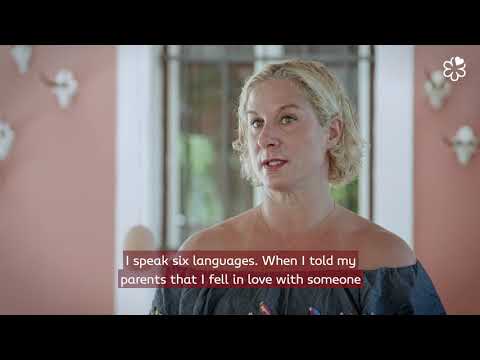
The useful way to watch the 2021 MICHELIN Guide Slovenia short on Hiša Franko is not as another celebrity-chef profile.[1] The video certainly gives you Ana Roš's presence, and it briefly sketches the now familiar origin story of a former diplomacy student who ended up in a kitchen.[1] But the more interesting thing in the film is structural. It keeps insisting that the restaurant is not built from "local ingredients" as a mood. It is built from a chain: river, forest, goat pasture, berry picker, wine producer, farm partner, and service team, all compressed into one tasting menu.[1][3][5]
Hiša Franko's own current materials make that reading stronger rather than weaker. The homepage calls the house "a menu written by nature" in the Soča Valley and describes a community of foragers, shepherds, cheesemakers, hunters, and fishermen behind the plates.[2] The philosophy page goes further and makes the sourcing logic unusually concrete: every ingredient has "a name, a face, a place"; wild herbs and mountain plants are gathered morning by morning; trout comes from a local fishing family; the restaurant works with high-mountain dairies and the protected Drežnica goat community; and when seafood becomes less reliable, the menu adapts toward what the land can still support.[3] The current menu PDF shows how that philosophy lands on the table in spring 2026: Corn beignet, Potato and hay, Spring Harvest, Trout the queen, Roebuck, Beeswax and poppy seeds, and Spring Fruit all appear inside one sequence.[4] This is why the video matters. It shows how a very small radius becomes a surprisingly large range.
That is also what keeps Hiša Franko from feeling like generic remote-luxury theater. The current site makes clear that there is only one seasonal tasting menu, no a la carte fallback, and a roughly three-hour service for both lunch and dinner.[2][3] The menu PDF adds three pairing tracks, including a non-alcoholic path.[4] Those choices matter because they tell you the restaurant is not selling flexibility or abundance in the usual metropolitan sense. It is selling coherence. If the valley is the pantry, the dinner has to be read as one argument rather than as a collection of highlights.
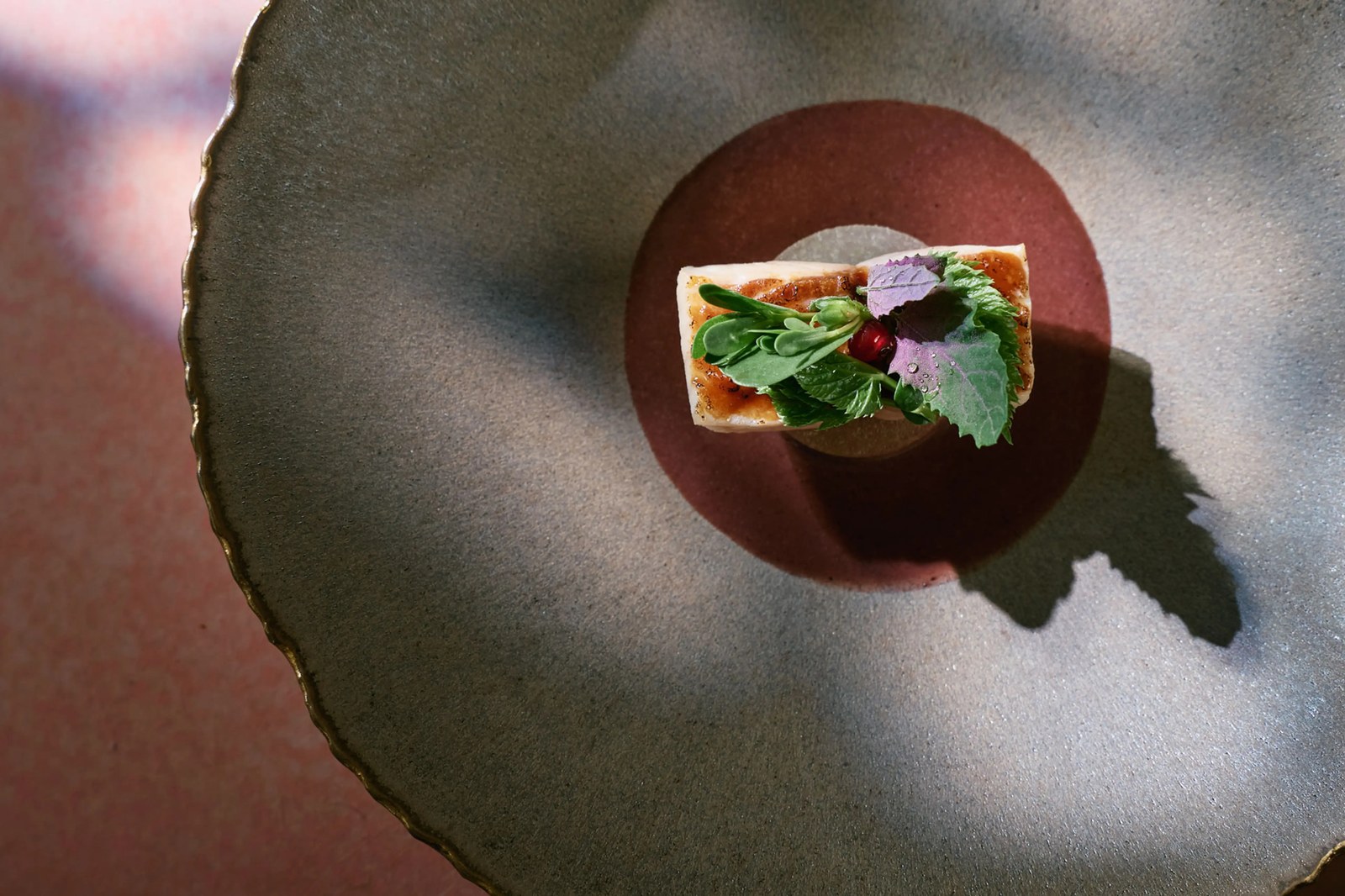
Image context: the lead image uses an official Hiša Franko plate photograph rather than a valley landscape or chef portrait.[6] That choice fits the article because the video's deeper point is not rustic scenery by itself. It is the act of tightening scenery, plants, and animal products into small, high-precision constructions that still keep their origin legible.
Around 0:12 to 1:30, the film turns remoteness from a limitation into a flavor grammar
Roš opens by saying the kitchen works with the rhythm of nature, the seasons, the moon, rain, and sun.[1] That could have landed as soft-focus terroir talk. It does not, because the very next movement is practical: the film shows her describing products from the area that are so specific they cannot be found elsewhere, then explaining that the restaurant takes even very traditional local materials and transforms them through its own mindset.[1] Read beside the official pages, the point becomes sharper. Hiša Franko is not claiming that untouched locality is enough by itself. The house is claiming that a narrow geography becomes interesting only after it is edited, translated, and made readable for a guest.[2][3]
That distinction matters in fine dining because rural rhetoric often cheats. A restaurant can use mountain, river, and foraging language as an alibi for looseness. Hiša Franko's current menu suggests the opposite pressure.[4] A sequence that moves from Corn beignet and Potato and hay to Trout the queen, Roebuck, and Beeswax and poppy seeds is not trying to reproduce peasant cooking on expensive plates.[4] It is trying to prove that the valley contains enough textural and ecological contrast to sustain an entire modern tasting grammar. The video's early stretch is persuasive because it does not frame remoteness as deprivation. It frames remoteness as selection pressure.[1][4]
Around 2:02 to 3:20, the producer chain becomes the real luxury
The middle of the film is the part most restaurants would shorten, which is exactly why it is the most revealing.[1] Valter Kramar talks about having to find wines for Ana Roš's dishes and about building, over many years, a chain of faces, producers, and farmers that together make the Hiša Franko story possible.[1] The restaurant's current menu page and PDF confirm how central that logic remains: pairings are not an afterthought but a parallel structure, with two wine tracks and one non-alcoholic track offered alongside the single menu.[4] Once you hear Kramar describe the producer network, those pairing options stop reading like hospitality upsell. They read like an extension of the sourcing map.
Then the film hands the argument to the forager. Miha Rustja explains that the house philosophy values what can be found within roughly 10 to 15 kilometres of Hiša Franko, and he describes the restraint built into gathering, taking only a limited share from a given patch so that the place can keep reproducing itself.[1][5] That detail matters because it turns locality into governance. The Philosophy page says every ingredient has a name, face, and place, and the herbs, mushrooms, and mountain plants are collected morning by morning by someone who knows the terrain intimately.[3] The video lets you see the cost of that intimacy. Locality is not just closeness. It is a set of self-imposed limits.
This is where Hiša Franko starts to feel broader than more urban luxury rooms. In a city, range often means access to everything. Here, range comes from staying inside a disciplined perimeter and learning how much variety can still be drawn from it.[1][3][5] That is a harder and more interesting proposition.
Around 3:39 to the end, the restaurant stops looking rustic and starts looking editorial
The closing passages are quietly the strongest. Roš and her farm partners talk through pumpkins, Malabar spinach, biodynamic farming, and the future of small farms in the Soča Valley.[1] She says these local, sustainable stories are what can save the planet from disaster; then, in the film's final character sketch, she imagines Hiša Franko as a curious, colorful girl who likes happy people.[1] That last image is useful because it blocks the wrong interpretation. Hiša Franko is not trying to stage monastic severity. Its food may be intense and unorthodox, but its self-image is lively, social, and curious.[1][3]
That liveliness matters when you read it against the written material. The official site describes the cuisine as expressive, intense, and unorthodox, and the menu itself is full of names that sound more like editorial chapter titles than luxury cliches: Spring Harvest, Trout the queen, Brown beans and cola, Spicy bite.[3][4] In other words, the restaurant is not merely receiving ingredients from the valley. It is arranging them with a point of view. The video helps you see that the house's deepest luxury is not remoteness alone, nor fame alone, nor even product quality alone. It is the ability to turn a very tight local chain into a dinner that feels mentally expansive.
That is why this short is still worth embedding in 2026.[1] It captures Hiša Franko before the language collapses into awards biography or generic sustainability halo. What you see instead is a restaurant that keeps asking one harder question: if you work inside a strict radius of land, water, people, and seasons, can that narrow world produce more surprise than a global pantry can? Hiša Franko's answer, in both the video and the current menu, is yes. The valley does not shrink the restaurant. It sharpens its range.[1][2][3][4][5]
Sources
- Feel Slovenia, "MICHELIN Guide Slovenia: Ana Roš, chef at Hiša Franko," YouTube video.
- Hiša Franko official homepage - Soča Valley framing, "menu written by nature" positioning, one-menu service structure, and current opening details.
- Hiša Franko, "Our Philosophy" - sourcing logic covering foragers, trout, the Drežnica goat community, and the house's expressive seasonal philosophy.
- Hiša Franko, current English menu PDF - Spring 2026 menu sequence and pairing structure.
- Slovenian Tourist Board, "A Michelin video about world-famous Hiša Franko and renowned chef Ana Roš" - context on the film's participants and the 10-15 kilometre local radius.
- Hiša Franko official image asset used for the lead photograph.