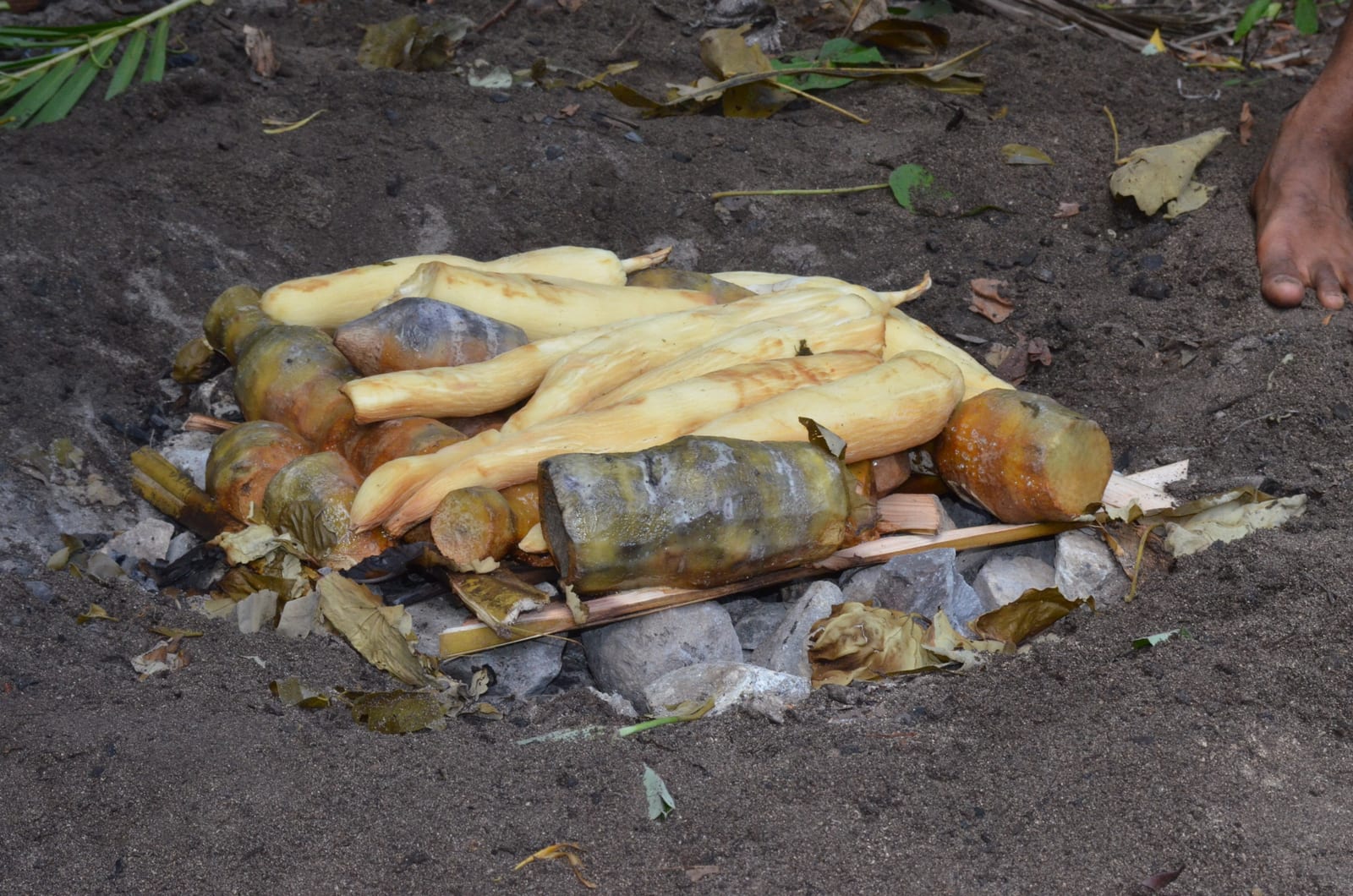
In Jaejay77’s photograph, the food looks less presented than excavated. Pale roots lie in a loose pile above ash-grey stones. Wilted leaves buckle around the edges. A bare foot enters the frame from the right, giving the open pit a human scale that polished kitchen photography usually edits away.[6]
There is no flame to admire. By this point, the open fire has already done its first job: it has heated the stones that will carry energy into the food. The meal emerges from earth rather than through an oven door.
The most useful way to understand the Fijian lovo is as a sealed batch oven whose controls largely disappear once cooking begins. Fire charges the stones; plant material supplies moisture; food is positioned according to size and the heat it needs; leaves, coverings and earth close the chamber. Once the cover goes on, there is no burner to turn down, no fish to move to a cooler corner and no lid to lift for a quick look. Apart from repairing a steam leak, every consequential adjustment has already been made.[1][2][3]
For fine dining, that reversal is the point. The lovo moves precision away from last-second pan work and into preparation: stone choice, heat storage, wrapping, load order, sealing and the timing of one collective reveal.
First, turn a fire into stored heat
A 2025 regional discussion paper presented to the FAO/WHO Codex committee for North America and the South West Pacific describes the common architecture of underground ovens, including Fiji’s lovo. It is a discussion paper, not a universal recipe or a finished safety code. Its reference process begins with a round, sloping pit, generally 0.5 to 1.5 metres deep, scaled to the food, stones and plant material that must fit inside.[1]
Kindling and larger wood are built under stones at least the size of a closed fist. After several hours, when the wood has become grey, glowing embers rather than open flame, the heated stones are leveled into a floor. A Fijian food-science study describes a somewhat quicker domestic sequence: stones one or two fist-sizes across heated over an open fire for one to two hours, followed by a covered cook of another one to two hours.[3] These are accounts of variable practice, not interchangeable timer settings.
The stone bed is a thermal battery. Its quality depends on mundane physical choices long before a plate exists. The Codex paper recommends similarly sized, non-porous stones—basalt is its example—for more even heat, while warning that moisture-bearing porous rock such as limestone may fracture explosively when heated.[1] In a conventional kitchen, a faulty pan can be swapped. In a lovo, the cooking surface is buried under the entire meal. Material selection is therefore not rustic scenery; it is equipment specification.
The flatness of that stone layer matters too. A high point can scorch the parcel resting on it while a hollow becomes a weak zone. Once food has been loaded and the chamber sealed, the fire cannot be fed and the stone floor cannot be rearranged. The pit has to contain enough stored energy at the start to finish every item inside.[1]
No poured water does not mean no steam
The lovo is often described casually as smoky barbecue. That misses its central climate. The regional Codex account explicitly treats underground cooking as a steam process, with moisture released when fresh plant material meets the hot stones.[1] Yet Kumar and Aalbersberg’s controlled Fijian lovo study says no water was poured into its pit and calls the stones extremely hot and dry.[3] The two descriptions are compatible: the water is carried in by banana stem, coconut husk, leaves and the food itself rather than by a kettle.
In the regional reference sequence, a thick, moist layer such as cut or pounded banana stem or coconut husk sits directly over the stones. Ti or palm leaves form another boundary above it. Food then enters, wrapped or unwrapped, followed by more leaves, a broad covering and finally loose earth. The plant layer generates steam; the upper layers stop it escaping.[1]
That structure gives wrapping two jobs. It protects a delicate item from direct contact with the hottest stones, and it creates a smaller aromatic chamber inside the larger one. A coconut-palm basket, a leaf parcel and bare cassava do not experience identical cooking even when they share the same pit.
Modern lovo practice can combine traditional and industrial wrappers within the same load. In Sarah Todd’s documented SBS recipe, chicken is braided directly into coconut palm while palusami is folded first in taro leaves and then in foil; banana leaves and coconut fronds cover the whole pit.[4] The foil is not treated as a universal substitute for leaves. It contains one especially wet parcel while the chicken keeps a more permeable plant boundary.
That exposes a useful fine-dining choice. Wrapping can be assigned component by component: what needs to hold coconut milk, what may touch stone or palm, what should admit more of the oven’s aroma and what needs protection. A tighter barrier can simplify containment, but it also changes the interface through which heat, moisture and smoke reach the food.
Smoke, then, is a variable rather than the lovo’s sole definition. How much reaches the food depends on coals, leaves, gaps, wrapping and position. Stored heat and trapped moisture do the cooking; smoke records how the parcel met that system.
The menu becomes a loading plan
All the food enters before the lovo closes, so a mixed feast has to become a spatial plan. Tourism Fiji describes root crops—dalo, cassava and sweet potato—going in first, followed by leaf-wrapped meats or fish and then vegetables such as palusami, pumpkin and breadfruit.[2] The Codex discussion paper gives the broader safety logic: large cuts lower in the oven, closer to the heat, and vegetables higher up.[1]
Neither account should be mistaken for an inflexible stacking law. Food size, wrapper, stone heat and pit depth change the useful position. What matters is that distance becomes a control. A dense root can tolerate the lower zone and use its long heat to soften starch. A fish needs protection from that same intensity. A coconut-rich leaf parcel needs enough time for its filling to heat without surrendering all of its moisture.
A reported research visit to Kokomo Private Island makes this logic vivid at the luxury end of Fijian hospitality. Resort staff guided Firedoor chef Lennox Hastie through a lovo using coconut spines, hot stones, elephant-ear leaves and banana leaves. Cassava sat nearest the direct heat; mud crab and snapper went above it. The resort chefs told the reporter that a whole slow-cooked lovo could acquire a certain sameness, while Hastie said he intended to use the process for one vegetable component during a forthcoming 2024 residency.[5]
The report documents an experiment and an intention, not proof of the dish that ultimately reached guests. But the proposed edit is instructive. Fine dining does not have to miniaturize an entire communal feast or make every course taste of one pit. It can use one lovo-cooked component where stored heat, leaf aroma and softening genuinely add something, then let brighter or crisper elements remain outside the oven.
Humid heat does not guarantee a juicy result
Steam sounds like insurance against dryness. The Fijian experimental evidence is less comforting. Kumar and Aalbersberg cooked chicken, lamb, reef fish, cassava, taro and palusami together in an earth oven for 75 minutes, then compared them with foods cooked by methods including roasting, microwaving, boiling and steaming. Across their samples, earth-oven cooking generally produced the greatest water loss; lean lamb lost as much as 32.9 percent of its water.[3]
That result does not make lovo cooking dry by definition. It comes from one experimental load, and moisture retention varied by food and method. It does puncture the easy claim that a covered pit automatically bathes everything in succulence. Water can still leave meat, drip away or migrate into another part of the parcel while humid heat softens collagen and starch.
For a chef, this is where cutting and wrapping become consequential. A lean piece of fish cannot be treated like a collagen-rich joint simply because both are underground. Coconut cream inside palusami, fat around meat, the surface area of a cut and the permeability of its wrapping all shape what survives the cook. “Tender” and “moist” are separate targets.
The seal is the last live control
Once earth covers the lovo, the cook loses visual access. The remaining intervention is to watch the cover rather than the food. The Codex paper says a steam leak should be closed promptly by adjusting the covering material. It also recommends extending the cover beyond the pit opening before burying it with loose earth, reducing paths through which heat and moisture can escape.[1]
This makes sealing active craft, not the ceremonial end of setup. A wisp at the wrong edge is not atmosphere for a photograph; it is information. The cook cannot restore a cold stone, but can still close the route through which the oven is losing its working climate.
The invisibility also creates a serious boundary between cultural knowledge and restaurant control. The Codex paper identifies unvalidated and unmonitored time and temperature as the main food-safety challenge. Among its proposed precautions are keeping raw meat refrigerated until loading, not placing frozen food in the oven, validating time and temperature for the specific process, avoiding soil contact during opening and holding cooked food above 60°C or the applicable national standard.[1] A commercial kitchen cannot treat the dramatic unearthing as evidence that every parcel is safe. The romance belongs in the reveal; the proof belongs in a validated process.
Unearthing is part of the meal
Tourism Fiji places lovo at weddings, celebrations and family gatherings, with many hands contributing ingredients and labour. When the cover is removed, the food is commonly spread over banana leaves and served as a shared feast rather than divided into a procession of chef-authored plates.[2] The oven’s batch logic and its social logic fit: many foods commit to the same heat and arrive together.
A tasting room can borrow the technique without pretending that one refined parcel reproduces that occasion. What it should not borrow is only the smoke or the spectacle. The lovo’s deeper lesson is that control does not always look like intervention. Sometimes it is a stone chosen before the fire, a moist plant layer prepared on time, a root set low, a fish protected above it, and earth pressed onto the one place where steam escapes.
By the time the first parcel is uncovered, the craft has become irreversible. Everyone sees at once whether the buried decisions held.
Sources
- FAO/WHO Coordinating Committee for North America and the South West Pacific, Discussion Paper on Traditional Underground Ground Oven Cooking in the South West Pacific: Food Safety Considerations (NASWP17/CRD05, February 2025) — regional process map, steam mechanism, staging, sealing and proposed safety controls; prepared with Fiji and six other Pacific states plus IUFoST.
- Tourism Fiji, “All About Lovo” — Fiji-specific account of communal preparation, stone heating, load order, the earth seal, cooking time and shared service.
- Shailesh Kumar and Bill Aalbersberg, “Nutrient retention in foods after earth-oven cooking compared to other forms of domestic cooking: 1. Proximates, carbohydrates and dietary fibre.” Journal of Food Composition and Analysis 19, no. 4 (2006) — controlled Fijian lovo process and comparative moisture findings.
- Sarah Todd, “Fijian feast cooked in the earth (lovo).” SBS Food (November 15, 2018) — documented recipe showing palm-braided chicken, leaf-and-foil palusami, the stone bed and whole-pit covering.
- Anna McCooe, “Lennox Hastie is playing with fire at Kokomo Island in Fiji.” Gourmet Traveller (November 2023) — reported account of a chef research trip, Kokomo’s lovo loading sequence and the plan to isolate the technique in one component.
- Jaejay77, “Lovo.jpg.” Wikimedia Commons — source, metadata and CC BY-SA 4.0 license page for the 2014 photograph of cooked staples in a Fijian lovo used here in resized form.