Tashkent does not need another dinner plan built around the phrase “modern Uzbek” as if it described one cuisine, one mood, or one price of ambition. Three of the city's polished rooms now make three quite different promises. OLOV builds the evening around live heat. Lali arranges Uzbekistan by region. OKO looks outward from an eighth-floor gastrobar, where the menu is as comfortable with ceviche and bao as it is with halva.[1][3][7][8]
This is a choice guide, not a ranking and not a report from anonymous visits. It reads the restaurants through their current published menus, booking information, and independent guide context. The useful question is not “Which is best?” It is “What kind of dinner are you trying to have?”
| Book | Best when you want | Build the meal around | Know before you go |
|---|---|---|---|
| OLOV | Fire, meat, bread, tea, and a room with elemental theatre | One live-fire centerpiece plus fresh or tart relief | The menu is broad; restraint makes the fire easier to taste |
| Lali | A composed survey of Uzbek regional dishes | One dough, one noodle or dumpling, and one shared rice or meat dish | UNESCO recognition belongs to palov culture, not to a certified restaurant recipe |
| OKO | A high-floor, cocktail-friendly, cosmopolitan night | A few sharp small plates, one main, then the pumpkin-halva dessert | This is the least Uzbek-specific choice, and its own page gives conflicting opening times |
OLOV: let one fire do the talking
OLOV's published interiors supply the first sensory clue: low tables and sand-colored walls sit behind a field of illuminated, petroglyph-marked forms. The room is theatrical, but the menu gives the theatre a working center. The restaurant says fire is not decoration and organizes much of its cooking around live flame and the tandyr.[1]
The kitchen's published account says the team spent almost half a year traveling through Uzbekistan and other Central Asian countries while developing the menu. That is a house claim, not independent proof of every dish's lineage, but the resulting menu is specific enough to test. There is horse steak cooked over fire with demi-glace, pickled onion, and crisp dough; green shivit oshi noodles with meat-and-vegetable gravy and kefir; beef tongue with hot katlama; long-cooked bone marrow; and a salty milk tea breakfast served with tail fat and patyr.[2]
The smart order is not “all the smoke.” For two people, start with a fresh tomato-led salad or a yogurt element, choose one serious fire dish, add bread or layered dough, and finish with tea. The current online menu lists the horse steak and slow-cooked beef ribs at 189,000 UZS each.[2] Those figures are menu anchors, not a promised final bill: drinks, service practices, substitutions, and future updates can change the total.
If the table is four, the mixed set begins to make sense because it lets kebab, lula kebab, lamb, chicken, vegetables, potatoes, corn, onion, and pita share one center. If the table is two, a single meat reveals more. Order three heavy fire preparations at once and the distinctions collapse into heat, fat, and browning. OLOV is the right booking when you want dinner to feel elemental, but the best way to read that element is with contrast.
The restaurant publishes its address as 36A Taras Shevchenko Street and provides a direct reservation form.[1] Confirm the time when the booking is acknowledged; the official page supplies the contact route but does not present a simple hours line as clearly as the other two restaurants do.
Lali: order across regions, not down the prestige column
Lali is the clearest answer when a table wants Uzbek food in an explicitly polished room. Its Tashkent branch says it opened in October 2024, operates daily from 11:00 to midnight, and sits at 57B, Markaz-5, Yunusabad district.[3] The current 2026 Ultima Guide reduces the concept to a useful sentence: a route from Bukhara's vaguri to Samarkand palov.[9]
That route should shape the order. Lali's own material names Alat somsa and vaguri from Bukhara, fried kovurma lagman associated with Tashkent, and Samarkand palov. It also ranges through manty, naryn, regional kebabs, and other dishes meant for a generous table rather than a procession of isolated tasting-menu bites.[4] Build a meal with different techniques, not merely different meats: a baked or layered dough, a pulled or fried noodle, something cold and acidic, then one shared pot or grill dish.
Palov needs one careful boundary. Lali's main site invokes the dish's 2016 UNESCO status, while Uzbekistan's tourism authority announced in October 2025 that the Tashkent restaurant would be the main venue for a three-week festival built around seven palov variations.[4][5] UNESCO's actual inscription is “Palov culture and tradition.” Its subject is the making and sharing of palov across rural and urban communities—as hospitality, celebration, support, remembrance, and transmitted knowledge—not the certification of one Samarkand formula or one restaurant's authenticity.[6]
That distinction improves the dinner. Instead of treating palov as a gold-medal endpoint, treat it as the table's social center. Let the somsa show sealed pastry, let fried lagman bring chew and savory depth, then let rice gather everyone back into the same dish. Lali's strongest promise is breadth, but breadth still needs editing. A table that orders three similar lamb-heavy centerpieces learns less than one that moves from crust to noodle to rice.
Book Lali when the group wants recognizable Uzbek anchors, a formal-looking room, and enough range for mixed appetites. Do not book it because a heritage label appears to settle a debate about the “correct” palov. The restaurant is most interesting as a regional sampler whose choices invite comparison, not as a museum with edible labels.
OKO: choose the city night, not a national survey
OKO is the deliberate outlier. Ultima calls it a panoramic gastrobar with a Bali mood and pan-Asian food; the restaurant calls its kitchen “gastronomy without borders.”[9][8] Its eighth-floor address at 152/1 Buyuk Ipak Yuli Street makes the room a night-out destination before any dish arrives.[7]
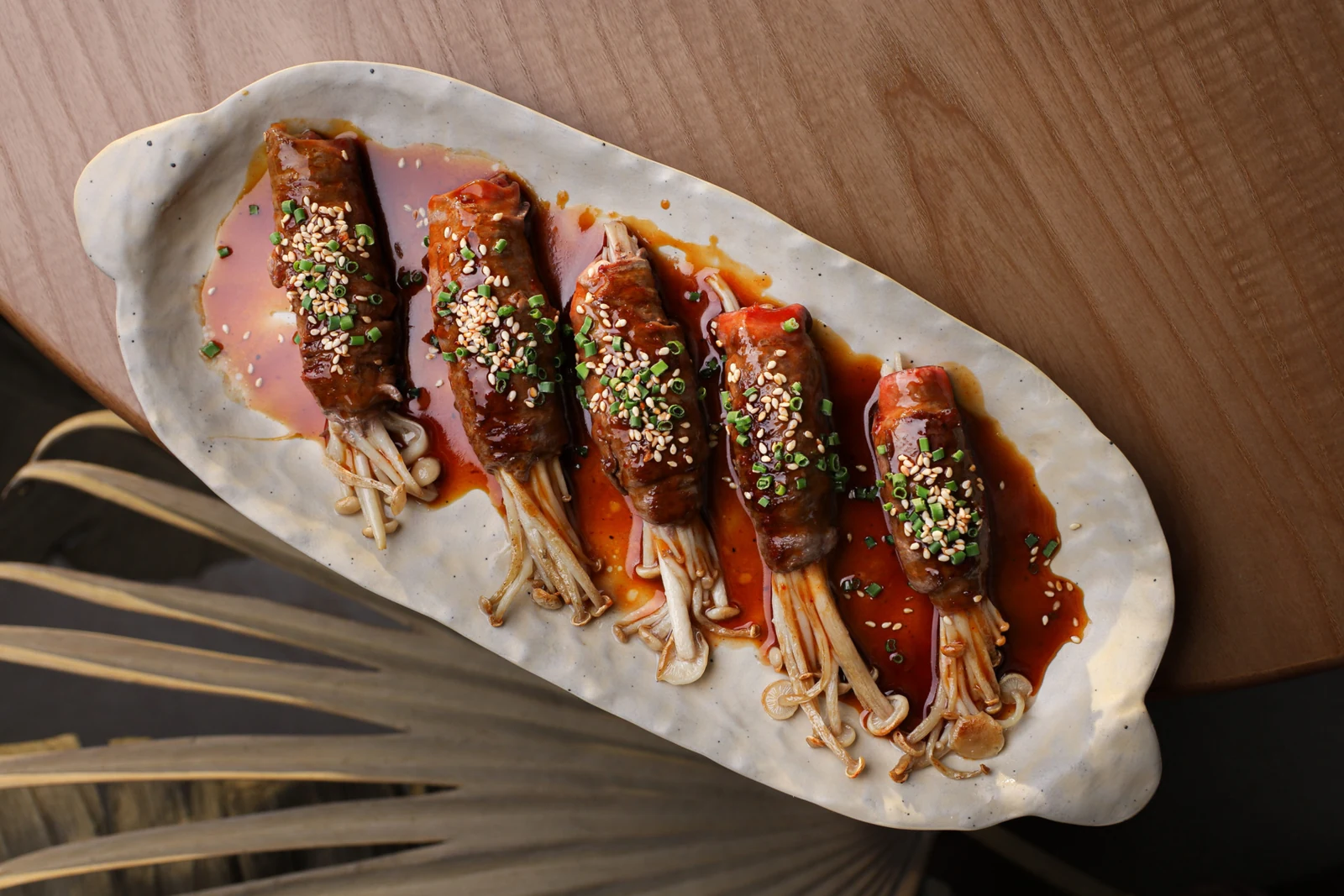
The menu backs up that outward gaze. Current listings include three ceviches, mezze, shrimp bao, eel éclairs, enoki mushrooms with veal and kimchi-sesame seasoning, beef tenderloin with smoked butter, and an “Oko” dessert of pumpkin sponge, condensed-milk custard, caramelized pumpkin, sesame crisp, halva ice cream, and gold leaf.[7][8] This is not the place to ask for a compressed lesson in Uzbekistan. It is the place to see how Tashkent participates in the circulating grammar of contemporary gastrobars: raw fish, fermented heat, soft buns, smoked dairy, glossy sauces, cocktails, height, and late light.
Order accordingly. Begin with one cold, acidic plate; add one warm small dish; share a main; keep room for the pumpkin-and-halva finish. A parade of ceviche, bao, gyoza, and mezze can turn “borderless” into airport-lounge sameness. One clean sequence gives the kitchen a better chance to show whether its combinations have a house voice.
There is also a live practical uncertainty. OKO's English homepage lists Tuesday through Sunday, 18:00–00:00 near the top, but 13:00–00:00 in its footer; both sections mark Monday as a technical day.[7] That contradiction is exactly why the reservation link matters. Ask for the current opening time and the availability of any special tasting event rather than building an afternoon plan from one line of the page.
Book OKO when the view, bar energy, and pan-Asian menu are the point. If someone at the table says, “We have one dinner in Tashkent and want to understand Uzbek regional food,” choose Lali instead. If they say, “We want flame, horse meat, bread, and tea in a designed room,” choose OLOV. A guide becomes useful when it is willing to send three different desires through three different doors.
The shortest answer
Choose OLOV for heat and material drama, then keep the order narrow enough to taste the differences between fire-cooked dishes. Choose Lali for regional comparison, then make technique—not prestige—the organizing principle. Choose OKO for a panoramic, outward-looking city night, with no pretense that a borderless gastrobar is the same thing as an Uzbek culinary survey.
Tashkent's contemporary restaurant culture looks more convincing when these rooms are not forced into a single story. Modernity can mean giving old heat a new stage, bringing regional recipes into one elegant dining room, or letting the city look confidently beyond the national repertoire. The right reservation is the one that knows which meaning it wants.
Sources
- OLOV, official restaurant site — live-fire and tandyr concept, reservation contact, address, and official dining-room imagery.
- OLOV, official current menu — menu-development account, dish descriptions, cooking methods, portions, and listed UZS prices.
- Lali Tashkent, official branch page — October 2024 opening, address, hours, regional menu framing, dishes, contact, and reservations.
- Lali, official restaurant site — regional dish origins, network concept, and the site's reference to the 2016 UNESCO palov inscription.
- Tourism Committee of the Republic of Uzbekistan, “Plov Festival kicks off in Tashkent and Russian cities” (October 21, 2025) — announcement naming Lali in Tashkent as the main venue and publishing seven planned palov variations.
- UNESCO Intangible Cultural Heritage, “Palov culture and tradition” — scope of the 2016 inscription as a shared social practice and transmitted body of knowledge.
- OKO, official English homepage — address, chefs, featured dishes, reservation route, and the conflicting opening-hour lines noted in the guide.
- OKO, official current menu — the restaurant's borderless framing, current food and drinks range, and source page for the enoki-and-veal photograph used as the article image.
- Ultima Guide Tashkent 2026 — current local guide descriptions of Lali as a regional Uzbek dining room and OKO as a panoramic pan-Asian gastrobar.