The dangerous object is not the baijiu. It is the refill.
Set one clear spirit beside a long tasting menu and a familiar ceremony can take over: the tiny cup topped up, lifted, emptied and topped up again. Flavor becomes secondary to stamina. Yet the same small glass, poured once and placed beside the right course, can behave less like a dare than a lens. Pineapple funk makes chile and fried crust flare brighter. Roasted, savory aromas deepen a glazed mushroom. A quieter rice spirit slips between shellfish and fermented rice without bleaching either one.
This is the case for bringing baijiu inside a fine-dining menu, not leaving it as a toast before dinner or disguising it in a sweet cocktail. The category is far too broad for the instruction “pair baijiu with Chinese food.” Its four principal aroma families—strong, sauce, light and rice—come from different raw materials and production systems and carry genuinely different sensory shapes.[1][2][3] They should be treated as four possible course partners, not four steps in a proof-of-courage flight.
The service rule is equally important: one 5–10 milliliter pour, optional, with water and food already on the table. That volume is an editorial recommendation, not a Chinese tradition or a health claim. Traditional service may use a 15-milliliter cup, and many baijius sit around the strength of whisky or higher.[3][5] A tasting menu has no reason to fill the vessel simply because it is small.
“Aroma” is a production map, not perfume copy
Baijiu usually begins with grain, but it does not follow the familiar Western sequence of making a clean ferment, distilling it and letting a wooden barrel supply much of the later flavor. A broad technical review describes five major stages: preparing materials, making qu starter, fermentation, distillation and aging. It also notes that styles differ by starter, technique and microbial community.[1] Much traditional production is solid-state: moist grain ferments in heaps, jars or pits rather than swimming in a vat.
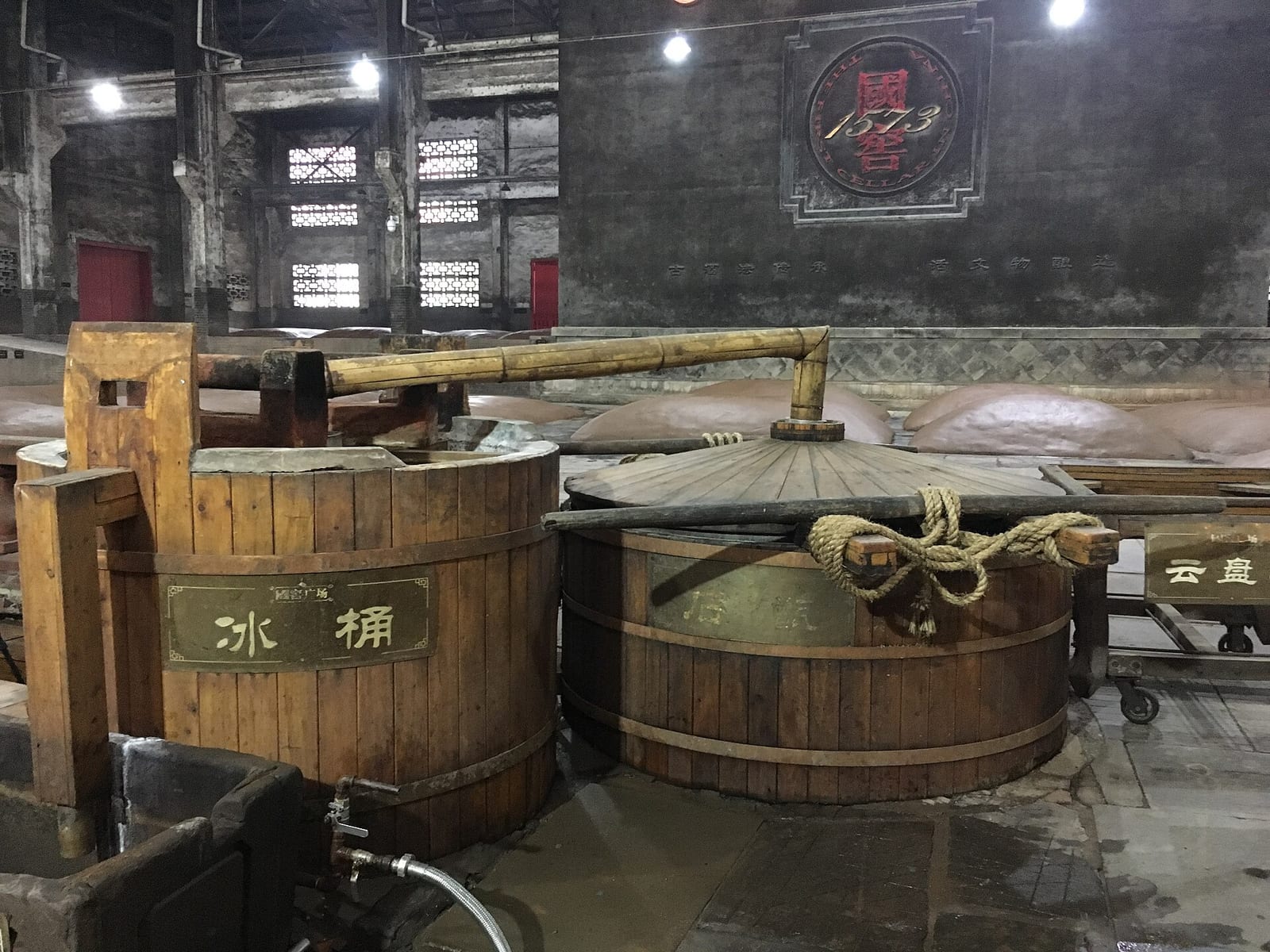
That is why the image of Luzhou Laojiao's old distillation room matters. The squat wooden equipment, bamboo pipe and rows of fermentation pits do not look like the polished still-life normally used to sell a clear spirit. Strong-aroma baijiu is associated with mud-pit fermentation; in the room, the architecture itself participates in flavor.[1][6]
The resulting liquid is mostly ethanol and water, but the minor fraction does extraordinary aromatic work. A 2023 review describes esters, acids, alcohols, aldehydes, ketones, pyrazines and sulfur compounds acting together, sometimes amplifying and sometimes masking one another.[2] The family name therefore identifies more than a tasting note. It points toward a linked ecology of grain, starter, vessel, microbes, fermentation and distillation.
For a beverage director, this is liberating. Pairing does not have to begin with brand prestige or bottle age. It can begin with the course's dominant action—frying, roasting, steaming, fermenting—and then choose an aroma family that either echoes that action or cuts across it.
Strong aroma wants the crispy, sticky course
Strong-aroma baijiu is the maximalist. The research literature places esters at the center of its profile, especially ethyl hexanoate, alongside acids and other compounds that build fruity, floral, cellar-like and sometimes funky impressions.[2] In more approachable sensory language, Decanter finds guava, pineapple and bubble gum in the family.[3] Those are not dainty top notes floating above neutral alcohol. They arrive like ripe fruit left beside a warm fermentation room.
Put that energy beside the menu's crisp, fatty, sweet-hot course. Think lacquered pork with a brittle edge, fried chicken skin with fermented chile, or a glazed root vegetable over a nutty purée. The spirit's fruit can enlarge caramelization; its acidity and volatile lift can reopen the palate after fat; its cellar funk can meet, rather than fear, fermented seasoning.
The bad match is delicacy for delicacy's sake. A whisper-thin raw white fish may simply disappear. The better course has a hard edge and a soft center, enough sugar or browning to catch the fruit, and something sour, bitter or hot to stop the combination becoming sticky. Serve the baijiu at room temperature in a small tulip-shaped spirits glass if aroma is the lesson. A traditional cup preserves the social gesture, but its quick-drinking shape can work against slow attention.[3]
Sauce aroma belongs with browning, not soy-sauce theater
Sauce-aroma baijiu is often translated too literally. The name does not mean the spirit tastes like a spoonful of soy sauce, and it certainly does not require the chef to paint every plate brown. Studies describe a far wider register: sauce-like, roasted, grain, caramel, nutty, floral, fruity and aged aromas, with sulfur- and nitrogen-containing compounds contributing cooked-vegetable, toasted-sesame, onion, meat-like and smoky suggestions.[2] Even laboratory reconstructions have struggled to reproduce the defining “sauce” character completely, a useful warning against tidy tasting-note certainty.[2]
Its natural home is the roasted or braised middle course: charred mushroom with a reduced vegetable jus, tea-smoked duck, a deeply browned cabbage, or beef glazed just enough to shine. Here the pairing works by resonance. Roasted aromas find roasted aromas; grain meets toasted grain; the spirit's savory strangeness lengthens the finish after the sauce has left the tongue.
Resonance still needs contrast. Pickles, bitter greens or a fresh allium can keep the course from sinking into one dark register. Avoid adding soy solely to “match” the category. That turns an aroma classification into theme-park literalism. The more elegant move is to build Maillard browning and fermentation into the food, then let the baijiu reveal their neighboring smells.
Light aroma is the reset button that still has a voice
Light-aroma baijiu is not flavorless baijiu. Research describes fruity, floral, sweet, grassy, earthy and mushroom-like possibilities; ethyl acetate and other odorants help define its profile.[2] Compared with the tropical saturation of strong aroma or the roast of sauce aroma, however, it can read as cleaner and more linear. Decanter's list—sesame, white chocolate, bell pepper, even Brussels sprout—shows why “light” should not be confused with neutral.[3]
That makes it useful at a tasting menu's hinge, where one savory movement needs to end before another begins. Try it with a steamed dumpling in clear broth, poached poultry with a restrained sesame sauce, or a warm brassica course sharpened by rice vinegar. The spirit can pick up sesame, grain and green vegetable while its dry alcoholic line clears the previous course's richness.
The temptation is to label this the beginner's baijiu and pour it first. Resist. A flight ordered from quiet to loud may make sensory sense in a classroom, but a dinner should follow the food. Light aroma may work better in the middle, after a rich fish or before red meat, precisely because it resets without becoming anonymous.
Rice aroma can end softly without becoming dessert
Rice-aroma baijiu is made principally from rice, commonly with xiaoqu, followed by fermentation and distillation. The flavor review describes a softer, slightly sweet finish and identifies ethyl lactate, ethyl acetate and beta-phenylethanol among important aromatic compounds.[2] Current specialist writing likens the family to distilled sake, with melon, seaweed and gentle salinity among its reference points.[3]
Its best position is beside a quiet, textural course: steamed shellfish with rice lees, a tender white fish with fermented rice and herbs, silken tofu with a clear mushroom broth, or a barely sweet rice-and-cultured-cream transition before dessert. This is matching by material memory. Rice meets rice; lactic softness meets cultured flavor; faint salinity can pull sweetness back toward the savory table.
Do not bury it under a high-sugar dessert. Alcohol can feel hotter when the food is much sweeter, while the family's gentler detail vanishes. If the menu needs a sweet-adjacent ending, use toasted rice, pear, cultured dairy or white sesame and keep the sugar restrained. Rice aroma should close a sentence, not supply the exclamation mark.
Four families do not require four pours
A menu could use this whole map and still serve only one baijiu. In fact, one excellent match is usually the stronger editorial choice. Four 10-milliliter pours of a 50% spirit contain about 20 milliliters of pure alcohol before any wine, sake or cocktails enter the meal. The arithmetic is a reminder that “tiny” describes the glass, not necessarily the dose.
If two baijius genuinely advance the menu, separate them by several courses and give them different jobs: perhaps strong aroma with a fried opening bite, then sauce aroma with the roasted centerpiece. Do not place four family samples in a row and call that pairing. That is a spirits class interrupting dinner.
The social context also requires care. Baijiu has long belonged to collective meals, toasts and reciprocal hospitality; the saying “without alcohol, it is not a banquet” captures its bonding role.[4] But hospitality can become pressure. A recent Associated Press report describes younger Chinese drinkers pulling away from compulsory, high-volume banquet drinking even as producers and bartenders explore lower-alcohol products and cocktails.[5] Fine dining should preserve the sense that the pour is shared while discarding the idea that refusal spoils the ritual.
The server can do this in one sentence: “This is a small optional pour of strong-aroma baijiu; its fermented pineapple and cellar notes are here for the fried course—sip it, return to it, or leave it.” No exhortation to drain the glass. No stealth refill. A non-alcoholic pairing should receive equal attention rather than arriving as the abstainer's consolation prize.
This approach also returns dignity to the category. Baijiu does not need to become whisky, and it does not need citrus and sugar before an international dining room will tolerate it. The clear spirit can remain culturally recognizable—poured neat, shared at the table, tied to grain and fermentation—while the service becomes more precise and more voluntary.
The most convincing baijiu pairing is therefore not the loudest bottle beside the loudest dish. It is the moment a guest tastes why the spirit and course were placed together: tropical ester against crisp skin, roasted sulfur beside char, clean grain between rich courses, or soft rice after steam. One small pour can do that work. The refill would only blur it.
Sources
- Xiao-Wei Zheng and Bei-Zhong Han, “Baijiu (白酒), Chinese liquor: History, classification and manufacture.” Journal of Ethnic Foods 3 (2016) — open-access overview of materials, qu, fermentation, distillation, aging, production categories and microbial differences.
- Zhen-Hao Xu et al., “A review on flavor of Baijiu and other world-renowned distilled liquors.” Food Chemistry: X 20 (2023) — review of the four principal aroma families, key odorants, sensory evidence and the limits of aroma reconstruction.
- Decanter, “Baijiu basics: Get to know the world's most valuable spirit” (March 27, 2026) — current specialist account of the four principal aroma categories, accessible sensory descriptions, traditional 15-milliliter cups and contemporary service.
- Derek Sandhaus, “Setting the Table.” Drink Baijiu (May 26, 2018) — account of qu, its relationship to Chinese fermented foods and baijiu's social place at the banquet.
- Huizhong Wu, “China's fiery baijiu spirit evolves to attract younger drinkers.” Associated Press (August 1, 2025) — reported context on alcohol strength, banquet toasting, declining compulsory drinking and newer low-alcohol and cocktail formats.
- Xiaomage de, “Traditioneller chinesischer Destillationsapparat in der Brennerei Luzhou Laojiao.jpg.” Wikimedia Commons — source and CC BY-SA 4.0 license page for the 2016 documentary photograph of the Luzhou Laojiao distillation room and fermentation pits used here in a resized version.