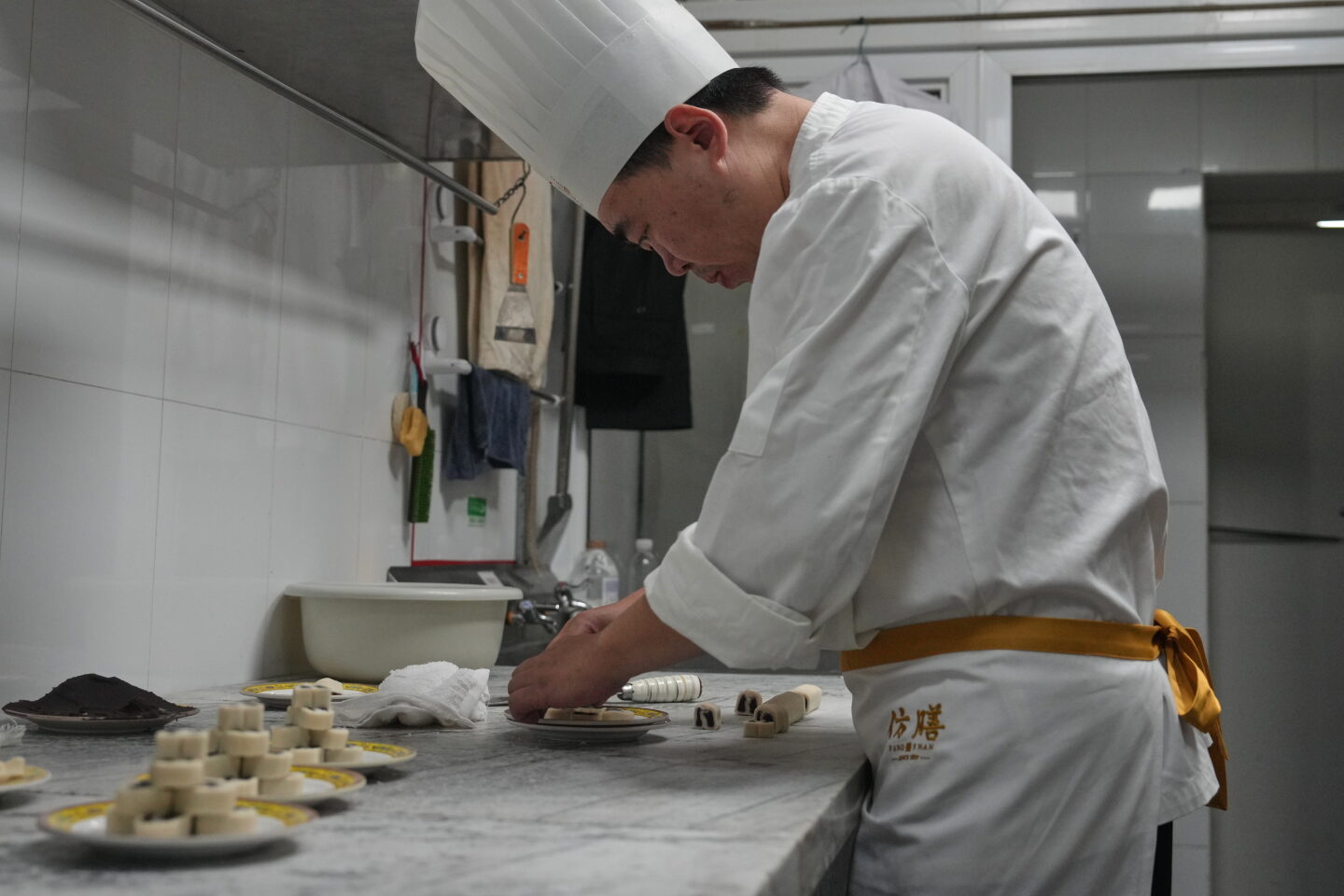
At Fangshan, a red bean roll begins by refusing the smoothness of a machine. The beans are worked through a sieve; special flours meet custom copper pots; a cook's hands preserve the faintly sandy texture that a blender would erase. On a busy day, more than 200 pea-flour cakes may leave the kitchen. Repetition is unavoidable. Mechanical sameness is not.[1]
That distinction is the restaurant's whole history in miniature. Fangshan opened in Beijing's Beihai Park in 1925, thirteen years after the Qing dynasty ended. Former cooks from the imperial kitchen started it as a teahouse serving palace-style pastries and dishes. Even the name declines to promise an unbroken royal table: fangshan means food made in imitation of the imperial kitchen.[1][3]
“Imitation” can sound like a confession of inferiority. Here it is closer to intellectual honesty. The Qing court was not a restaurant waiting for civilian customers. It was a sealed administrative world in which rank determined provisions, eunuchs carried lacquered food boxes, rulers generally ate alone, gifts of food expressed hierarchy, and different offices managed daily meals and state banquets.[2] Once the emperor disappeared, that system could not simply continue. To preserve court cooking, Fangshan first had to translate it into hospitality.
The Palace Was A System, Not A Menu
Modern diners tend to imagine imperial cuisine as a parade of rare ingredients on an overfilled table. The Palace Museum's account is stranger and more revealing. In the Qing court, meals followed protocols of offering and bestowing food. The emperor's allotted ingredients exceeded those of people below him in rank. Three square tables could be covered and loaded from red lacquer boxes, yet many dishes functioned partly as display and could later be distributed through the household.[2]
Time itself was courtly. The museum places the two main daily meals roughly between 7 and 9 in the morning and 1 and 3 in the afternoon, with pastries and other snacks between them. Major banquets belonged to a separate ladder of occasions and administrative tiers: New Year, imperial birthdays, weddings, military victories and diplomatic receptions did not all mean the same meal.[2]
This matters because a surviving recipe is only one fragment of that world. Remove the rank, household, ritual calendar, procurement network and labor force, and the same dish does different work. A steamed corn bun eaten by a paying guest in a park restaurant cannot carry exactly the meaning it held inside a palace.[1] Fangshan's lineage is therefore not a straight line from an emperor's bowl. It is a conversion: private privilege becomes a public reservation; household allocation becomes an order; ceremonial display becomes restaurant theater.
The conversion began with people who still possessed embodied kitchen memory. Quanjude Group, Fangshan's current parent company, names former Qing imperial cooks Zhao Renzhai, Sun Shaoran, Wang Yushan and Zhao Chengshou among the founders of the 1925 teahouse. Its own history defines their project precisely: to prepare dishes and pastries by imitating the methods of the imperial kitchen.[3] The founders did not bottle an entire court. They selected techniques that could survive outside it.
A Sieve Can Carry A Lineage
The most persuasive survivors are not always the grandest. Recent reporting from Fangshan's kitchen follows chef Zhou Tong making red bean rolls, pea-flour cakes, small corn buns and a pastry associated with Empress Dowager Cixi. Zhou learned from a master who had learned from a mentor. The restaurant's rule against blenders and processors is not anti-modern decoration; sieving preserves a delicate grain that high-speed puréeing would flatten.[1]
That texture gives the historical claim something a diner can test. A story about Cixi may be charming, but court anecdotes are easy to embroider. Zhou describes the desired result as a delicate graininess, a sandy mouthfeel that machine processing would erase.[1] Lineage becomes credible when it lives in a repeatable sensory consequence rather than in costume alone.
The same logic appears in nizihuo, a technique executive chef Fan Liangliang describes as mincing fish, shrimp or chicken into a smooth paste and reshaping it as frogs, birds or flowers. It risks reading as ornamental nostalgia until one considers the labor required to make the mince hold together and keep the form legible after cooking. Fan says he had to unlearn some of culinary school's speed-first habits when he apprenticed at Fangshan.[1] The palace survives here as disciplined slowness, not merely as a dragon on the plate.
Beijing's municipal guide gives the living repertoire a less mythic cast: stir-fried fish fillet, pork kidney and liver, prawns, pea sauce and cucumber sauce sit alongside the pastries. It also notes that Fangshan's Qing imperial cooking techniques have been listed as national intangible cultural heritage.[4] Recognition protects a practice, but it does not freeze it. It asks a harder question: which motions, textures and flavor structures must remain recognizable when ingredients, laws and appetites change?
Preservation Requires Substitution
Fangshan's answer includes refusal. Bear paw and other rare ingredients once associated with elite abundance are no longer served. The kitchen substitutes what is available and acceptable while trying to keep each dish's inherited spirit legible.[1] That boundary prevents heritage from becoming an excuse for obsolete luxury.
It also exposes the weakness in the word “authentic.” If authenticity means using every historical ingredient, the restaurant should fail. If it means recreating the entire political order that gave the food meaning, it must fail. A modern dining room cannot reproduce a court without reducing history to pageant. Fangshan is more convincing when it preserves relationships: handwork to texture, shape to occasion, technique to mentorship, and a narrated dish to the record that makes its reconstruction plausible.
The restaurant's movement through Beihai Park sharpens the argument. Fangshan moved into the Qianlong-era Yilan Hall complex in 1959, but vacated it in 2016 so the historic buildings could be restored; the halls now receive visitors as a heritage site rather than a dining room.[5] A Fangshan teahouse has since reopened on the park's north shore, returning palace-style pastries to a more ordinary, affordable park stop.[6] The setting still offers painted beams and lake light, but the address itself demonstrates the article's point: preservation changes the container. Public entry—not permanent possession of one imperial hall—is part of the transformation.
The Most Honest Luxury Is Reconstruction
There is still reason for skepticism. Stories attached to famous rulers can make any pastry taste more important. Yellow tablecloths and palace architecture can blur the line between preservation and theme dining. Fangshan has changed ownership and name, shifted locations, and entered a formal heritage system.[3][5] No serious history should pretend that a plate served in 2026 is untouched from the nineteenth century.
But untouched continuity is the wrong standard. Fangshan's achievement is that it makes the breaks visible enough to discuss. The dynasty ended; cooks entered the market; a private teahouse passed into state ownership and took a new name in 1955; its cooking entered the national intangible-cultural-heritage list in 2011.[3] Scarce or unacceptable ingredients disappeared, modern chefs relearned slow techniques, and guests began buying what was once embedded in rank.[1] Each break changes the food, yet each also creates a new carrier for the craft.
That is why “imitation” is the restaurant's strongest word. It replaces a fantasy of perfect survival with the more interesting work of selection. The kitchen must decide what a machine would destroy, what a substitute can preserve, what a story clarifies, and what should be left in the past. A sieve becomes more important than a throne because the sieve can still change the bite.
Fangshan did not save the Qing court. It built public hospitality from some of the court's surviving gestures. The red bean roll is still shaped by hand to retain a deliberately grainy mouthfeel.[1] What reaches the guest is not an emperor's breakfast restored whole, but a century of cooks choosing which pressure to keep. That smaller claim is exactly why it carries weight.
Sources
- María Teresa Hernández, “Once shaped by court rituals, China's imperial cuisine lives on today.” Associated Press, August 19, 2026 — reporting and photography from Fangshan on pastry handwork, apprenticeship, nizihuo, substitutions and the restaurant's modern preservation choices.
- Palace Museum Youth, “The Imperial Cuisine Unveiled” — institutional overview of Qing meal rituals, allotted provisions, dining times, food distribution and banquet administration.
- China Quanjude Group, “Fangshan Restaurant” — official history of the 1925 teahouse, its imperial-kitchen founders, 1955 change in ownership and name, handmade repertoire and 2011 heritage listing.
- Beijing Municipal Government, “Try Traditional Cuisine in Parks in Beijing” — documented Fangshan repertoire, Beihai Park setting and national intangible-cultural-heritage status.
- Beijing Municipal Forestry and Parks Bureau, “Yilan Hall Scenic Area Reopens After Three Years of Restoration” (Chinese), February 21, 2023 — the restaurant's 1959 move into the historic complex, its 2016 departure and the halls' restoration for visitors.
- Beijing Municipal Bureau of Culture and Tourism, “Fangshan Teahouse Revives Royal Pastry Traditions” — current north-shore Beihai Park teahouse and its accessible palace-style pastry service.