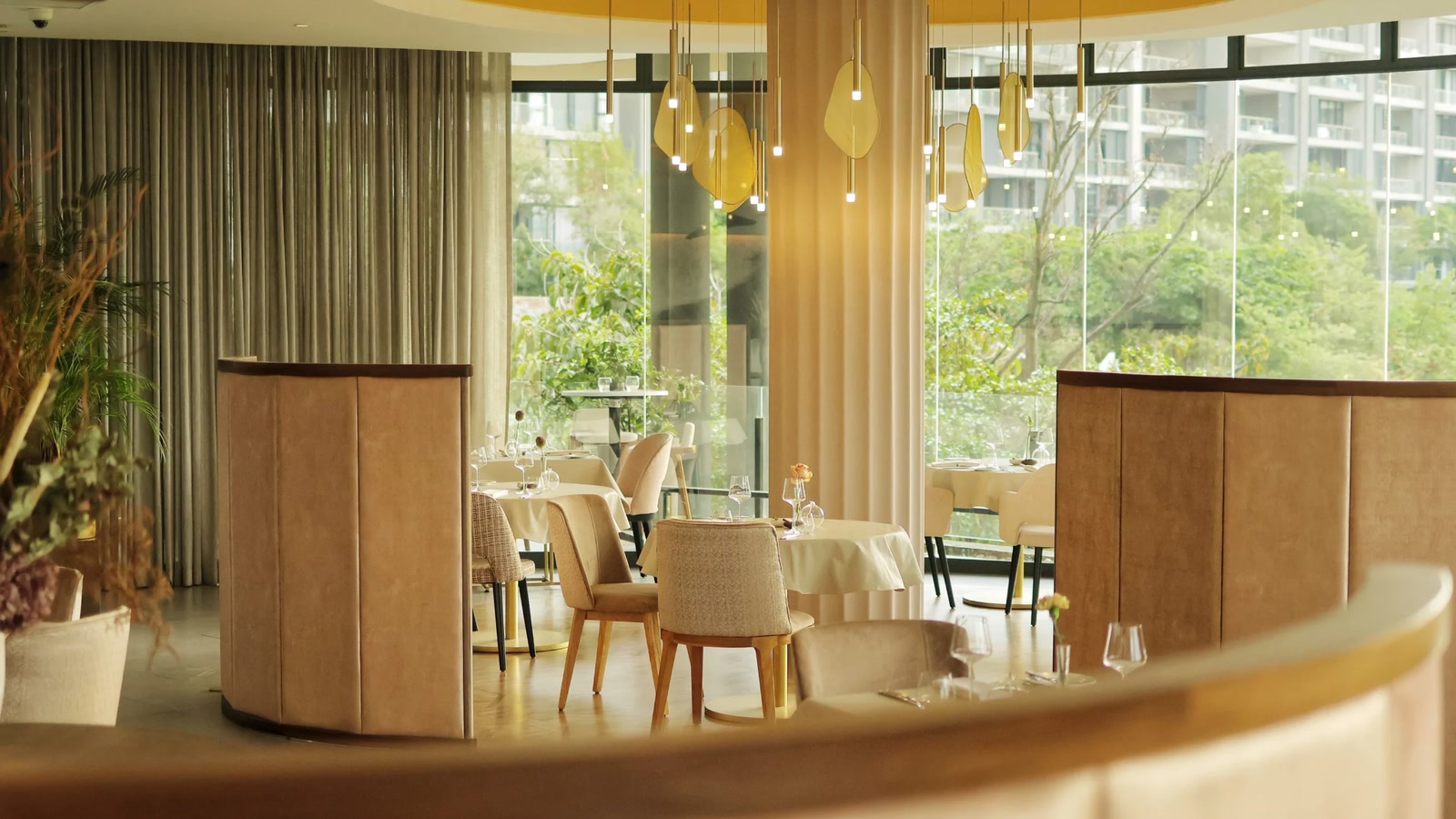
Cyra catches Johannesburg at the moment daylight turns flattering. Curved peach banquettes and pale chairs gather beneath suspended gold lights; white-clothed tables keep enough distance for conversation; garden green opens beyond the glass.[3][4][9] It is the sort of setting that could persuade a restaurant to whisper all night.
Chef Candice Philip's food does something more useful: it lets the room whisper, then puts an edge on the plate. Early reviewers repeatedly found softness interrupted by crunch, richness checked by acid, and polished presentation made appetising by smoke, pickle or bitterness. Their shared favourite was not caviar or a trophy cut of meat. It was a tomato course sharpened with ginger and cucumber, layered with smoked tomato jelly and fennel aioli.[3][4]
That pattern—not any one dish—is the strongest case for Cyra after its first two years. The restaurant opened at the Houghton Hotel in October 2024 and quickly collected acclaim.[3][4][8] Yet the tasting menu changes with the seasons, and the menu available now is not the one those opening reviews judged.[1] A fair synthesis can therefore say more about Philip's working grammar, the room and the service than it can about how a particular plate will eat tonight.
The calm is architecture, not the whole experience
Cyra took over the former Séjour space with a name the restaurant connects to the sun, then built the idea through warm metal, muted colour and open views.[2][3] Kgomotso Moncho-Maripane described a room of golden hues, greenery and hand-worked metal with generous space between tables. Johannesburg In Your Pocket found the pace warm and unhurried, with enough room to take a balcony walk during a dinner that ran from 19:00 until after 22:00.[3][4]
Those observations matter because quiet luxury can become anaesthetic. Beige rooms, hushed voices and tiny courses sometimes remove friction until dinner feels like being politely erased. Cyra's early notices point to a different bargain. The room lowers social pressure while the food keeps sensory pressure alive.
The photographed interior makes the distinction plain. Its peach, cream, gold and garden green are atmospheric rather than thematic; nothing in the room explains a dish before it arrives.[9] Philip's official profile calls her cooking modern European and stresses unusual pairings, bold flavour and complex texture beneath apparently simple presentations.[2] The language is broad, but the reviews supply the missing evidence: smooth against crisp, fruit against fat, smoke against freshness.
This separation is one of the restaurant's strengths. The décor promises care. The plate still has to create appetite.
The tomato was an early proof of method
Two detailed early accounts covered substantially the same summer sequence, and their overlap is revealing. Both began with lemon bread and miso butter, then moved through a savoury doughnut, beef-and-mushroom tartare, tomato, ostrich, sea bass, beef, cheese and nectarine.[3][4] They did not merely agree that the food looked delicate. They singled out the places where delicacy acquired resistance.
The tomato course is the clearest example. Roasting concentrated the fruit; pickling and a ceviche-like dressing raised the acidity; smoked tomato jelly deepened the register; cucumber and ginger refreshed it; fennel aioli added a creamy layer; a crisp element stopped the composition from becoming sauce on sauce.[3][4] The dish sounds elaborate, but its logic is simple enough to taste in the description: tomato is made more tomato-like, then prevented from becoming monotonous.
The beef course worked by the opposite route. Fillet, layered potato and truffle jus could easily have become an upholstered block of richness. Moncho-Maripane praised the jus for keeping truffle in proportion, while In Your Pocket found the plate warm and deeply satisfying rather than merely grand.[3][4] Restraint here did not mean using less flavour. It meant refusing to let the most expensive-smelling ingredient take over.
The reviews were not perfectly unanimous. Moncho-Maripane admired a hibiscus addition to sparkling wine at dessert but still wanted a dessert wine.[3] That is a small dissent, yet a useful one: an inventive pairing still has to satisfy the course's emotional finish. Novelty does not win automatically.
The ostrich kept the method from becoming a formula
A third full early review admired the tomato but eventually chose the ostrich as its favourite course. Marie-Lais Emond described beetroot worked into a soft paper over ostrich carpaccio, with deeper beetroot, cherry and duck liver beneath it.[5] The plate did not repeat the tomato's bright architecture. It moved the same appetite for contrast into a darker register: lean meat against liver, fruit against earth, a sheet-like garnish that softened under the fork instead of supplying another brittle snap.
The sequence kept changing pressure. Sea bass arrived with crisp skin, leek and spirulina. Beef brought walnut, shiitake and truffle, but Emond praised the truffle for contributing to the jus rather than trying to become the dish's whole identity.[5] These are different moves from pickle plus cream, yet they solve the same problem. Each course needs a counterforce that makes richness feel intentional.
That variety matters. If every plate were sharp acid plus crisp garnish, contrast would harden into a house mannerism. The early menu instead shifted among temperature, texture, bitterness, fruit and savoury depth.[3][4][5] A third enthusiastic account strengthens the consensus around Philip's method. It also exposes the evidence limit: all three detailed reviews belong to the restaurant's early seasonal cycle. Agreement across critics is useful, but it is not the same as inspection across several generations of menu.
Today's menu is a new test, not a victory lap
As accessed on August 29, 2026, Cyra's own menu page offers a four-course choice menu alongside seven-course signature, pescatarian and vegetarian routes. It lists the four-course food menu at R980 and the seven-course menus at R1,350, before a discretionary 12.5 percent service charge; wine-pairing options are published separately.[1] Those are time-sensitive details, not promises about a future booking.
The current signature sequence again makes contrast easy to see on paper. Rye bread comes with smoked butter; a salmon-and-Champagne doughnut is paired with sweetcorn and seaweed; kudu tataki meets beetroot, walnut and duck liver; squid meets leek, cannellini beans and chorizo; beef fillet is set against cauliflower, Marmite and romesco; banana closes with rum, miso and tonka.[1]
The shorter route has already evolved in public. In September 2025, Time Out Johannesburg reported a newly launched four-course menu at R895, with choices including smoked tomato jelly and curry-leaf custard or sea bass with tiger's milk, cucumber, apple and coriander.[6] The current four-course page is priced at R980 and lists a different set of constructions.[1] Tomato may return, but the surrounding argument does not stand still.
These combinations fit the method the early reviewers admired, but they are not proof of execution. Marmite can lend fermented depth or bulldoze a sauce. Miso can make banana taste longer or simply make dessert busy. Walnut and duck liver can give kudu bass notes, yet tataki still rises or falls on temperature and texture. The public menu tells us that Philip's appetite for counterpoint remains. Only a current visit can establish whether every counterpoint resolves.
The online record itself advises caution. The restaurant says menus may change with seasonal availability and without notice.[1] The price, choices and format reported in September 2025 already differ from the menu published now.[1][6] That is not a culinary flaw. It is a reminder to treat Cyra's own menu and booking channel as the live record rather than turning an old review into a planning document.
Service may be the most durable course
Across the professional accounts, service attracts unusually consistent praise. Moncho-Maripane found it attentive, collaborative and cohesive. In Your Pocket described personalised, unstiff hospitality and gave particular attention to sommelier Solly Mmethi's work: tasting broadly, deciding whether a wine should mirror a dish or oppose it, and explaining the result without turning the table into a classroom.[3][4]
The current diner record points in the same direction. On August 29, 2026, Dineplan's rolling twelve-month summary showed service rated above food, value and ambience; recent comments also praised individual hosts even when one table found parts of its meal less convincing.[7] Aggregated diner scores are not equivalent to an anonymous critic's review, and they can move. Here they are useful as a continuity check. Menus changed, but guests kept noticing the room team.
That consistency matters in a restaurant built around surprise. Unusual pairings need trust. A guest is more willing to follow Marmite toward beef or coffee toward duck when the person presenting the plate can explain the intention, read the table and then step away. Warmth is not the decorative opposite of technical food. It is what lets technical food land without defensiveness.
What the awards prove—and what they do not
Cyra's first-year momentum was real. The 2025 Luxe Restaurant Awards named it Fine Dining Restaurant of the Year, gave it two Luxe stars and named Philip Chef of the Year.[8] Dineplan's current listing also records its 2025 Eat Out Best New Restaurant recognition.[7] Awards can identify attention, peer approval and a strong opening. They cannot preserve a tomato at peak ripeness or guarantee that a seven-course sequence will hold its rhythm on a particular night.
The more interesting verdict is narrower. Cyra has built a recognisable house style without making the room shout about it. Its visual calm is not copied directly onto the food. Philip uses polished surfaces, but beneath them she keeps returning to friction: acid against cream, smoke against fruit, crispness against purée, umami against sweetness. Reviewers noticed the pattern across the opening sequence, and later menus still declare it.[1][3][4][5][6]
There is an honest limit. The strongest published criticism belongs mostly to the early seasonal menu, while later format reports are closer to announcements than anonymous reviews. Current diner feedback suggests that service and ambience may be more consistent than every course.[3][4][5][6][7] Cyra deserves a fresh independent review of the food now being served.
Until then, the early record supports one confident conclusion. The restaurant's softness is not a lack of nerve. It is staging. Sunset colours, generous spacing and warm service make room for cooking that likes a little abrasion. Cyra works when the room holds the guest gently and the plate refuses to go limp.
Sources
- Cyra, “Menus” — current four- and seven-course formats, dish compositions, prices, pairing options, service charge and seasonal-change notice; accessed August 29, 2026.
- Cyra, “Chef Candice” — official account of Candice Philip's cooking style, tasting-menu format, vegetarian and pescatarian provision, and the restaurant's intended soft atmosphere.
- Kgomotso Moncho-Maripane, “A Candice Philip renaissance.” TimesLIVE, February 24, 2025 — early review of Cyra's summer menu, room, service, pairings and individual courses.
- Johannesburg In Your Pocket, “Review: The stars align at Cyra at The Houghton Hotel by Chef Candice Philip,” 2025 — detailed early account of menu texture, wine-pairing logic, pacing, hospitality, opening date and the room's golf-course outlook.
- Marie-Lais Emond, “Candice Philip brings the Joburg sun out again at Cyra.” Daily Maverick, December 13, 2024 — independent early review of the tomato, ostrich, sea bass, beef, room and service.
- Poelano Malema, “Experience fine dining at its best with Cyra's new dinner offerings.” Time Out Johannesburg, September 10, 2025 — launch date, price and choices for Cyra's first published four-course spring/summer format.
- Dineplan, “Cyra” — live booking page, current formats and rolling twelve-month verified-diner scores and comments; accessed August 29, 2026.
- Poelano Malema, “Johannesburg restaurants win big at the 2025 Luxe Restaurant Awards.” Time Out Johannesburg, February 20, 2025 — Cyra's Fine Dining Restaurant of the Year and two-star awards and Candice Philip's Chef of the Year award.
- Cyra, “Gallery” — first-party source page for the real dining-room photograph used as this article's cover.