A piece of sourdough dragged through stracciatella is an inviting way into a restaurant's philosophy. In her May 2026 Nairobi guide, Wallpaper travel director Lauren Ho describes Cultiva's fire-oven caprese alongside its working farm and gardens.[1] The combination offers a useful introduction: a familiar Italian idea, a warm cooking method, and bread that makes the sauce part of the meal.
Cultiva, in Nairobi's Karen area, has built its identity around growing things while allowing its cooking to travel widely. The interesting question is how those two impulses fit together. An Ecuadorian founder, a Kenyan business partner and a repertoire that has included dim sum, ceviche and pizza make the restaurant more particular than the phrase “farm to table” can convey.[2][4]
This profile follows published interviews and reporting. The dishes are examples from the dated accounts cited below; they describe the kitchen's approach rather than promise a particular menu on arrival.
Before the dining room, a catering problem
Ariel Moscardi's route to Nairobi ran through kitchens and growing plots. Kari Mutu's 2021 Business Daily profile traces his training at Le Cordon Bleu in Mexico, a catering business established in Ecuador in 2014, and seeds supplied by his grandmother for microgreens and edible flowers. He met safari operator Peter Silvester while catering for yacht guests in the Galápagos. Their collaboration took him into Kenyan safari catering in 2018, before the restaurant opened in 2019.[2]
Those beginnings make the farm easier to understand. Catering requires a cook to reproduce an appealing plate many times, often away from the comfort of a restaurant kitchen. Growing a particular leaf or flower gives that cook another way to shape the result before service begins.
In Njeri Muthari's interview for Luxury Life Kenya, Moscardi connects the growing project directly to the difficulty of keeping individually plated catering food fresh and vivid. His mother was an agronomist; agriculture was already part of his upbringing. Microgreens and flowers offered a practical response to something he wanted on the plate.[3] The garden began with a cook's dissatisfaction, which gives its prettiness a purpose.
A worldly menu takes root
The first Nairobi restaurant had five tables made from old oil drums. Mutu records hamburgers and dim sum among its early offerings, alongside food shaped by available farm ingredients.[2] That is a cheerfully unceremonious beginning for a place now discussed as a destination restaurant.
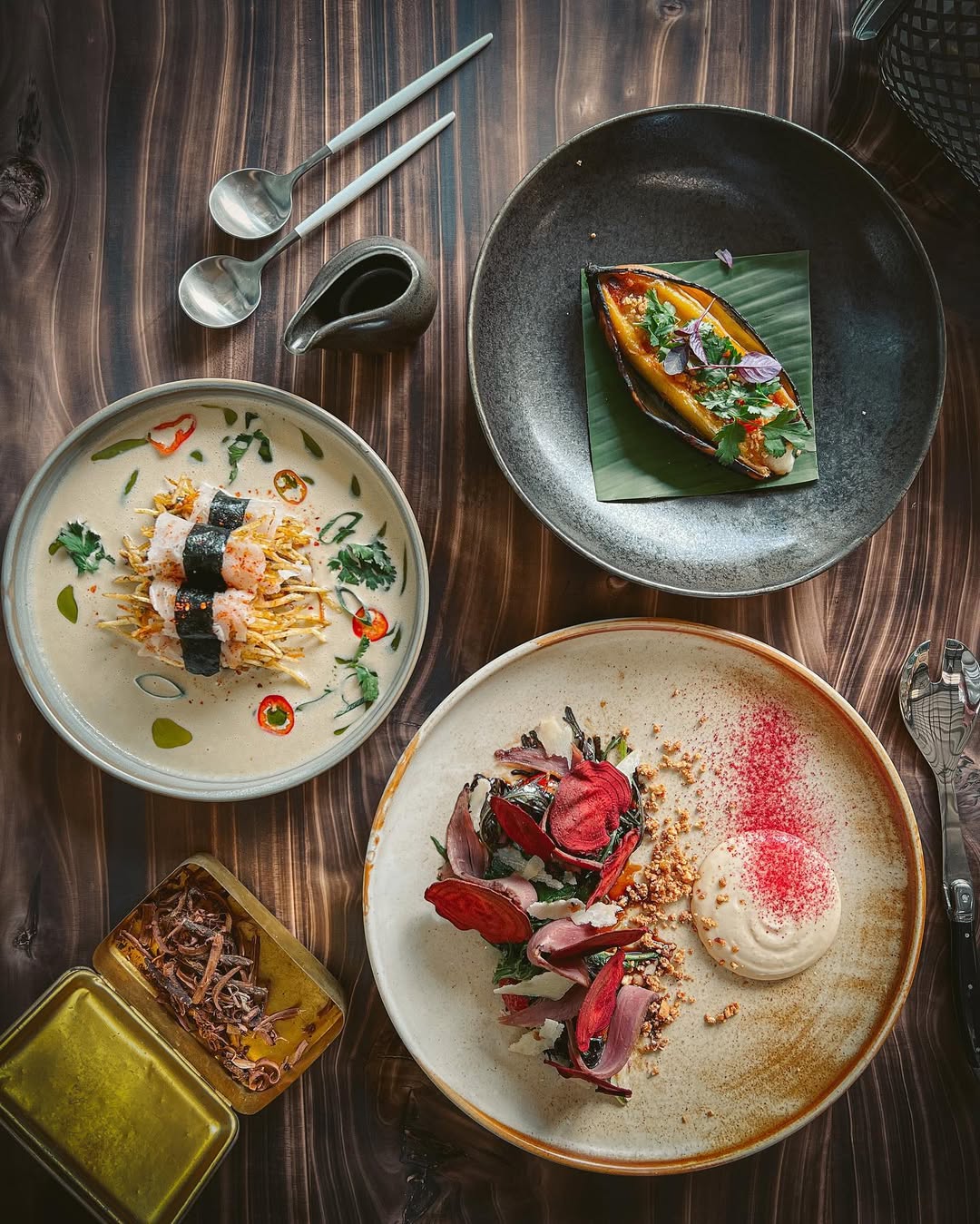
The pleasure of reading its menus across time is the absence of a single culinary passport. In a separate September 2021 review for The EastAfrican, Mutu describes a sharing platter combining avocado, lentils, kimchi and tofu, with edible flowers and substantial slices of charred bread. Elsewhere in the meal came baked Camembert and pork wontons in a clear sauce. She also records a stone pizza oven and pans of microgreens growing on the kitchen counter.[4]
These are dishes with different histories and different ways of holding a mouthful together. A dumpling encloses; a platter invites mixing; bread lets the diner gather what remains. Read this way, the menu's variety gives produce several routes to the table. The continuity lies in the kitchen's handling of ingredients, while the forms remain open to borrowing.
That is an interpretation of the reported repertoire, not a claim that every experiment succeeds. It does, however, explain why caprese can belong comfortably in the same restaurant story as dim sum. The garden supplies possibilities; it does not dictate one cuisine.
The work stays in view
Early photographs and descriptions of Cultiva put its construction close to the dining experience. In an account of the pop-up, The Expat Mummy describes the eating space between two shipping containers used as kitchens, with a substantial wooden bar, barrel furniture, roses and candlelight.[6] The materials gave the restaurant a provisional, handmade character.
Moscardi's later explanation to Muthari makes visibility part of the intention. “I didn't want walls,” he says, describing an open arrangement where guests might see sacks of flour carried through the tables. He also credits the people working at Cultiva with building the place.[3]
The flour is an especially good detail. It lets the restaurant remain a workplace during dinner. A guest can register the ingredients as weight and volume before encountering them as a neat portion. There is a kind of hospitality in leaving that connection visible: the room includes the making of the meal.
What the garden can tell you
Kainyu Njeri's account in Cha Kula, published by the Route to Food Initiative, provides a closer view of the growing side. During her visit she describes varieties of kale, lettuce, carrots, tomatoes and herbs, and restaurant organic waste returning to the garden as compost. Her account places the restaurant's own urban farm alongside local sourcing.[5]
That distinction matters. A garden beside a dining room can be both productive and beautiful without supplying everything the kitchen uses. The published descriptions establish cultivation and particular reuse practices; they do not provide an independently measured account of the restaurant's total waste or environmental footprint. Its ambitions deserve to be understood at the scale the evidence supports.
The more immediate culinary point is persuasive enough. The source of an ingredient can influence what a cook chooses to make, and the scraps from that preparation can have another use. Njeri's report gives the green surroundings activity: plants being grown, ingredients being selected, material returning to soil.[5]
Cultiva's appeal in this record comes from the ease with which those processes share space with pleasure. Growing food does not require the menu to become solemn. There can still be a dumpling to open, a crust to tear, and a piece of bread worth saving for the last of the sauce.
Sources
- Lauren Ho, “An insider's guide to Nairobi: 7 unmissable haunts,” Wallpaper, May 25, 2026 — Cultiva's setting and fire-oven caprese; restaurant photograph credited to Cultiva.
- Kari Mutu, “Cultiva Kenya: Farm-to-plate eatery with unique cuisine,” Business Daily, September 22, 2021 — Moscardi's background, Peter Silvester, safari catering and the restaurant's early tables and menu.
- Njeri Muthari, “Cultiva Kenya—The Incredible Story Behind the Plate,” Luxury Life Kenya, undated — interview on the catering origins of the growing project, Moscardi's family background and the open restaurant design.
- Kari Mutu, “Delicious farm-to-fork meals served in greenhouse setting,” The EastAfrican, September 3, 2021 — dated review of the dining room, kitchen counter and dishes.
- Kainyu Njeri, “Good food. Good farming: The role of a chef in influencing change,” Cha Kula, issue 5, pp. 18–21, Route to Food Initiative — interviews, garden observations, local sourcing and composting.
- The Expat Mummy, “Fine dining with a rustic feel at Cultiva” — account of the restaurant in its pop-up form, including shipping-container kitchens, furniture and flowers.