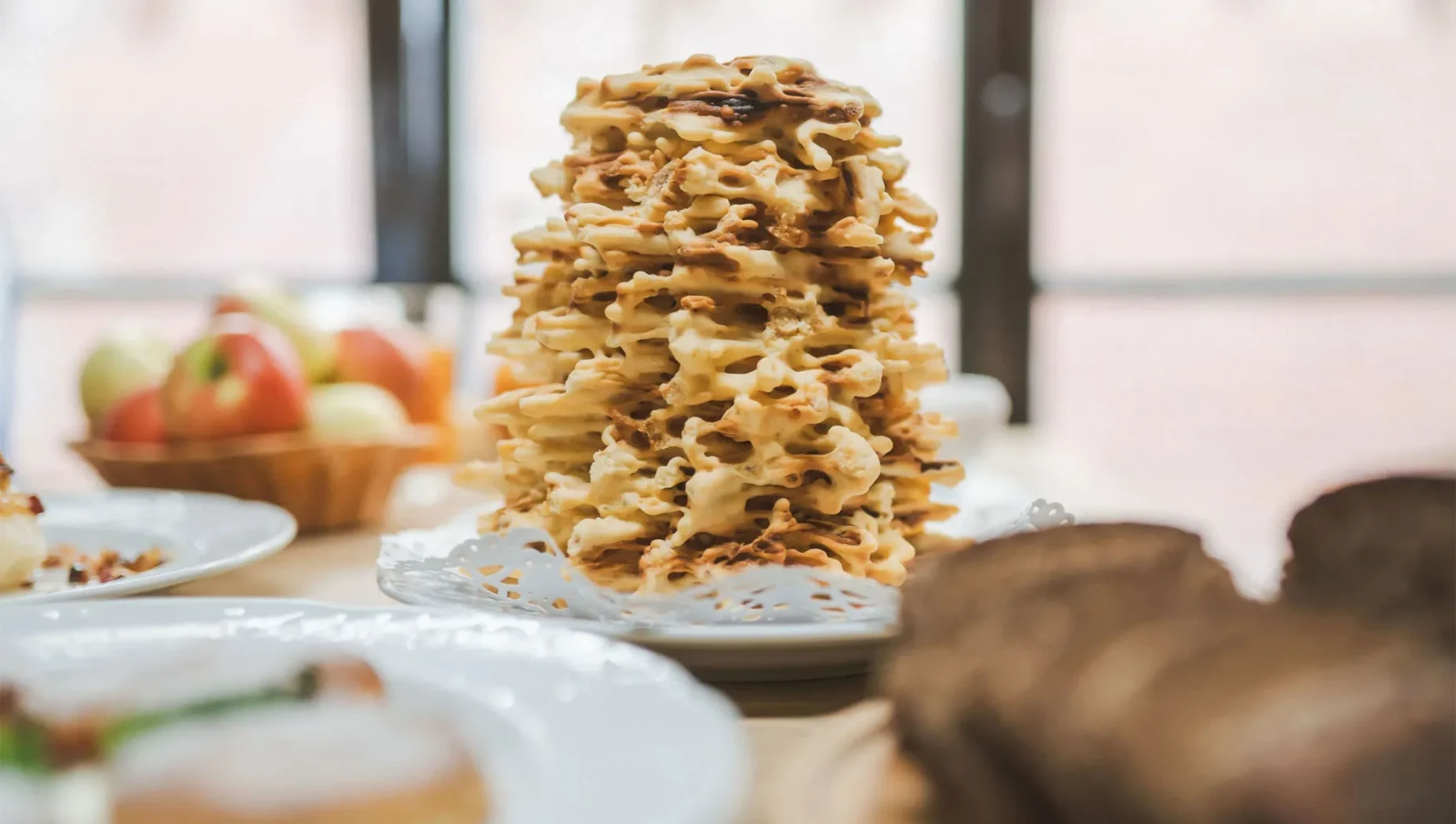
The branches of a šakotis grow during baking. A spit turns, batter lands on its surface, and the accumulating cake develops the golden projections that make it look like a small, extravagantly dressed tree. Butter, eggs, flour, sugar and cream supply the familiar pleasures of a rich cake; movement gives them this remarkable form. Lithuania Travel places šakotis on the country's Christmas and Easter tables, where its silhouette makes an occasion visible before anyone takes a bite.[1]
Seen upright, the cake invites admiration of its height. Seen during baking, it invites a different kind of attention. The useful thing to watch is the next spoonful: where it lands, how it spreads and what has happened to the layer beneath it. Much of the cake's elegance resides in that repeated, apparently modest act.
A cake built one surface at a time
The Vilnius and Trakai bakery business Kibinai describes a method in which a thin coat of batter goes onto an already baked layer. It turns through the heat until golden, then receives another coat. Repetition builds the desired diameter and leaves rings visible in a cross section.[2]
That sequence gives the cut cake a second visual life. Outside, the branches scatter the light; inside, the layers record successive applications. Looking from one to the other connects the showpiece on the table with the time spent beside the oven. Its form contains a record of its making.
The same bakery offers a flat adaptation for a domestic oven: spread a thin layer in a lined tray, brown it under heat from above, and repeat.[2] It is a revealing comparison. Layering can survive a change of equipment, while the upright, branching form depends on the spit. A home version can explore the alternating pale and browned layers without reproducing the whole sculptural cake.
For the diner, those rings are an invitation to look closely before eating. The intricate exterior has an equally interesting interior, especially in a piece cut cleanly enough to show the transitions between layers.
The fire and the handle belong to one job
An unusually detailed account appears in the 2021 registration application for Nijolės Šakočienės šakotis, associated with Skaistgiriai village in the Kėdainiai district. This describes a particular local method. Its bakers scald the flour and rest the batter; the application links this preparation to browning and a slower loss of freshness.[3]
At the oven, the specification calls for dry birch wood stripped of bark to avoid smoke from its resins affecting the cake. The baker controls the chimney draught, pours with a slotted wooden spoon, regulates the fire through different stages and adjusts the spindle's speed so the branches develop.[3]
Read together, these instructions explain why a turning handle alone cannot deliver a finished shape. The baker is coordinating what the batter is doing with how quickly the surface meets the heat. Each new application changes the object being worked on. The cake grows, and the work must respond to that growth.
The appearance therefore gives us a useful way to think about the craft: irregular branches can coexist with deliberate control. Their individual shapes are part of the appeal. A pastry chef's judgment is visible here in the relationship between repeated actions and a result that retains variation.
One silhouette, several kinds of bite
The eye can make promises that the recipe has never agreed to keep. A spiky cake might suggest a brittle mouthful, yet the Skaistgiriai document describes a moderately dense, crumbly texture that holds together when cut and is neither brittle nor crunchy.[3]
Romnesa, another Lithuanian producer, distinguishes its “traditional” and “crumbly” varieties. Its English catalogue also offers cakes in different sizes and decorated versions, making clear that the familiar outline accommodates choices of texture and presentation.[4] These are useful distinctions to ask about when buying a cake or discussing a dessert with a server.
For a tasting, I would begin with an unadorned piece and pay attention to how it breaks and chews. Does it scatter immediately, or hold together? How strongly do the browned surfaces register against the inner crumb? These are questions for the actual cake in front of you. A photograph can establish the shape beautifully; texture requires a mouthful.
That is also what makes a comparison worth arranging. The Ignalina tourism office describes Romnesa's baking programme as including a tasting of both varieties with tea or coffee.[5] A side-by-side serving gives the distinction substance, letting a shared shape introduce two different experiences.
The occasion can begin at the oven
In Lekėčiai, the Šakiai tourism centre describes a workshop in which visitors pour batter onto the roller, turn it themselves beside a wood fire and taste the freshly made cake.[6] The participation matters. Once someone has had a hand on the equipment, a branch on the finished cake becomes something they can connect to an action.
This suggests a generous way of presenting such a dessert: give the making enough space in the occasion. Let people see a layer go on, notice its colour change, and understand why another ladleful follows. The wait has something to look at, and the eventual serving carries a memory of the work.
Šakotis can command a festive table at full height. Its craft becomes more intimate in the small piece passed to a guest: a projecting tip, a patch of browned surface, a few visible layers. The grand silhouette has been divided, but the evidence of how it grew remains.
Sources
- Lithuania Travel, “Šakotis” — ingredients, festive context and photograph credited to Simas Bernotas.
- Kibinai, “Shakotis” — bakery account of successive baked layers and a flat home-oven adaptation.
- European Commission, “Nijolės Šakočienės šakotis,” registration application, Official Journal C 446, November 3, 2021, pp. 38–42 — local method and texture.
- Romnesa, “Šakotis cakes” — producer's descriptions of traditional and crumbly varieties, sizes and decoration.
- Ignalina District Tourism Information Center, “Šakotis Baking” — Romnesa's demonstration and comparative tasting programme.
- Šakiai Tourism and Business Center, “Culinary heritage education” — hands-on šakotis baking in Lekėčiai.