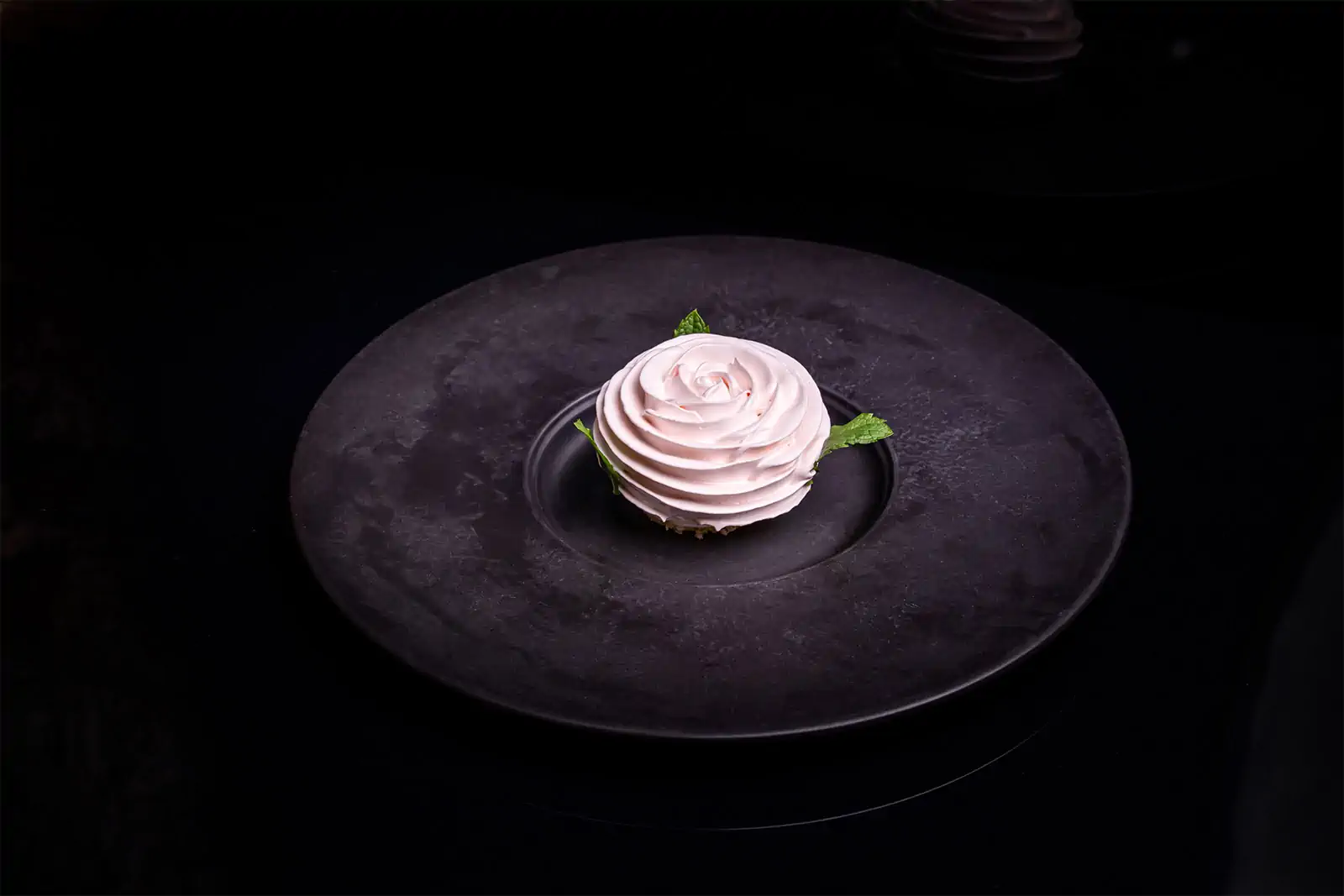
A rose is the easy thing to remember about Cosmos. Its signature dessert gathers vanilla sponge, yogurt ice cream with pink pepper, strawberry-and-rose sorbet and rose meringue into one extravagantly named finish. The restaurant's own description suggests a little argument between perfume, dairy tang and sweetness. It is an inviting way to put Bulgaria on a dessert plate.[6]
The more revealing ingredient is yesterday's bread.
In reporting originally published by the Bulgarian newspaper Dnevnik in April 2022, Cosmos's fermentation specialist Anton Vasev described a problem familiar to any restaurant baking its own sourdough: what happens to the surplus? Breadcrumbs were one answer. A miso-inspired paste called bredso became another. Bread could return to the kitchen as seasoning, carrying a different texture and purpose.[4]
That small transformation helps explain this Sofia restaurant as it reaches ten years since its March 2016 opening.[1] Cosmos makes familiar food available for revision. Its most interesting proposition is that culinary memory can reside in a pantry under active development, as well as in recipes handed down intact. This profile follows published menus, staff accounts and reporting; it makes no claim to a firsthand meal.
A restaurant with more than one author
Cosmos occupies 19 Lavele Street in central Sofia. Its name invites celestial language, and the restaurant leans into it: geometry and Bulgarian folklore inform the interior, while its account of the soundtrack describes Balkan motifs mixed with experimental arrangements.[1] The promise is playful. A diner is allowed to arrive curious, without approaching national cuisine as an examination.
The kitchen's credits deserve to be read carefully. The current team page identifies Vladislav Penov as executive head chef, Nikolay Penev as head chef, and Anton Vasev as founder and head of CosmosLab. Creative director Alexander Tsekov began there as a pastry chef; he describes serving his own desserts and explaining their inspiration as the beginning of his move toward hosting and storytelling.[1]
Those roles reveal several kinds of work behind the same dinner: directing the food, running the kitchen, developing ingredients and communicating what reaches the table. It is tempting to assign a restaurant's personality to one chef. Here, the published staff accounts make the collaboration more interesting than that shorthand.
The distinction matters particularly when fermentation is involved. An ingredient developed over months has to become useful in a service measured in minutes. The person making a paste and the person deciding how much belongs in a sauce are solving connected, different problems.
Familiar names give the kitchen something to change
The menu still offers a reassuring vocabulary. Kachamak comes with goat cheese, porcini and milk skin; Panagyurishte eggs with sheep yogurt, cheese, butter and garlic. Cucumber meets dill, garlic, walnuts, cashew and ferments. These are the combinations on the restaurant's main English menu when checked on September 18, 2026.[2]
Read together, they suggest a kitchen interested in the relationship between recognizable dishes and altered surroundings. Creaminess can acquire an earthy companion; a familiar cucumber-and-dill association can take on another layer. The pleasure promised is partly recognition: enough remains legible for a returning diner to notice what has moved.
Cosmos also lets those foods occupy different kinds of meal. The published Vega Star tasting menu includes cucumber and ferments, charcoal-cooked cabbage, Panagyurishte eggs and kachamak before ending with milk and koji rice. It is listed at €90.90 per person, alongside an à-la-carte menu; the restaurant specifies that tasting menus are taken by the whole table.[2]
That arrangement gives the same kitchen two expressive tools. An individual dish has to satisfy someone who simply wants that plate. Within a sequence, it also has to change the appetite for whatever follows. A bowl associated with comfort takes on a new role when placed between lighter vegetables and dessert.
These are observations about the menu's design. Whether its rich and sharp elements achieve balance on a particular evening remains a question for the actual meal.
Bread leaves the basket, then comes back
The bredso story makes the restaurant's experimentation unusually concrete. Dnevnik's account describes surplus bread being processed with koji rice to make the paste. It also follows liquid from fermentation into a sauce and pressed residue into a dried powder. Several usable ingredients emerge from material that might otherwise have completed its working life.[4]
This is a change in how the kitchen counts its ingredients. The loaf is valuable first as bread; later, its remaining material can help season something else. Developing that second use requires storage, attention and a cook who wants the resulting flavor. The appeal cannot depend entirely on a good story about waste.
There is a useful glimpse of the product doing exactly that job away from Sofia. Hotel Gela's account of an April 2025 guest dinner with Vasev and Penov describes an opening of sourdough and BredSO butter. The host compared the butter's appearance to liquid chocolate and identified it as a miso butter.[5] The account is promotional, but the serving is specific: the experimental pantry returns to the table in an immediately understandable form. Bread and butter require little explanation before the first bite.
The restaurant's aspiration to reduce waste should still be read at its proper scale. In the earlier reporting, Penov acknowledged that the work had not reached the scale the team wanted.[4] A documented reuse of bread demonstrates a practice; it does not establish that an entire restaurant produces no waste.
The pantry can travel farther than the plate
By December 2022, Sofia magazine Go Guide was reporting on SO ferments at 21 Lavele Street. Its shelves offered small batches of sauces and pastes, including lentil sauce, Smilyan sauce, tamari, bredso and miso, alongside fermented vegetables. The stated audience included home cooks as well as professionals.[3]
That changes the restaurant's reach. A signature dessert belongs to the place where someone assembles and serves it. A jar can enter another kitchen, where the next cook decides what dinner should be. Cosmos's contribution becomes an ingredient in somebody else's work.
It also gives its treatment of Bulgarian food a practical test. An unusual condiment has to earn another spoonful after the explanation ends. It needs to make a sauce, a vegetable or a piece of bread more compelling.
The rose remains a persuasive invitation: floral, theatrical, readily remembered. But the bread tells the fuller story of Cosmos. Baking it is one act of hospitality. Finding another use for what remains opens a second round of cooking—and gives an established restaurant something new to say.
Sources
- Cosmos, “Why choose Cosmos?” — official account of the March 2016 opening, setting, atmosphere and current team roles; checked September 18, 2026.
- Cosmos, “Menu” — main English menu, named dishes, Vega Star sequence, price and whole-table tasting-menu condition; checked September 18, 2026.
- Go Guide editors, “New place in Sofia: SO ferments,” December 9, 2022 — Bulgarian-language report on the Lavele Street shop, products and intended customers.
- Dnevnik, reporting on food waste originally published April 10, 2022, reproduced by Cosmos as “How not to throw away food” — Vasev's bread fermentation and Penov's account of reuse and its limits; Bulgarian-language text.
- Hotel Gela, “MENU X: Worlds Gathered Into One Dinner,” April 18, 2025 — the host's account of Vasev and Penov's guest dinner, including sourdough with BredSO butter.
- Cosmos, official homepage — Bulgarian Rose's listed composition and the restaurant's photograph of the dessert; checked September 18, 2026.