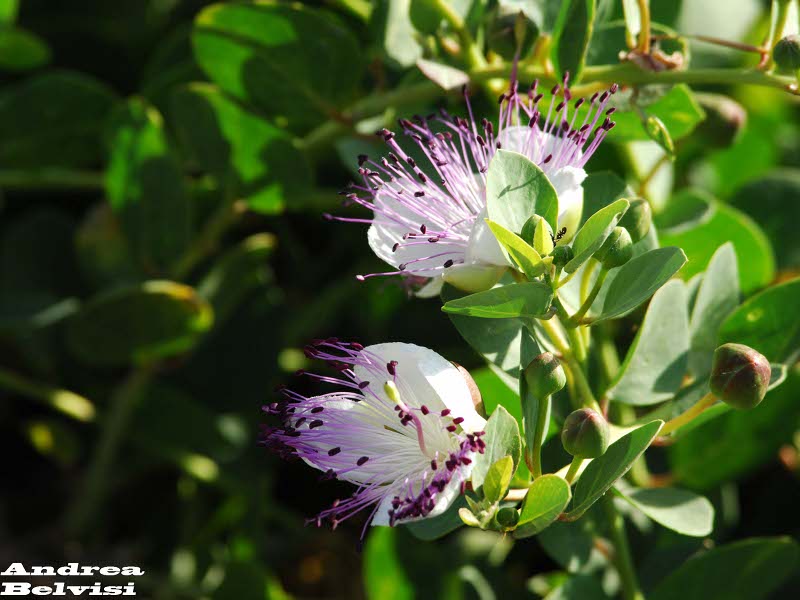
A caper flower is an extravagant thing to miss. White petals spread around a spray of pale pink stamens, turning the shrub's compact buds into something airy and conspicuous. The Royal Horticultural Society describes both stages of Capparis spinosa: the flower is the display; the unopened bud is what we preserve as a caper.[1]
On Pantelleria, that distinction organizes a harvest. The island's national park describes workers collecting unopened buds before dawn, during the flowering season from late May into September.[2] The little green punctuation on a restaurant plate begins with someone reaching the plant at the right moment.
That is the useful story inside a jar labelled Cappero di Pantelleria IGP. IGP is the Italian abbreviation for Protected Geographical Indication, or PGI. The name identifies a product grown on this Sicilian island and matured with sea salt.[2][3] To understand what a kitchen is buying, follow the bud through the field, the curing vat and the pan.
A harvest made of return visits
Qualigeo, the geographical-indications database maintained by Fondazione Qualivita, describes cultivation on sunny terraces in Pantelleria's dry, volcanic terrain. Picking happens by hand, in stages. Farmers return to the plants roughly every eight to ten days, with the interval depending on weather, leaving buds that are not yet ready.[3]
The repetition matters. A field of caper bushes cannot simply be cleared on one convenient morning. Its crop keeps developing, and the picker keeps making small decisions about what to take and what to leave. A jar compresses those return journeys into something that can sit quietly on a pantry shelf.
There is another distinction worth keeping when reading a menu: a caperberry is the fruit, usually recognizable by its elongated shape and long stalk. It is a different stage of the plant's life from the unopened bud.[1] A supplier offering berries has supplied something botanically different, even though both products share the caper name. That makes the precise ingredient description consequential before any argument about prestige begins.
The salt is part of the making
The park describes two ten-day saltings: first with sea salt at about 40 percent of the buds' weight, then, after draining, about 20 percent, with periodic mixing.[2] These processing additions do not measure a diner's salt intake.
Qualigeo's product profile limits the sea salt in the finished product to 25 percent of the capers' weight.[3] The distinction between curing additions and the finished pack helps explain why a production description and a jar's specification can contain different percentages without disagreeing.
For the cook, the practical consequence is simple: salt belongs to the ingredient's history, but its final contribution to dinner still needs managing. Qualigeo advises rinsing away excess salt before use.[3] Taste the caper after that preparation, before deciding how much more seasoning the dish needs. A prestigious place name cannot make that judgment for the kitchen.
Nor does preservation erase the harvest. It makes a short-lived developmental stage available later. The buds that had to be caught promptly can now move through a restaurant's larder at a different pace.
Small buds, larger possibilities
The national park values smaller capers after maturation.[2] Yet a professional kitchen has more than one use for the crop, and a sourcing decision should account for the intended preparation.
Pantelleria producer La Nicchia describes making caper powder from larger capers, which are dehydrated, ground and sifted. Its range also includes crunchy capers and crumbled caperberries. The producer even sells the salt that has acquired aromas during caper processing as a seasoning in its own right.[4] These are commercial product descriptions, rather than an independent tasting comparison, but they show how an island pantry can reach the pass in several forms.
The culinary implication is a choice about distribution. A whole bud concentrates the encounter in one bite. A powder lets the cook spread the ingredient through a preparation without leaving the same visible shape. Choosing between them is part of composing the dish; a size hierarchy alone cannot settle it.
When the caper enters the rice
Mariano Chiarelli provides a concrete example. In a recipe published by Italia a Tavola in December 2020, the chef of I Du Matt near Parma specifies Pantelleria capers in a risotto with red prawns, 'nduja bisque and Sichuan pepper. He finely chops the capers and adds them a few minutes into the rice's cooking, then finishes the risotto with thyme oil.[5]
That timing is revealing. The capers are already inside the rice before the bisque and prawns go on top. Read as a piece of kitchen design, the recipe gives them a role throughout the risotto. This is evidence from a published preparation, not a claim about today's restaurant menu.
The national park offers a different approach for protecting the ingredient's intense aroma: add capers near the end of cooking so they warm only briefly.[2] Both examples give timing a purpose. A cook can preserve a distinct late accent or work chopped capers into the food as it cooks.
The flower makes the first deadline visible. After that come the picker's next visit, the turns through salt, the rinsing and the moment the caper enters the pan. By the time the plate reaches the table, much of that work has disappeared from view. Good sourcing gives the kitchen enough information to make it count.
Sources
- Royal Horticultural Society, “Capparis spinosa” — plant description and the distinction between flower buds and caperberries.
- Parco Nazionale Isola di Pantelleria, “Cappero di Pantelleria IGP” — harvest, two-stage salting, culinary uses and Andrea Belvisi's caper photograph.
- Fondazione Qualivita, Qualigeo, “Cappero di Pantelleria PGI” — production area, repeated hand harvesting, curing and preparation for use.
- La Nicchia, “Dried aromatic” — the producer's descriptions of caper powder, crunchy capers, caperberry crumbs and caper salt.
- Mariano Chiarelli, “Risotto ai capperi di Pantelleria, bisque alla 'nduja, gamberi rossi di Mazara del Vallo e pepe di Sichuan,” Italia a Tavola, December 20, 2020 — chef-authored recipe and cooking sequence.