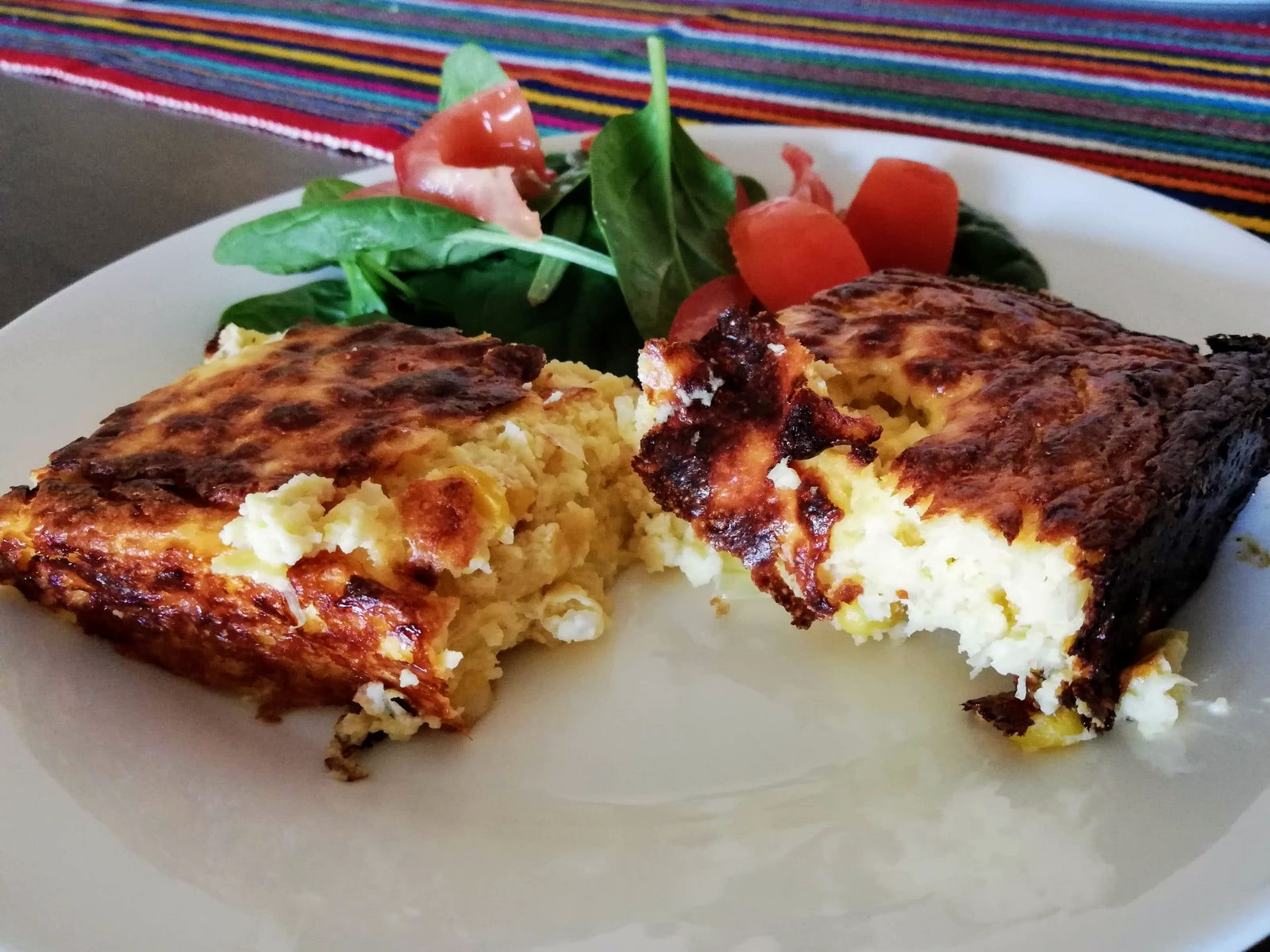
A browned top gives way to a yellow interior, with enough structure to reach the plate and enough softness to invite the side of a fork. Chipa guasu, Paraguay's savory corn-and-cheese bake, offers a particularly good reason to pay attention to an accompaniment. The most interesting part is the center.
In the recipe Aquilina “Ña Mami” Aguilera shared through the Paraguayan newspaper ABC Color, the starting point is a kilogram of choclo: corn kernels, blended or ground, then mixed with eggs, cheese, onion, oil and milk. Alongside grilled meat, that combination offers a tender, dairy-rich mouthful between bites from the fire.[1]
Its apparent simplicity makes the dish easy to underestimate. Read several cooks' versions together and the same name opens onto quite different decisions: whether to cook the corn first, how to incorporate the cheese, what dairy to use, even whether to hide fish inside. Those published recipes are the starting point for this portrait of the dish.
The corn changes the expectation
Aguilera's paired recipes provide a useful introduction. Her sopa paraguaya begins with corn flour; her chipa guasu begins with kernels. Both contain queso Paraguay, onion, eggs and milk. They are close relatives whose different treatment of corn gives the cook a different starting material.[1]
“Cornbread” suggests a crumb to break apart; “corn pudding” suggests something to scoop. Chipa guasu occupies the appetizing territory between them. A savory custard is another useful comparison, though individual recipes give the center different textures.
Aguilera specifies milk as needed.[1] Even this short recipe leaves room for judgment: before the tray enters the oven, the cook still has to read the mixture.
Cheese can arrive after the blender
Enrique Lando's published recipe takes another route. He boils the kernels first, cooks the onions in fat until translucent, and blends them with the corn before adding eggs and cream. The crumbled queso Paraguay goes in afterward, in a bowl.[2]
That sequence is worth noticing. The blender makes the corn mixture more uniform, while the late addition leaves cheese distributed through it. As a reading of the method, it suggests a dish with small variations from forkful to forkful: a smoother patch of corn here, more cheese there. Perfect uniformity need not be the ambition.
Lando uses half a kilogram of cheese for a kilogram of corn, with six eggs and a cup of cream.[2] Cheese is substantial enough to help define the mouthful. It is easy to imagine how the corn's sweetness and the dairy's richness could become heavy together; onion gives the recipe another savory presence to work with.
A version published by Cheffo Pájaro shows what happens when the pantry changes. It uses frozen sweetcorn and mature cheddar, with milk and cream. The method explicitly tells the cook to defrost and squeeze the corn before incorporating it.[3]
That small instruction is more revealing than an extravagant garnish. Frozen corn arrives with water that the recipe asks the cook to remove. Substitution involves handling as well as shopping. Cheddar also announces a different cheese choice from the queso Paraguay named by Aguilera and Lando; the versions should be understood on their own terms.[1][2][3]
A slice with a job to do
Pájaro serves his version with asado and suggests it beside other grilled meats.[3] It is an appealing arrangement: browned meat asks for chewing, while the corn bake gives the next bite somewhere softer to go. The accompaniment changes the rhythm of eating.
It can also carry the main event. In a 2023 ABC Color recipe, María Löffler fills chipa guasu with fish. Tilapia or surubí is cooked with a tomato-and-vegetable mixture, then enclosed between two layers of corn batter. She offers either a conventional oven or a hot tatakua for baking.[4]
The filling gives the slice a different purpose. A diner cutting down through the corn reaches a second preparation, one with its own vegetables and seasoning. What looked like a single bake becomes a small assembled meal. Löffler's recipe makes that change without requiring the familiar outer form to disappear.
This is also a useful reminder when reading a menu: the name identifies a family of preparations. A cheese-and-corn accompaniment and a fish-filled portion can invite quite different appetites. The interesting question is what this particular cook has put inside.
The familiar bake on a tasting plate
Chipa guasu has already appeared in a more formal sequence. Reporting on Paraguay's presence at Madrid's FITUR tourism fair in January 2025, La Nación described a ten-course menu offered by chef Vidal Domínguez. One element was a trio of sopa paraguaya, chipa and chipa guasu. The newspaper's account drew on information from Paraguay's tourism authority.[5]
The grouping is an intriguing piece of menu design. Put related preparations beside one another and the diner can notice distinctions that a single serving might leave unexplored. The two corn bakes, in particular, become something to compare at the scale of a bite. Read this way, the published menu invites close attention to familiar food.
A tasting portion does, however, raise a practical question for any cook: how much browned surface should accompany the soft middle? A tiny serving still needs to communicate the dish's texture. Decoration alone cannot make that decision.
The pleasure promised by chipa guasu is wonderfully direct. A fork meets the top, passes into the corn, and finds cheese along the way. Give that small journey enough attention, and the supposed side dish can hold the table for a moment.
Sources
- ABC Color, “Gastronomía tradicional: sopa paraguaya y chipa guasu,” September 27, 2021 — Aquilina Aguilera's paired recipes, corn forms, ingredients and baking instructions; Spanish.
- Enrique Lando, “Chipa Guasú (Paraguay),” Cookpad, April 3, 2009 — the cook's recipe, including boiled corn, cream and cheese added after blending; Spanish.
- Cheffo Pájaro, “Chipá Guasú Recipe” — the author's frozen-corn and cheddar version, moisture handling and serving suggestion.
- ABC Color, “Recetas de Semana Santa al tatakua,” April 2, 2023 — María Löffler's fish-filled chipa guasu and alternative baking methods; Spanish.
- La Nación, “Chefs paraguayos deleitaron con platos con sabores a lo yma en feria de turismo,” January 25, 2025 — reporting based on Senatur information, including the ten-course menu and its trio; Spanish.
- Amambay T, “Paraguayan chipa guazú,” photograph dated December 27, 2018, Wikimedia Commons — chipa guasu served with salad; CC BY-SA 4.0.