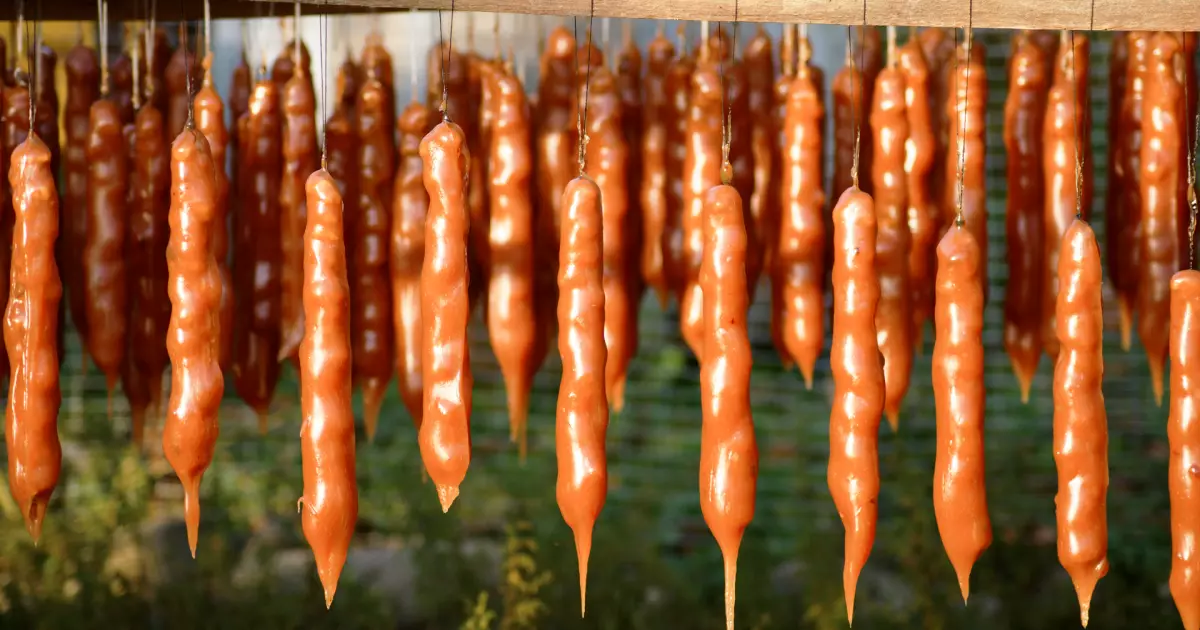
Before churchkhela becomes something to bite, it is something to hang. Nuts are threaded together, lowered into a pot of thickened grape juice and lifted out under a smooth coat. The familiar Georgian sweet carries the outline of that work: a long, gently knobbled strand, with a piece of nut waiting beneath each swelling. Georgia's national tourism administration places its making after rtveli, the grape harvest, when pressed juice is available for the pot.[1]
The pleasing trick is that a liquid becomes a wrapper. Getting there takes several kinds of patience: concentrating the juice, cooking the coating, then giving the suspended strands time to dry. Each stage answers a different question. How much water remains? Will the coating cling? What will it feel like between the teeth?
First, give the grapes time
The work begins with badagi, concentrated grape juice. In Georgian Recipes' photographed preparation, crushed white grapes yield juice that is simmered gently, skimmed and left overnight before passing through a fine sieve. The instructions allow up to three hours at the stove and describe a reduction of a little less than half.[2]
That is a considerable amount of work before a single walnut enters the story. Water leaves the pot; the grape juice becomes more concentrated. Skimming and straining also give the maker a clearer liquid to work with. The useful image is of someone tending a simmer, watching the surface and returning with a spoon, long before the more photogenic dipping begins.
This first preparation can serve several desserts. Georgian Recipes names grape tklapi, a fruit leather, among badagi's other uses.[2] A batch of concentrated juice is therefore a pantry ingredient with several possible futures. Churchkhela is the future that needs a thread.
Then make a coat that holds
For the Kakhetian version, wheat flour turns the juice into tatara. Georgia Travel's account calls for steady stirring to prevent lumps and sticking, and identifies the disappearance of the flour's smell as a sign that cooking is complete. It also distinguishes the thicker preparation used for churchkhela from the softer tatara served as a dessert.[3]
That distinction explains the task facing the cook. A pudding has a dish to support it. Here, the grape mixture must stay around a suspended row of nuts. Smoothness and sufficient body matter because the coating has to travel out of the pot with its filling.
The 2014 Georgian Recipes demonstration makes that demand unusually visible: it uses a wooden spoon to cover the immersed nuts and says a properly prepared coating should stay on the strand without dripping. Its photographs show walnut halves, quarters and eighths, as well as whole hazelnuts, threaded before coating.[4]
Those different cores invite a different reading of the same silhouette. A rounded hazelnut and an irregular piece of walnut give the outer coat different shapes to follow. The bumps are clues to what is inside. A neatly cut slice makes the relationship easier to see: pale nut surrounded by its darker, fruit-based covering.
The drying line is part of the kitchen
Dipping is repeated, and the air has work to do between applications. Georgian Recipes gives its strands three to four days before another coating, using loss of surface stickiness as a cue. Georgia Travel's account of western Georgian janjukha describes a second dip after ten days. These are documented methods with different schedules, rather than a single countdown for every batch.[4][1]
The regional variation reaches inside the pot. Georgia Travel associates western janjukha with hazelnuts and corn flour, while its Kakhetian example uses walnuts and wheat flour.[1] The family resemblance survives those changes: a threaded center, a cooked fruit coating, repeated immersion and hanging.
Crucially, drying does not imply that the finished sweet should become rigid. The Georgian product specification held by Sakpatenti describes the texture as soft, dense and elastic. It also accommodates almonds, pumpkin seeds and dried fruit, and allows mulberry juice alongside grape juice.[5] The familiar walnut strand is one expression of a broader craft.
For the diner, that specification offers a better point of attention than sheer hardness. The coating should have substance while still yielding. A sweet can hold its shape and remain pleasant to chew; the drying stage has to leave room for both.
Give the cross section a moment
Georgian Recipes finishes its instructions by removing the string before eating.[4] With that small piece of equipment gone, the construction becomes entirely edible.
At the end of dinner, I would serve a few slices with one longer piece beside them. The slices expose the fruit-to-nut proportions; the uncut length preserves the slightly eccentric form that first catches the eye. There is enough to discuss without elaborate plating: the smooth coat, the interrupted outline, the way the center changes from one slice to the next.
A churchkhela's elegance lies in how little of its making disappears. Even on a small plate, it still looks like something lifted from a pot and patiently hung up to finish.
Sources
- Georgian National Tourism Administration, “Churchkhela” — harvest context, regional ingredients, dipping methods and article photograph.
- Georgian Recipes, “Badagi,” October 11, 2013 — photographed juice extraction, reduction, settling and straining.
- Georgian National Tourism Administration, “Tatara” — cooking the flour-thickened juice and distinguishing dessert tatara from the coating.
- Georgian Recipes, “How to Make Churchkhela,” January 10, 2014 — threaded nut shapes, coating consistency, drying intervals and removal of the string.
- Sakpatenti, “Geographical Indication: Churchkhela,” registration no. 2 — product specification covering texture, ingredients and regional methods.