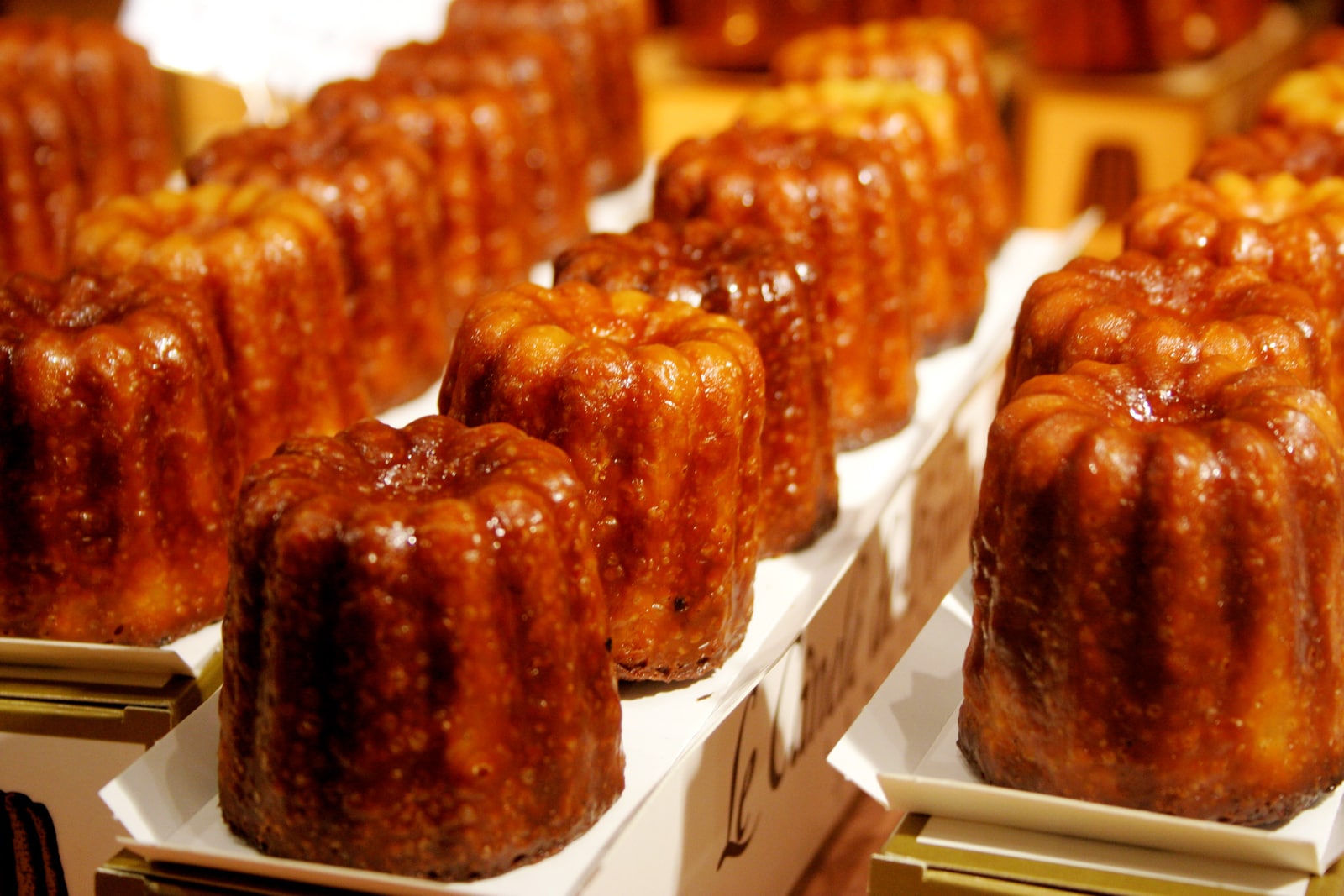
A canelé makes an unusually compact ending to dinner. Its little fluted tower offers a dark, caramelized shell, a yielding middle and the fragrance of rum and vanilla. There is enough contrast inside that small shape to make a final sweet interesting after a much larger dessert. The Dictionnaire des régionalismes de France preserves a restaurant writer’s 1998 account of canelés closing a meal in Arcins, in the Gironde: a local cake doing the quiet work of a last course.[4]
The story often served alongside it is more elaborate. It brings together nuns, Bordeaux wine, surplus egg yolks and the resourcefulness of a convent kitchen. Almost every ingredient acquires a reason to be there. Follow the evidence, however, and another story emerges: a regional pastry with uncertain beginnings, a changing name and a remarkably effective modern revival.
The convent makes a persuasive setting
Baillardran, the Bordeaux specialist, introduces the religious origin as a question, then recounts the familiar connection with winemaking. Egg whites used to clarify wine supposedly left yolks available for the sisters’ cakes. This is useful evidence of how a maker presents the pastry’s heritage today; it does not establish that the transfer created the modern canelé.[3]
The appeal is easy to understand. The tale turns a sweet into an act of thrift and ties the kitchen to the vineyard. It also gives the pastry a human author: someone noticing what would otherwise go unused. A restaurant can tell it in the few seconds between setting down a plate and pouring coffee.
The regional government’s history supplies a less comfortable detail. Excavations before the cultural administration occupied Bordeaux’s Annonciade convent in 1995 found no canelé molds; the convent archives yielded no record of the pastry either. The same account says there is no proof for the proposed connection between surplus wine-fining yolks and the cake.[2]
Absence of a mold cannot identify the actual inventor. It does mean the convent story needs to remain a story. A dated recipe, inventory or account linking that kitchen to a recognizable canelé would change the discussion. The sources cited here do not provide one.
A name leaves a different trail
The dictionary offers a more precise, and more interesting, complication. It points to a recipe called milliasses cannelées de Bordeaux in Pierre Lacam’s 1890 pastry book, then records the shorter name cannelés in Jean Balde’s 1937 novel La Maison au bord du fleuve. Its explanation connects the word with millas cannelé: a cake described by the grooves impressed by its mold.[4]
Those references deserve to stay distinct. An earlier recipe title is a lead for investigating related preparations. A later literary mention shows the shorter name circulating in a recognizable social setting. Neither, on its own, supplies an unbroken recipe lineage from a seventeenth-century convent to today’s bakery counter.
That distinction also makes “the first canelé” a slippery phrase. Are we looking for a word, a fluted shape, a particular batter or the familiar combination of crust and center? A date answering one question can easily be made to answer all four. Keeping them separate lets the pastry retain a past without forcing every old name into a family tree.
The revival changed its place at the table
Firmer ground arrives in the 1980s. The Nouvelle-Aquitaine account credits baker Jean-Luc Poujauran with helping bring the canelé to prominence in Paris. It describes the cake shrinking into a mignardise, one of the small sweets that extend the end of a meal, and reaching luxury food house Fauchon.[2]
This is the historical turn that matters most to the dining room. Miniaturization gives a regional cake a new role. A guest can encounter its characteristic shape and contrasting textures in a small final portion; the pastry becomes part of a sequence, sharing the closing minutes with other sweets. Its identity has to survive the reduction.
The name was being shaped too. Baillardran dates the confraternity’s adoption of the single-n spelling, canelé, to 1985 and its own specialization in the cake to 1988.[3] The dropped letter offers a neat emblem of this period: people were actively defining how Bordeaux’s pastry would be recognized. Local heritage was receiving a deliberate public identity.
What survives in the mold
A maker’s published method brings the discussion back to something tangible. Baillardran’s home recipe rests the batter overnight, then gives it a hotter opening bake followed by a lower-temperature finish. The cakes come out of their molds while hot and are left to cool. Milk, eggs, sugar, butter, flour, vanilla and rum become a pastry through a sequence that extends across two days.[1]
Read that method beside the origin story and the emphasis shifts toward the baker’s work. A list of historically available ingredients cannot explain the finished object by itself. Resting, filling, baking and unmolding are decisions somebody has to repeat successfully. They make the familiar outline worth recognizing.
At the table, that suggests a more satisfying introduction than a confident claim about an unknown inventor. Describe the shell and the soft middle; explain how this Bordeaux specialty found a second scale among the mignardises. Leave room for the uncertainty. The pleasure is still immediate: the ridges catch the light, the crust gives way, and a small pastry earns a few more minutes of attention.
Sources
- Baillardran, “La recette du Canelé de Bordeaux” — the maker’s published home method, ingredients, overnight rest and baking sequence.
- Région Nouvelle-Aquitaine, “Le cannelé bordelais” — the convent evidence, uncertain origins and Parisian revival as a mignardise.
- Baillardran, “L’origine du canelé” — the maker’s presentation of the wine-and-convent story, the 1985 spelling change and its 1988 specialization.
- Dictionnaire des régionalismes de France, “cannelé” — texture, the Lacam and Balde references, and a 1998 restaurant description.
- Robyn Lee, “Caneles stemilion,” November 4, 2006, Wikimedia Commons — photograph, licensed CC BY-SA 2.5.