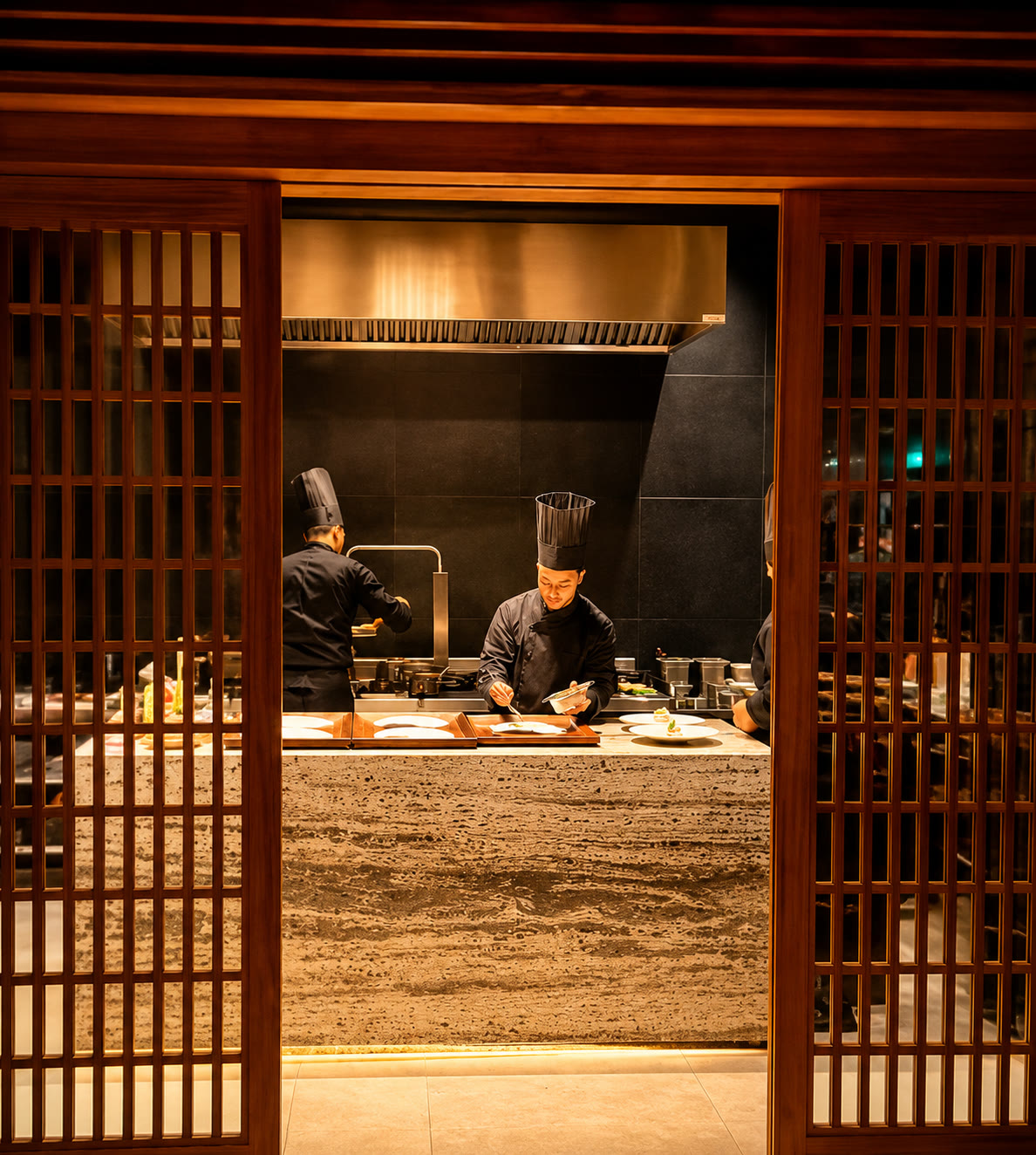
Casablanca's most revealing fine-dining route begins with two different uses of the Atlantic.
On the first night, the ocean stays mostly out of sight. Table 3 sits about 200 meters from it, but the room turns inward, toward an open kitchen and the cooks working at its center. The coast arrives as fish and shellfish; nearby land arrives as herbs and vegetables. On the second night, La Grande Table Marocaine lifts the city to the 23rd floor. The ocean becomes panorama, the Hassan II Mosque takes its place in the view, and Moroccan hospitality—not the pass—becomes the principal theater.[2][5]
That sequence is more useful than a contest over which restaurant is more “authentic.” Table 3 uses a returning chef's international technique to ask what contemporary Moroccan cooking can become. La Grande Table Marocaine sets familiar national forms inside a new Casablanca palace and asks how grandly they can be received. One concentrates attention on authorship and ingredients; the other expands it through repertoire, ritual and room.
Give them separate nights. Begin close to the catch. Finish with the whole kingdom spread beneath the windows.
Night one: the Atlantic comes through the pass
Table 3 opened in June 2024 in Aïn Diab. Chef Fayçal Bettioui, who was born and raised in Casablanca, returned after training at Per Se in New York and spending years in the United States and Germany, where his former restaurant, Zur Krone, earned a Michelin star. His homecoming was not framed as a retreat from those kitchens. It was a chance to put their discipline to work on Moroccan material.[2][3][4]
The room makes that proposition visible. Thirteen tables face a central open kitchen; black crushed-concrete walls and long bands of dark wood hold the light low around it. Gault&Millau Morocco calls the live view of the brigade a defining feature, while the 2026 MENA's 50 Best listing describes the restaurant as just 200 meters from the Atlantic. The latter also names Table 3 the Best Restaurant in Morocco for 2026.[2][3]
Do not book it for a sea view. Here the ocean is provenance, not scenery. The restaurant says it buys directly from local fishers, while roughly 70 percent of its greens, herbs and vegetables come from its own gardens. Those are restaurant sourcing claims reported by 50 Best, not a public supply-chain audit, but they clarify the menu's organizing idea: Moroccan identity can enter through where a fish was landed and where a leaf grew, not only through the name of a canonical dish.[2]
That distinction keeps the cooking from collapsing into the vague word fusion. French reductions and Japanese-inflected restraint are methods, not destinations. A tuna-and-foie-gras course, on the menu since opening, makes the argument compactly: 50 Best describes it as Table 3's take on surf and turf and a showcase for Morocco's natural bounty. Other courses move with catch and harvest, so the stable feature is the grammar—clean cooking, concentrated sauces, acid and umami—rather than a promised list of plates.[2]
Bettioui has said that the tasting format lets the kitchen innovate around what is available and reduce waste, while an à-la-carte lunch gives the restaurant a less ceremonial register. He also said the team debated whether the tasting-menu concept suited Casablanca, while insisting on bringing the experience of his Michelin-starred restaurant to his hometown.[4] That makes the first night more than a booking at the current trophy table. It is a wager about how Casablanca wants to spend an evening.
At publication, Table 3's own site lists a six-course menu at 900 MAD per person, ordered by the whole table, with a 450 MAD pairing. It gives dinner service Monday through Saturday, lunch Tuesday through Saturday, and Sunday as closed. Treat those numbers and hours as a dated planning snapshot and reconfirm them when reserving; a harvest-led menu is supposed to move.[1][2]
The best use of the room is therefore simple. If the whole party wants the same long arc, choose the tasting menu and let the open pass supply the pacing. If one diner wants more control, ask about the current à-la-carte service before booking rather than discovering at the table that the longer menu is collective. Take the Atlantic walk before dinner if you want the horizon. Once inside, face the labor.
Why this restaurant comes first
Starting at Table 3 prevents the second night from defining refinement too narrowly.
If La Grande Table Marocaine came first, its pastilla, couscous, caftans and orange-blossom handwashing could make Moroccan identity look like a set of recognizable objects polished to palace brightness. Table 3 establishes a different baseline. Its Moroccanness can be a fisher relationship, a garden percentage, a Casablanca-born chef returning home, or the decision to put local tuna through a technique learned elsewhere.[2][4]
This does not make the smaller room intrinsically more progressive, nor its food more “real.” A visible kitchen is still a stage, an award list is still an institution's judgment, and international technique still carries prestige of its own. What the first night contributes is scale: thirteen tables, one visible team and a menu whose argument can change when the boats or beds do.
The second night can then be read not as the default meaning of Moroccan luxury, but as another deliberate construction.
Night two: hospitality takes the stage
La Grande Table Marocaine occupies the 23rd floor of the Royal Mansour Casablanca, between the port and the Old Medina. The hotel opened in April 2024 as a revival of a landmark first built in 1953; its restored mid-century identity makes the restaurant new and historical at once.[5][7]
The ascent changes the terms of dinner. Mirrors, marble, patterned tables and amber glass share the room with a panorama that reaches the Hassan II Mosque. Gault&Millau's 2026 account adds the moving details: hosts in caftans, hands washed with orange-blossom-scented water, and Andalusian musicians accompanying the service. Here, what happens around the plate is not a polite support system. It is part of the text.[5][6]
Chef Karim Ben Baba's menu moves in the opposite direction from Table 3's oblique signals. It names the repertoire openly: a spread of Moroccan salads, briouates, pigeon pastilla, vegetable and meat tagines, couscous, m'rouzia and milk-cream pastilla. Geography appears inside the classics—Oualidia lobster, Tafilalt dates, Dakhla shellfish—while the forms remain legible.[5]
For the full second-night version, the official menu currently lists the Anfa Experience at 1,800 MAD per person. Its sequence includes Oualidia lobster, stuffed fish, Moroccan salads, lamb shoulder m'hamer with couscous, and a date-and-orange-blossom dessert. À-la-carte ordering is also available. If dinner at that level breaks the trip's budget, the same dining room has a 950 MAD Lahda lunch and a 650 MAD weekday lunch or Friday couscous offer on the menu published at this writing. Hours are listed daily, noon to 2:30 p.m. and 7 to 11 p.m.; verify the live menu before treating any of those figures as fixed.[5]
The sensible order is not to chase every emblem at once. At dinner, either accept the Anfa sequence or build one shared arc from salads through a single large savory centerpiece to the cream pastilla. The salad assortment matters because it resists the idea that abundance requires one massive protein: eggplant, pumpkin, artichoke, beetroot, pepper and prawns arrive as a field of separate textures and seasonings. Then a pastilla or lamb dish can feel like a change of register rather than the beginning of excess.[5]
There is a useful counterweight to the hotel's own language of transcendence. Gault&Millau praises the room, service rhythm and cooking precision, but finds some plates intentionally cautious and more faithful to classics than personally expressive.[6] That is not a fatal flaw in this route. It is the point of contrast. Table 3 foregrounds one chef's return and revision; La Grande Table foregrounds a repertoire and the people trained to receive you into it.
The comparison works because it is unfair
These restaurants do not need to be ranked against each other. Their most interesting qualities would disappear in a single score.
At Table 3, the kitchen is the view. The room draws the eye toward hands, pans and plating, while the nearby Atlantic is translated into supply. At La Grande Table Marocaine, the city is the view. Much of the kitchen remains backstage while the dining room translates hospitality into music, scent, dress, sequence and gesture.[2][5][6]
One also makes change easier to see. When Table 3 substitutes a catch or harvest, the menu declares its responsiveness.[2] The palace restaurant works within forms whose continuity is part of their value.[5] A couscous or pastilla can absorb different ingredients and refinements while remaining recognizable enough to carry expectation.
Calling the first “modern” and the second “traditional” would therefore be lazy. Both opened in their current Casablanca forms in 2024. Both edit Moroccan food for a paying audience. Both use architecture to tell diners where attention belongs. They simply locate authority in different places: the returning chef and his sources on one night; the inherited dish and the choreography of welcome on the next.[2][5][7]
Nor do two expensive rooms stand in for Casablanca's food culture. They omit home tables, bakeries, grills, market counters, neighborhood cafés and the daily economies that make restaurant luxury possible. This is a narrow route by design: two ways in which a fine-dining scene turns local material and national memory into public performance.
Build the route cleanly
Reserve Table 3 first, especially if the 13-table dining room and full tasting menu are non-negotiable. Avoid Sunday, and do not stack another major meal before it. Its Aïn Diab address belongs to the coastal side of the city, even though the restaurant's focus is inward.[1][2][3]
Put La Grande Table Marocaine on the following evening. The Royal Mansour sits at 27 Avenue des Forces Armées Royales, closer to the port and Old Medina; this is a transfer between districts, not a two-restaurant stroll. Arrive before full darkness if the changing view matters, but leave enough appetite and time for the welcome to unfold.[1][5]
Most important, preserve the order. First watch a Casablanca chef turn coast, garden and foreign training into a personal language. Then let a palace turn familiar dishes and gestures into a national-scale reception. The first room makes the kingdom taste close enough to touch. The second lets the city fall away beneath it.
Casablanca does not resolve the tension between invention and inheritance. Over two nights, it gives each one a room.
Sources
- Table 3, official website — current six-course menu and pairing prices, whole-table condition, service hours, reservation link and street address.
- Middle East & North Africa's 50 Best Restaurants, “Table 3,” 2026 list profile — opening date, chef background, 13-table room, coastal and garden sourcing claims, menu approach and 2026 recognition.
- Gault&Millau Morocco, “Table III,” 2026 — independent review of the open-kitchen room, cooking and service, plus the documentary restaurant photograph used above.
- Visage du Maroc, “Fayçal Bettioui” (March 12, 2024) — pre-opening interview on his return to Casablanca, tasting-menu rationale, waste, hospitality and the lunch/dinner split.
- Royal Mansour Casablanca, “La Grande Table Marocaine” — official current page and menu for location, hours, chef, à-la-carte dishes, tasting and lunch formats, and published prices.
- Gault&Millau Morocco, “La Grande Table Marocaine, Royal Mansour,” 2026 — independent assessment of the room, welcome rituals, music, service, dishes and the kitchen's classical restraint.
- Kristen Nichols, “Inside the Royal Mansour Hotels in Tamuda Bay and Casablanca,” Who What Wear (November 19, 2025) — reported visit covering the 1953 hotel's 2024 revival, the 23rd-floor restaurant, view, music and salad service.