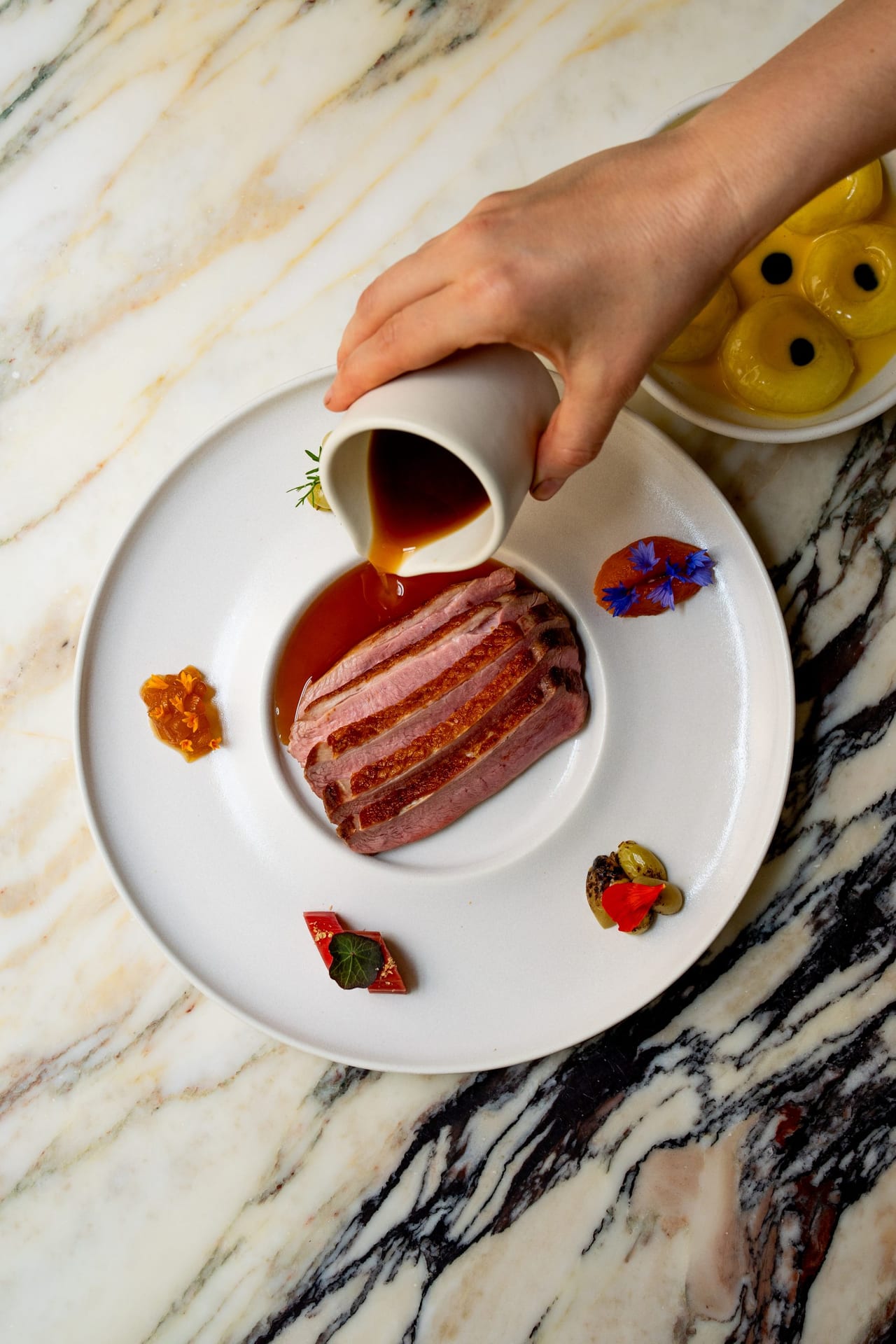
A hand tips a small white jug. Dark bordelaise runs toward sliced duck breast, its skin lacquered and its center still pink; a dish of Silesian dumplings waits at the edge of the marble. The plate at BABA looks composed, but not sealed behind glass. Sauce is still moving. Dinner has not been reduced to a chef’s statement.[1][2]
That image explains why one of Wrocław’s two new Michelin-starred restaurants is so interesting—and why the award creates an unusual expectation test. BABA has roughly twenty seats, a short à-la-carte menu and the pulse of a close-packed bistro. It does not offer a tasting menu. In May 2026, Michelin promoted it from a Bib Gourmand to one star, praising Beata Śniechowska’s subtly complex revisions of Polish dishes and singling out her tiny “Petit Bonbon” pierogi.[3][4][5]
The award changed the expectation more dramatically than it changed the restaurant. A detailed pre-star review describes warm service and cooking that hides long processes beneath familiar nouns; a current diner likewise praises the service, while two September reports preserve dish-level reservations amid strong overall approval.[6][7][8] One dissenting commenter found the restaurant underwhelming against Michelin-level hype.[8] That is a counterexample, not a consensus—but it reveals the new pressure on every apparently simple plate.
This is therefore not a disguised first-person review. It is a synthesis of Michelin’s 2026 judgment, the restaurant’s current menu, Śniechowska’s own account of the concept, a detailed pre-star review, a written September recap of a video visit, and one September diner post with its discussion. Together they support a sharper case than unqualified applause would: BABA succeeds when the guest can taste the labor beneath simplicity, and becomes vulnerable when the star makes simplicity look insufficient.
The restaurant did not put on a star costume
Śniechowska did not build BABA around the familiar prestige machinery of one fixed sequence, synchronized reveals and a three-hour narrative. In a post-award interview with Vogue Polska, she described wanting the energy of a loud Paris bistro, the seasonal attentiveness she admired in Copenhagen and dishes that remain clean and understandable on the surface. The work stays underneath: patient sauces, fermentation and maceration, live-fire cooking, and dumpling dough made with 35 egg yolks per kilogram of flour. Her conclusion was practical rather than philosophical: guests should be able to arrive and order what they actually want, so BABA has no tasting menu.[4]
That freedom is not decorative. The September 2026 menu is genuinely concise: two small snacks, six starters, five mains and three desserts. Prices run from 34 zł for an oyster or two cod croquettes to 179 zł for lamb loin; desserts sit between 40 and 60 zł, and service is not added automatically.[2] A diner can stop after herring and one main, share across the table, or build a long improvised progression. The kitchen supplies authorship without dictating duration.
The room supports the same contract. BABA’s own site calls it intimate and surrounds the meal with craft, art, wine and progressive cocktails.[1] A detailed May 2025 account by the Polish reviewer behind Chez Cezary found small tables set close together, green walls, servers in white aprons and a Friday-evening hum that felt closer to a French bistro than a hushed tasting room. Śniechowska herself moved between kitchen and guests.[6] Michelin later described the setting as relaxed and buzzy.[3] The sources differ in status, but they see the same room: concentrated rather than ceremonial.
The star did not force BABA to become something else. Michelin rewarded the restaurant while it was still speaking in its own accent. That is the achievement.
Familiar nouns, very long verbs
The menu reads like comfort food after a suitcase has been unpacked beside it. There is herring with potato, horseradish cream and kohlrabi; duck with bordelaise and Silesian dumplings; mielony royal, the Polish minced-meat cutlet, with chanterelles, pepper sauce and umami purée. Then kombu enters an onion essence, miso seasons the corn beside curd-cheese dumplings, and the duck is described simply as being “in five flavours.”[2]
Calling this fusion would be too easy. Śniechowska’s better formulation is a kitchen rooted in Polish ingredients but not fenced by them. In a 2025 interview with The Best Chef, she described BABA as minimalist in appearance and complex in execution, supplied through relationships with growers about half an hour away while remaining open to exceptional products and ideas from elsewhere.[5] The point is not to make every ingredient prove nationality. It is to let a Polish structure absorb travel without losing its center.
The photographed duck makes that grammar visible. Silesian dumplings provide the soft, sauce-catching home note. Bordelaise contributes classical depth. The menu’s “five flavours” wording opens the seasoning outward. None needs to win. If the duck is properly rendered and the sauce held in balance, the plate can feel both recognizable and newly awake. The photograph is an official image, not proof of taste, but its tableside pour captures the restaurant’s most persuasive idea: refinement can arrive as attention applied to something you already know.[1][2]
The Petit Bonbon takes the argument down to one bite. The current version encloses mushrooms in dumpling dough and serves four pieces with butter.[2] Michelin highlighted it as a signature reworking of pierogi.[3] A recent diner praised the force of the filling and sauce, and the delicacy of the wrapper, while finding that wrapper slightly too firm; that small reservation is useful because it returns the dish from symbol to food.[8] A clever shape does not exempt dough from being pleasurable.
What the praise actually shares
Across the positive accounts, BABA’s most consistent strength is not visual novelty. It is depth where the menu has promised plainness.
Chez Cezary’s 2025 review treated the mielony royal as the clearest example: a pork-and-beef cutlet that looked familiar but ate with unusual juiciness and concentration. The reviewer also traced the hidden work elsewhere—beetroot compressed with a peel-based marinade, green strawberries preserved from the prior year, and fruit dehydrated before being soaked again—then returned the next day for another meal.[6] That is enthusiastic testimony from one self-selected reviewer, not a controlled test, but it identifies a repeatable mechanism: trim, time and technique intensify ingredients without turning the plate into a laboratory display.
The September evidence points in the same direction. A widely followed Polish food reviewer ordered almost the entire menu for two; Fakt’s written report says he was especially taken with the onion toast, curd-cheese dumplings, mielony and old-fashioned strawberry-rhubarb compote, while preferring a more traditional arrangement for the beef tartare. Most dishes, in his view, were worth eating again.[7] A separate September visit posted to r/finedining praised the service, oysters, croquette, pâté on milk bread and tartare, and described the restaurant as bistro-style fine dining with full choice rather than a tasting route.[8]
Those accounts did not cover identical menus, and neither is an anonymous professional inspection. Their overlap still matters. Both locate pleasure in the meeting of high technique and recognizable forms. Neither argues that BABA’s value comes from luxury ingredients stacked for effect. The onion, dumpling, cutlet and compote do the memorable work.[7][8]
Service is the other through-line. Michelin’s 2025 guide had already given Śniechowska its Service Award before BABA received a star; the independent accounts repeatedly describe hospitality that is knowledgeable, close and lively rather than scripted.[1][6][8] In a room this small, that warmth is not an accessory. It is what prevents technical cooking from becoming self-serious.
The star creates a harder test
A small but revealing disagreement appears when “one star” becomes shorthand for one kind of evening.
In the same September Reddit discussion, one commenter called a BABA meal very good by ordinary standards but underwhelming against Michelin-level expectations and advance hype. Even the positive original post found the mielony less compelling than the oysters, pâté and tartare.[8] Fakt’s otherwise enthusiastic account likewise preserved one point of friction: its reviewer admired the tartare’s meat and construction but would rather have eaten the classic version with bread and butter.[7]
One dissenting comment and one tartare preference do not establish a trend, much less prove Michelin wrong. They do show why BABA has nowhere to hide. A tasting menu can create momentum: a slight course disappears between an opening flourish and a finale. At BABA, the diner chooses a 99 zł mielony or a 139 zł duck and judges that plate as a complete proposition.[2] Familiar dishes also arrive with strong private benchmarks. Anyone who grew up with cutlets, dumplings or compote may carry an internal version against which ingenuity must compete.
Price intensifies the test. The near-whole-menu visit reported by Fakt reached 1,600 zł for two, including drinks and tip; it should not be mistaken for a standard two-person bill.[7] The current published prices nonetheless let an à-la-carte meal climb quickly if a table orders snacks, several starters, mains, desserts and wine.[2] BABA also moved directly from a Bib Gourmand—a distinction Michelin frames around good cooking at good value—to a star that foregrounds culinary distinction.[3] Its public story now contains both expectations, even though the awards measure different propositions.
Online reactions cannot settle that tension. They are self-selected, sensitive to ordering and date, and too few to prove consistency. The September menu has already moved beyond dishes assessed in the 2025 review.[2][6] Michelin’s star records its inspectors’ 2026 judgment; it does not promise that every diner will prefer a revised tartare to the version in memory, or that every à-la-carte choice will form a perfect sequence.[3]
The honest verdict must stay narrower: the restaurant’s concept survives scrutiny; any particular night still has to earn it.
Choice makes every verdict partial
BABA’s no-tasting-menu stance gives agency back to the table, but it also means that reviewers may encounter materially different versions of the restaurant. One order could emphasize pâté, buttered mushroom bonbons, lamb, pepper-sauced mielony and rum baba. Another could move through herring, gravlax with golden beet, cod with cauliflower and an herb salad.[2] Those are not interchangeable sequences.
This is an inference from the format, not a claim that one sequence is better: the restaurant refuses to choose every bite, so no single account reviews a fixed product. Each verdict needs to remain attached to the dishes, date and expectations that produced it. Choice is part of the hospitality and part of the evidence limit.
BABA’s offer is nevertheless clear. It is serious authored cooking without required surrender to a set menu. A guest can order the mushroom pierogi Michelin loved, decide that four are enough, follow them with duck and still change dessert because the rum baba suddenly sounds better than chocolate mousse.[2][3] Choice keeps appetite in the conversation.
That makes BABA’s drama unusually specific. It lives in yolk-rich dough, the gloss of a patient sauce, a cutlet made worth reconsidering and a server close enough to see whether the table wants another explanation.[4][6][8] The reviews support that pattern more securely than they support a universal verdict on every possible meal.
The strongest recent reading is therefore neither “a bistro somehow won a star” nor “a star should have made the bistro grander.” Michelin recognized the hidden verbs under BABA’s plain nouns. The award is convincing precisely because the restaurant kept its short menu, close room and à-la-carte freedom.
The sauce in the photograph is still moving. That is where the star belongs.
Sources
- BABA, official website — restaurant concept, chef profile, address and service hours, plus the August 2026 documentary food photograph used as the cover.
- BABA, official September 2026 food menu — current dishes, à-la-carte structure, prices and notice that service is not included.
- MICHELIN, “The MICHELIN Guide Poland 2026: Four New MICHELIN-Star Restaurants and 92 Additions Announced” (May 29, 2026) — BABA’s move from a 2025 Bib Gourmand to one star, inspector assessment and Petit Bonbon highlight.
- Małgorzata Minta, “Beata Śniechowska of Michelin-starred BABA on taste, memory and authenticity,” Vogue Polska (May 30, 2026) — post-award interview on the casual format, hidden technique, 35-yolk dumpling dough and decision not to serve a tasting menu.
- The Best Chef, “#FoodMission 2025 — Beata Śniechowska, BABA, Wrocław, Poland” — interview on the roughly 20-seat room, modern Polish approach, global openness and advance planning with nearby growers.
- Cezary Powała, “BABA — Wrocław,” Chez Cezary (May 3, 2025) — detailed pre-star review of the room, service, dishes, preservation work and repeat visit.
- Katarzyna Jaraczewska, “Książulo checked a Michelin-starred restaurant. One dish clearly did not work for him,” Fakt (September 4, 2026) — written account of a near-whole-menu visit, praised dishes, tartare reservation and total bill context.
- u/julianengel, “Baba ⭐️ (Wrocław, Poland),” r/finedining (September 2026) — current diner report, course-level reactions, service assessment and discussion containing a contrasting post-star experience.