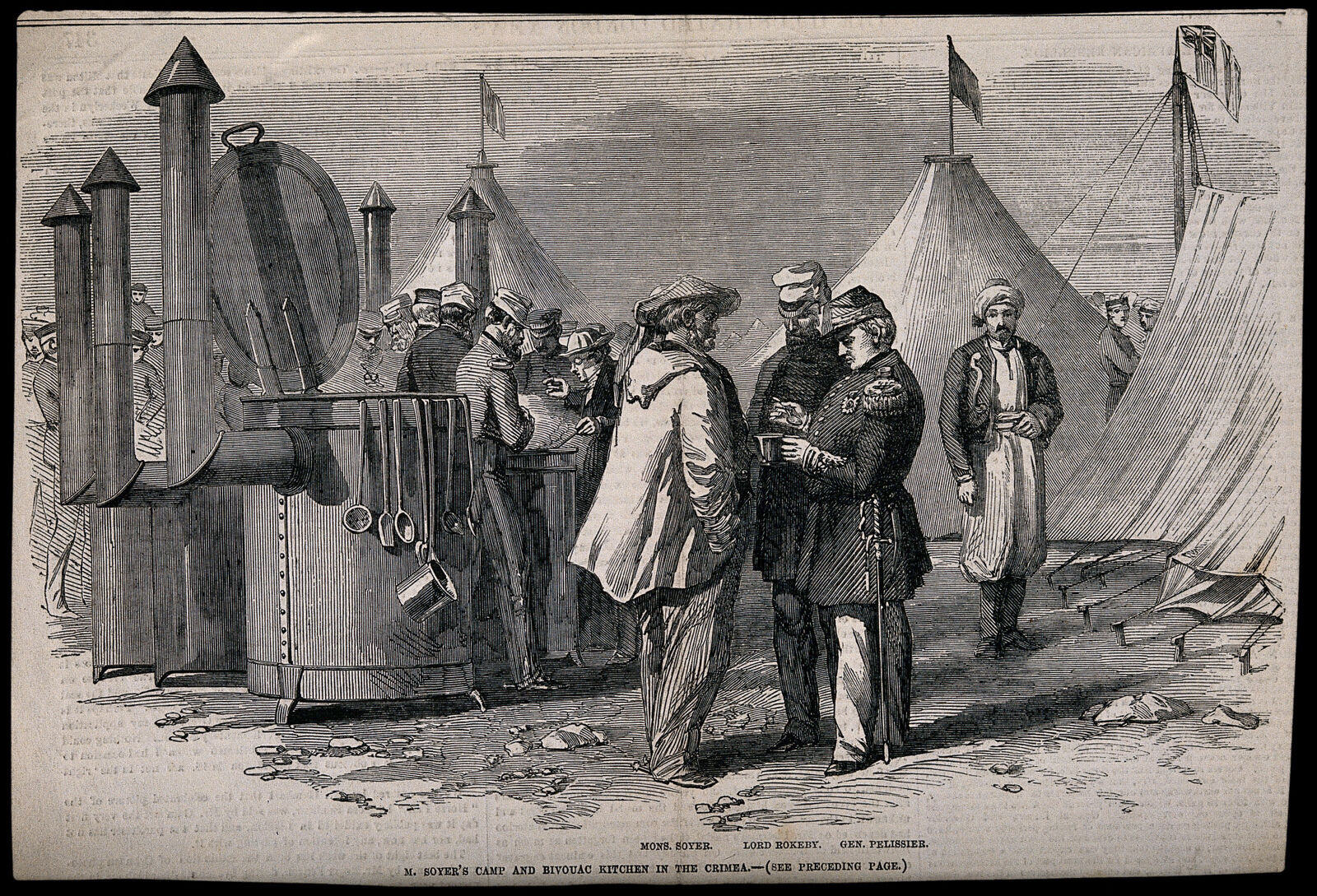
The kitchen has walls, but only just.
In an 1855 engraving of Alexis Soyer's Crimean camp, strips of canvas sag between poles while tall, capped flues rise from cylindrical cookers. Ladles and small pans hang within reach. At the center, a figure in pale clothes and a tilted hat presides over the improbable scene: a French celebrity chef, famous for one of London's grandest dining rooms, cooking outdoors in a war.[1]
Nothing here resembles the polished stage on which Soyer built his name. There is no Pall Mall facade, no conducted tour, no ice-cooled counter hidden behind expensive service. Yet this rough kitchen is not the opposite of fine dining. It is what happens when a grand kitchen is reduced to its working grammar: controllable heat, protected fuel, ordered movement, repeatable recipes and someone trained to make the parts cooperate.
That was Soyer's unusual lineage. He did not merely leave luxury cooking to perform charity and military service. He carried the systems thinking of a technically ambitious club kitchen into places where elegance was irrelevant but organization could decide whether food arrived hot, fairly and at all. The transfer was imperfect, politically compromised and too often polished into a lone-genius legend. It was also real.
Soyer's most durable dish was not a dish. It was the kitchen made portable.
Pall Mall: luxury begins behind the door
The Reform Club was founded in 1836 for Radicals and Whigs associated with the Great Reform Act. Its current history credits architect Charles Barry and Soyer with designing the club's kitchens in 1838.[2] The National Portrait Gallery dates Soyer's appointment as the new club's first chef to 1837 and notes that the finished kitchens became famous enough to open for tours.[3]
The attraction was machinery as much as menu. When the main kitchen came into operation in 1842, the Science Museum describes gas-powered cooking, temperature-controlled ovens, ice-chilled drawers, slabs and cabinets, and distinct preparation and storage areas. It calls the result arguably the world's most technologically advanced kitchen of its moment.[4]
Those details change the flavor of “luxury.” A grand dining room could promise roast meat at the right degree, cold preparations that remained cold and several demands answered at once because the kitchen had engineered the conditions first. Gas offered controllable heat. Ice became a storage system rather than a last-minute rescue. Separate work areas reduced collisions. The chef's art still mattered, but it now moved through architecture, fuel and workflow.
Soyer understood that the hidden system could itself be spectacle. Visitors came to see the kitchen, and his angled hat, books, branded products and gadgets helped make him one of Victorian Britain's early celebrity chefs.[3][4] Yet the theatricality should not obscure the practical insight underneath it. Fine dining does not scale through inspiration alone. It scales when heat, cold, tools, ingredients and labor are arranged so that another good plate remains possible after the first one leaves the pass.
The Reform Club gave Soyer room to build that argument at full size. The rest of his career asked how much of it could survive when the room disappeared.
The stove was a family of answers, not one magic box
Soyer's inventions are often compressed into a single heroic object: “the Soyer stove.” The record is messier and more useful.
The fixed Reform Club kitchen was a building-wide system. The Science Museum separately records a portable “Magic Stove,” patented by Soyer and Alexander Symons in 1850.[4] Its collection catalogue describes the later army cooker as a metal cylinder with an enclosed grate below, a fitted boiler above, a hinged lid, chimney and cowl.[9] These designs belong to an evolving practice, not one machine teleported unchanged from club to battlefield.
The shared idea was control through enclosure. An open fire leaks heat to wind, rain and every side of the pot. Put the fire inside a metal body, regulate its air and wrap the vessel with heat, and less fuel has to do more predictable work. Add handles and removable parts, and a kitchen can move. Match the equipment with recipes and trained operators, and it can be reproduced.
This distinction matters because a beautiful invention story can make everything around the object disappear. A stove without fuel, ingredients, maintenance, portions or a cook is only iron. Soyer's real advance was to keep redesigning the relationships around the heat source.
Ireland: throughput meets the politics of hunger
The Great Famine put that systems instinct inside a catastrophe no kitchen could solve.
In 1847, Soyer went to Dublin to establish relief kitchens. The National Portrait Gallery records the government commission and links it to his later hospital-catering work in Crimea.[3] A Florence Nightingale Museum fact sheet describes the kitchens' low-cost food and a sixpenny recipe book whose proceeds partly supported charity.[8]
It is tempting to frame the episode as haute cuisine compassionately scaled down. That version is too clean. Soup kitchens and food-relief systems already existed, and the British government's response to famine was shaped by ideology, rationing and administrative choices far larger than one chef. Historian Ian Miller's study of the period shows officials turning to Soyer in 1847 while medical critics attacked his grasp of nutrition and argued that some economical soups were inadequate for people already weakened by hunger.[5]
That dispute establishes an essential boundary. Efficiency is not nourishment. A kitchen can move many portions quickly and still serve a mean ration. It can measure inputs precisely and still participate in an unjust policy. Soyer's ability to design flow did not make him author of the famine, but neither does ingenuity place his relief work outside its politics.
What Ireland supplied was an extreme lesson in the difference between a recipe and a feeding system. Large-scale relief required vessels that could be heated reliably, portions that could be repeated, ingredients translated into cost, queues moved through space and instructions followed by people who had not trained under a famous chef. The individual flourish prized in an elite dining room had to become a protocol.
Soyer carried that lesson forward. Not a recipe for soup, exactly, but the conviction that equipment, instructions and distribution must be designed together.
Crimea: the cook goes with the cooker
By the first winter of the Crimean War, British soldiers and hospital patients were suffering through failures of supply, preparation and sanitation.[6] Soyer publicly offered to travel at his own expense in February 1855. At Scutari and Constantinople he revised hospital diet sheets and used his equipment to prepare food; he later worked at Balaklava and with the Fourth Division.[8]
Again, the significant unit was larger than the stove. The Florence Nightingale Museum's account follows Soyer through investigating rations and field equipment, writing simple camp recipes, arranging new cookers, training staff, repairing hospital kitchens and reorganizing the production and distribution of food. The stove answered rain and fuel. Recipes answered inconsistency. Training answered the question of what happened after the inventor left.[6]
The National Army Museum gives the cooker a remarkably clear operating brief. One unit could prepare food for about 50 people, work indoors or outside in heavy rain, and use less fuel than an open fire. A 1953 sealed-pattern example preserves the type with only minor modifications after more than a century of British Army use.[7]
Soyer calculated that his design could save 90 tons of fuel a day for an army of 40,000. That number belongs to Soyer's own estimate, as the museum carefully notes; it is not a neutral trial result.[7] The less spectacular evidence is stronger. An enclosed fire resists weather. A fitted pot captures heat. A cooker sized to a known group makes provisioning legible. If variants remain useful for generations, the underlying geometry has probably answered a persistent problem.
The engraving catches that geometry in use.[1] Canvas gives the cooks a room without pretending they are indoors. Tall flues lift smoke above the work; enclosed cooking bodies stand together; ladles and pans hang along one edge. Officers stand close enough to turn the kitchen into a demonstration, just as visitors once gathered at the Reform Club. The audience has changed; Soyer is still showing people how the system works.
What fine dining inherited
Modern fine dining did not inherit Soyer in one straight institutional line, and a military field stove is not a tasting-menu ancestor in disguise. The inheritance is a way of seeing the kitchen.
The dinner begins before the ingredient reaches the pan. It begins with the energy source, refrigeration, delivery route, storage height, prep surface, tool position and the person assigned to the station. It continues through portion size, written method, service timing and the ability to recover when conditions turn hostile. These are not glamorous supplements to creativity. They are what let creativity happen more than once.
Soyer saw those dependencies in the gas pipes and ice drawers of the Reform Club. Ireland exposed the moral limits of treating human need as a throughput problem. Crimea showed that equipment had to travel with instructions, training and a plan for distribution. Together, the episodes form a sharper history than the familiar portrait of a flamboyant chef who happened to own a useful stove.[2][4][5][6]
There is also a challenge here for contemporary restaurant storytelling. Chefs are often celebrated through singular gestures—a signature plate, a rare ingredient, a heroic night on the pass. Soyer was exceptionally good at manufacturing that kind of attention. But the part of his work worth carrying forward is collective and mostly invisible: a kitchen arranged so that other people can cook safely, consistently and under pressure.
The ethical test remains the one Ireland makes impossible to avoid. A system is not virtuous because it is efficient. Ask what it produces, for whom, in what quantity and under whose rules. The same intelligence that helps a club serve elaborate dinners can make relief more reliable or make an inadequate ration cheaper to distribute. Design magnifies the purpose it is given.[5]
Back in the Crimean camp, the canvas walls still look temporary.[1] That is the image's force. The kitchen has been stripped of marble, silver and ceremony, but not of thought. Heat is contained. Pots have places. Smoke has a route. Cooks have a method. Dinner—or simply survival—no longer depends on a lucky fire.
Soyer made the grand kitchen portable by deciding which parts of grandeur were never decoration in the first place.
Sources
- Wellcome Collection, “Crimean War: A.B. Soyer's kitchen camp,” wood engraving published September 22, 1855 — archival image record, publication details and identification of the camp kitchen and figures.
- Reform Club, official site — the club's 1836 founding context and its account of Charles Barry and Alexis Soyer designing the kitchens in 1838.
- National Portrait Gallery, “Alexis Benoît Soyer” — biographical chronology covering his Reform Club appointment, kitchen tours, Irish relief work, Crimean hospital catering and cookbooks.
- Helen Peavitt, “Kitchen Spectacular,” Science Museum Group, October 26, 2016 — Reform Club technology, Soyer's public celebrity and the 1850 portable Magic Stove.
- Ian Miller, “The Chemistry of Famine: Nutritional Controversies and the Irish Famine, c. 1845–7,” Medical History 56, no. 4 (2012) — scholarly context for existing relief systems, government policy and contemporary criticism of Soyer's economical soups.
- Kate Williams, “The Life and Stoves of Alexis Soyer,” Florence Nightingale Museum, March 12, 2026 — sourced museum account of relief kitchens, field-cooking constraints, stove design, recipes, training and hospital reorganization.
- National Army Museum, “Soyer stove, sealed pattern, 1953” — collection record describing the Crimean type, capacity, all-weather use, fuel claim and century-long service.
- Florence Nightingale Museum, “Alexis Soyer Fact Sheet” — concise chronology of his 1847 Dublin work, low-cost food and charitable cookbook, and his 1855 hospital and field-kitchen activity.
- Science Museum Group Collection, “Soyer army portable catering stove” — object record identifying the Crimean design's grate, boiler, lid, chimney and cowl.