Imagine a chocolate tart arriving with a spoonful of raspberry sauce. Now imagine the same tart with toasted walnuts and a thin ribbon of caramel. The chocolate has stayed put, but the dessert has changed direction. That small shift is a useful way into Banyuls: a wine whose name leaves an important question unanswered. What happened to it in the cellar?
On France's Côte Vermeille, between the Mediterranean and the Pyrenees, Banyuls comes in several colors and styles. INAO, the French appellation authority, draws a particularly useful distinction for the dessert table. Red rimage wines mature protected from air, retaining fruit aromas such as cherry. Wines aged in contact with air develop the amber or tawny character associated with oxidative styles.[1]
For a chocolate course, those are different starting points. One invites the pastry chef to think about berries; the other opens a cupboard of nuts, dried fruit and toasted flavors. The pleasure lies in choosing which part of the plate the wine should join.
First, let the wine survive dessert
Chocolate and red wine sound like a luxurious combination. Sweetness can make the encounter less flattering. WSET School London explains that sweet food can reduce a wine's apparent fruitiness and emphasize bitterness; chocolate can leave the next sip tasting hollow. Its advice is to consider the food's sweetness and, for chocolate, explore sufficiently sweet wines.[2]
Banyuls has a useful foundation here. It is a vin doux naturel: grape spirit is added during fermentation, interrupting the yeast's work and leaving some of the grape's sugar in the wine. Domaine Tambour describes this process, called mutage, alongside the different aging routes used for its cuvées.[3]
That makes Banyuls a promising candidate, rather than an automatic match. A restaurant still needs to taste the actual wine with the completed dessert. The chocolate on its own cannot stand in for the spoonful that includes sauce, cream and a sugar-coated garnish. An appealing aroma match is only useful if the wine remains enjoyable after that bite.
Follow the fruit
Domaine Augustin's rimage provides a concrete example of the fruit-preserving approach. Maison Parcé Frères describes Grenache noir fermented in stainless steel, fortified while the juice is still macerating with the grapes, then aged in a protected environment and bottled early. Its tasting description runs through black cherry, blackberry and blackcurrant. These are the producer's notes, not a tasting conducted for this article.[4]
The same sheet makes clear that sweetness does not mean an absence of structure: it describes the wine as tannic. That is another reason to judge it with food rather than treating every dessert wine as a soft, interchangeable finishing drink.[4]
Terres des Templiers offers a specific pairing for its Rimage Alegría 2023: chocolate containing 50–60 percent cocoa, accompanied by red-fruit coulis or fresh raspberries.[5] Domaine Tambour points its own rimage toward Black Forest cake.[3] Both suggestions give the wine's fruit something recognizable to meet on the plate.
For a pastry kitchen, the attractive idea is continuity. A little raspberry sauce can make the fruit character in the glass feel like another component of the dessert. This is a proposed way to build the course, grounded in those producers' suggestions. The precise balance still depends on the bottle and recipe; the cocoa percentage alone cannot settle it.
Open the walnut cupboard
Oxidative Banyuls offers a different set of companions. Domaine Tambour describes its Tradition cuvée through dried figs, walnut, orange peel and roasted notes, and recommends walnut cake among its pairings. The wine spends time in oak casks outdoors before further aging inside.[3] Those flavors have a practical consequence: the pastry chef can look toward the toasted and dried ingredients already waiting beside the chocolate.
An independent tasting gives that direction more texture. In its 2023 guide, Hachette described Terres des Templiers' Terre des Oms, a traditional Banyuls aged for six years in large wooden casks, through prune, fig, toasted nuts and a hint of cocoa. The review found a rich, velvety wine with preserved-fruit and spice-cake character.[6] It is evidence about that particular cuvée, not a promise that every mature Banyuls tastes alike.
Terres des Templiers' own chocolate pairings place its Traditionnel Vieille Réserve beside dark praline chocolate, drawing on the wine's candied-fruit, nut and caramel notes.[5] Here the proposed connection is easy to picture: the crunch of the praline, chocolate melting around it, then a sip that carries the nutty theme onward.
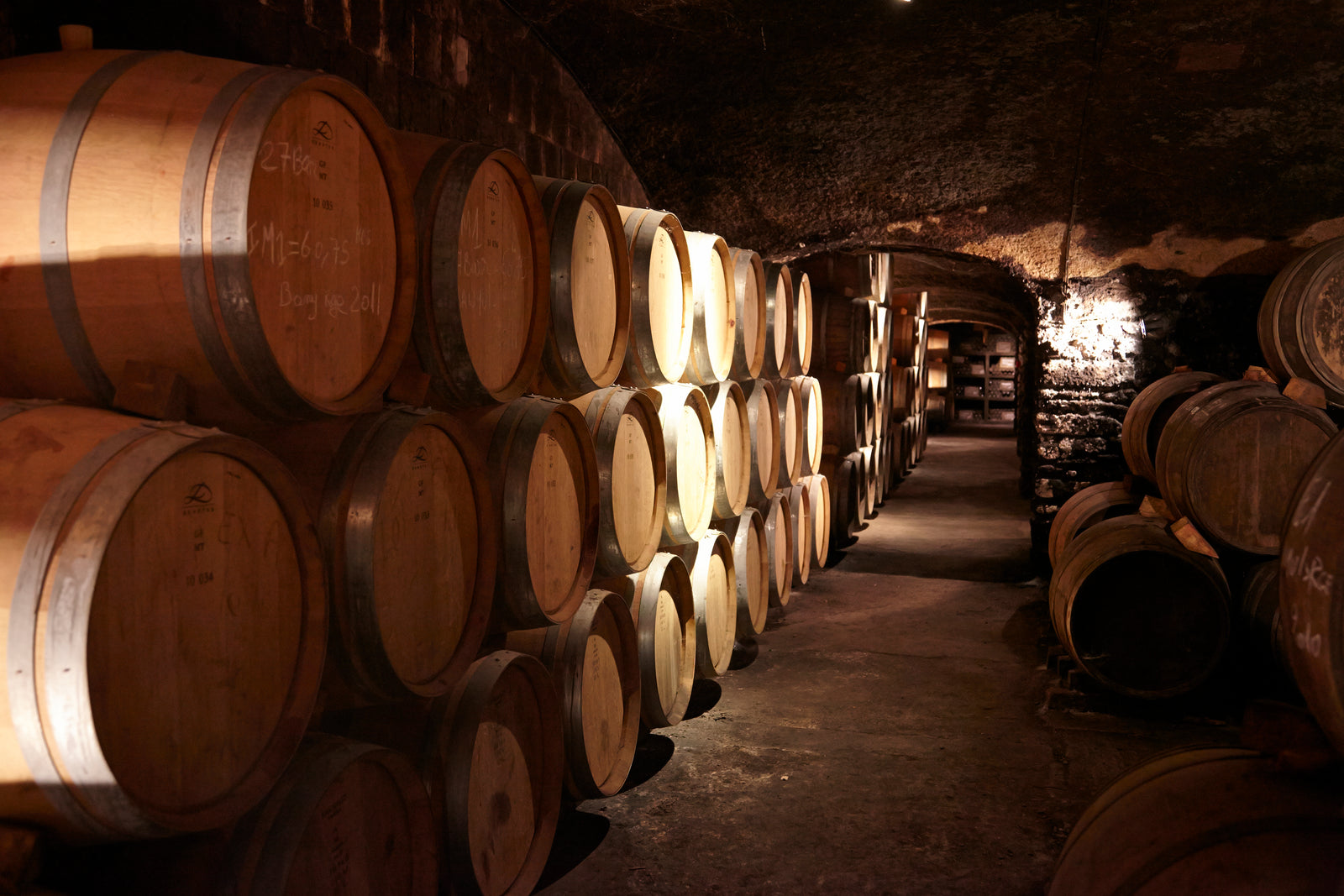
The cellar photograph makes the work behind that sip tangible. Terres des Templiers presents its underground cellar as one of the places where visitors can encounter the aging of Banyuls and Collioure wines.[7] At the table, the barrels disappear from view; their relevance survives in the choice between a fresh raspberry and a toasted walnut.
Taste the whole forkful
A useful restaurant rehearsal would keep the chocolate preparation constant and change its accompaniment. Try a fruit-led version with a rimage, then a nut-led version with a traditional oxidative Banyuls. Compare the wines before and after each bite. Does the fruit remain clear? Does the nutty connection feel pleasing? Does either sip become more bitter than it was alone? These are questions for the tasting, not predetermined results.
Service should follow the bottle, too. Maison Parcé Frères recommends 12–16°C for its Domaine Augustin rimage.[4] That is a specific producer's range, useful as a starting point when trying that wine, rather than a temperature commandment for the entire appellation.
For the diner, a good explanation can be wonderfully brief: this glass follows the berries; that one follows the walnuts. The interesting part of the pairing has already happened in the kitchen and cellar. All that remains is a forkful and a sip.
Sources
- INAO, “Banyuls rimage” — appellation setting and the distinction between protected and oxidative aging.
- WSET School London, “A guide to Easter food & wine pairings,” 26 March 2024 — sweetness, chocolate and their effects on the perception of wine.
- Domaine Tambour, “AOP Banyuls — Vins Doux Naturels” — explanation of mutage; Rimage and Tradition production details, producer tasting notes and food suggestions.
- Maison Parcé Frères, Domaine Augustin, “Banyuls Rimage,” technical sheet filed as the 2022 vintage — vinification, early bottling, producer tasting notes and serving temperature.
- Terres des Templiers, “Sublimez vos festivités de Pâques avec Terres des Templiers” — producer pairings for Rimage Alegría 2023 and Traditionnel Vieille Réserve; cited for pairing ideas, not promotional prices.
- Guide Hachette des Vins 2023, “Terres des Templiers — Terre des Oms” — independent tasting and six-year aging description.
- Terres des Templiers, “La cave” — official cellar description and photograph titled “Cave Souterraine de Terres des Templiers.”