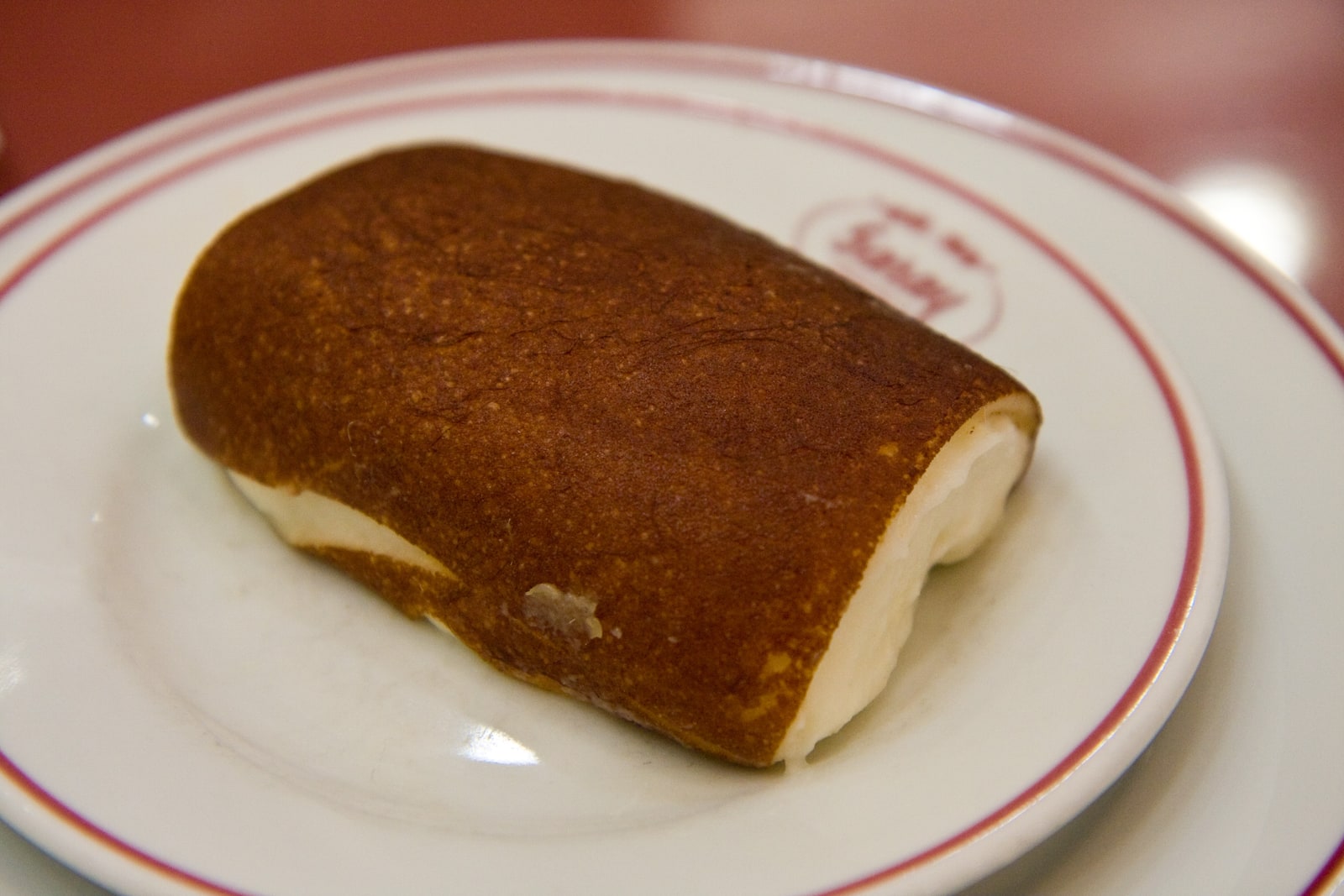
The brown face of kazandibi begins out of sight. A pale milk pudding sits against a hot pan; the surface touching the metal takes on color; only at serving does that hidden layer turn toward the diner. Türkiye’s tourism authority explains the name through the bottom of the cauldron. It is an unusually useful name for a dessert: it tells you where to look for the work.[1]
In Garrett Ziegler’s photograph, a thin brown skin bends around pale folds of pudding.[6] At the table, the appeal is the meeting of those two textures in one small portion. The drama is close to the spoon, where the dark exterior gives way to the milky center. There is enough going on without building a tower around it.
Kazandibi also carries a small surprise for anyone treating its appearance as an ingredient list. GoTürkiye connects its traditional form to tavuk göğsü, the pudding made with finely shredded chicken breast, while noting that chicken-free versions are widespread.[1] The methods considered here use milk and flour or starch without chicken. They show how much craft remains even in that apparently simple bowl of ingredients.
First, make something that can be lifted
Before the pan can leave its mark, liquid milk has to become pudding. The Turkish Ministry of Culture and Tourism’s recipe combines rice flour and starch with milk, cooking and stirring until thick before adding sugar. The mixture then goes into a greased pan dusted with confectioners’ sugar.[2]
Chef Musa Dağdeviren takes a different route in The Turkish Cookbook. His recipe begins by cooking rice flour and a smaller quantity of wheat flour in butter; milk and mastic follow. The pudding thickens over further cooking before it meets the separately prepared sugar in a flameproof pan.[3]
The two preparations deserve separate trials. For a pastry kitchen, the first question is texture: can a chilled portion survive the trip from tray to plate while still yielding easily to a spoon?
The rice need not even enter as flour. In a 2009 survey of Turkish dairy desserts, food engineers Arzu Akpinar-Bayizit, Tulay Ozcan and Lutfiye Yilmaz-Ersan describe subye: rice soaked overnight and ground with water into a milky liquid. Their kazandibi production method uses rice milk and starch, thickens the mixture, then transfers it to a sugar-dusted tray for browning.[4] The smooth appearance conceals a choice about how the rice was prepared.
Move the pan; protect the middle
The most revealing instruction comes from Et ve Süt Kurumu, Türkiye’s Meat and Milk Board. Its published method tells the cook to rotate the filled tray over the burner, beginning at the edges, so that the underside browns evenly. The text explicitly calls this a task requiring skill.[5]
That movement makes the cooking legible. A burner heats a limited area, while the dessert occupies a wider surface. Moving the tray lets the cook distribute that contact across the portioned dessert. The aim is for the browned layer to accompany each serving, rather than leave one diner with a pale square and another with the darkest patch.
The same source specifies heat from below when using an oven.[5] Position matters: the defining surface forms against the vessel. Browning the exposed top would change which part of the pudding receives the treatment.
Dağdeviren specifies a flameproof aluminum or cast-iron pan measuring 20 by 25 centimeters. His directions distinguish melting the sugar from the subsequent browning beneath the pudding and insist on close observation at the base.[3] This is a demanding moment to reduce to a timer. The cook has already made the tender interior; the next task is to develop its outer face without letting that face overwhelm everything above it.
For a restaurant portion, I would judge the result across the tray before adjusting the garnish. An attractive center square cannot tell the kitchen whether the edge portions will offer the same balance.
The final tool is time
A browned underside does not mean the dessert is ready to lift. The food-engineering survey describes a refrigeration stage of at least three to four hours before cutting and rolling, with the colored side facing outward.[4] Chilling belongs to the production sequence, as much as the burner does.
Presentation then follows the chosen method. The ministry folds its chilled portions; Dağdeviren serves squares with the browned underside facing up.[2][3] Both gestures bring the pan’s work into view. A roll shows a curved surface and a pale interior at its ends; a square gives the diner a broader, flatter expanse of brown.
I would keep that boundary visible on the plate. Leave the spoon a clear route through the browned layer into the soft milk beneath it. Kazandibi has already acquired its most expressive decoration during cooking: the mark of the pan it came from.
Sources
- GoTürkiye, “Taste Atlas’s list of notable Turkish desserts that you should not miss” — the name, tavuk göğsü connection and chicken-free versions.
- Republic of Türkiye Ministry of Culture and Tourism, “Baked and Caramelized Pudding” — rice-flour-and-starch method, sugared pan and folded presentation.
- Musa Dağdeviren, “Burned Milk Pudding,” excerpt from The Turkish Cookbook, Phaidon, 2019, published by The Splendid Table — preparation and serving.
- Arzu Akpinar-Bayizit, Tulay Ozcan and Lutfiye Yilmaz-Ersan, “Milk-based traditional Turkish desserts,” Mljekarstvo 59(4), 2009, pp. 349–355, especially pp. 353–354 — rice milk, manufacturing sequence and chilling.
- Et ve Süt Kurumu, “Kazandibi” — Turkish-language preparation describing tray rotation, even browning and oven heat from below.
- Garrett Ziegler, “Kazandibi Dessert.jpg,” photograph dated October 29, 2010, Wikimedia Commons — article photograph and attribution; CC BY-SA 4.0.