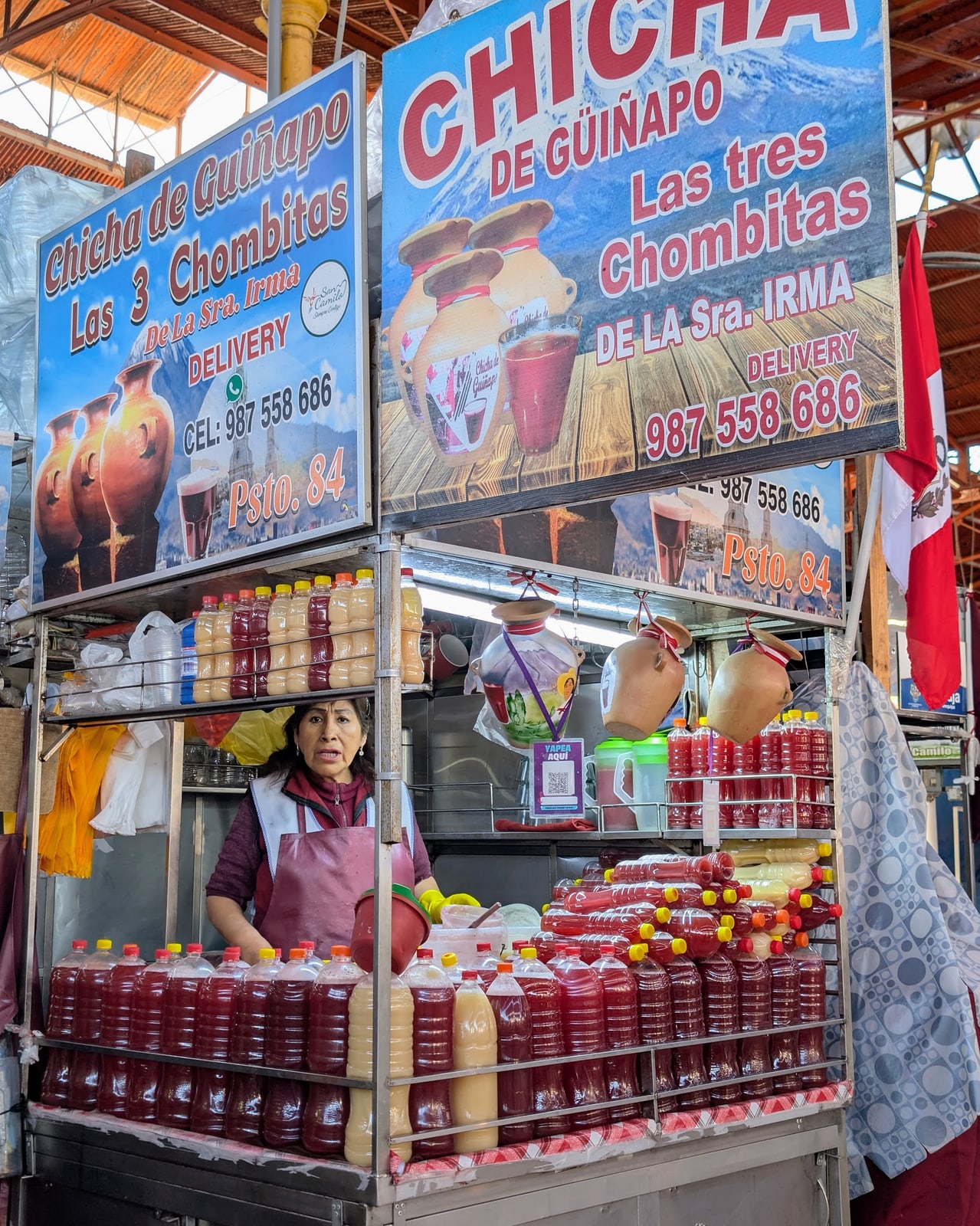
A spoonful of pork adobo and a glass of chicha can introduce the same ingredient twice. In Arequipa, southern Peru, the stew brings together pork, ají pepper, onion and fermented corn drink. Beside it, chicha arrives ready to sip. The connection is already in the cooking: the diner gets to discover what changes between the pot and the glass.[1]
That makes chicha de güiñapo an intriguing subject for anyone who thinks carefully about restaurant pairings. Made from germinated dark maize, it belongs to the working life of Arequipa's picanterías, the traditional eating houses where the local culinary society considers making and serving it a defining requirement.[2] Its place at lunch precedes any sommelier's explanation.
The pleasure lies in that familiarity. A drink can accompany a richly seasoned meal without needing a separate origin story for every course. But choosing it well still demands attention: which chicha, how sweet, how sharp, and with what on the plate? The suggestions here draw on documented preparations and ingredients; they are pairing proposals, rather than a report of a personal tasting.
Taste this batch
Güiñapo is germinated, dried and ground maize. The Sociedad Picantera describes boiling, cooling and straining it before fermentation in a chomba. Sediment from the previous batch, called concho, helps ferment the next day's drink. Brown sugar may be added before serving.[2]
A 2020 study by Diego Vargas-Yana and colleagues gives that household variation some measurable shape. The researchers examined chicha from five picanterías in different districts of Arequipa province. Their surveys recorded differences in maize sourcing, preparation and the timing of sugar additions. Reported ethanol values ranged from 1.63% to 3.43% by volume, with pH values from 3.21 to 3.72.[3]
Those figures describe the sampled drinks; they are not a specification for everything sold under the name. Alcohol measurements varied substantially, and the researchers did not find statistically significant differences between districts in the chemical properties they measured.[3] A district name cannot tell a server exactly what is in today's jug.
For pairing, the useful first act is therefore a small taste. Notice whether sweetness lingers after swallowing, how firmly the acidity announces itself, and whether the next mouthful of food remains inviting. A corn drink with a sweet finish asks a different question of a sauce from one whose most obvious feature is tartness. Its name alone cannot make that decision.
Let the pot introduce the glass
Adobo offers the most direct starting point. PROMPERÚ's account of Arequipa's cuisine places chicha in the pork preparation alongside onion and ají.[1] A sip beside the stew could let the diner follow a fermented ingredient through two treatments: one absorbed into a hot, savory preparation, the other still a drink. That is the pairing's proposed interest, even before discussing contrast with the pork's richness.
The liquid used in each role need not be identical. Peruvian food publication Buenazo distinguishes chicha that has developed acidity for cooking from drinking versions sweetened with sugar or chancaca, unrefined cane sugar. It specifically identifies güiñapo chicha in Arequipa's kitchens.[4]
This distinction changes the service conversation. “The sauce contains chicha” is an invitation to compare, not a promise that the glass will reproduce the sauce. Ask how each has been prepared. A sweeter pour might give the savory stew a softer counterpoint; a tarter one might emphasize the fermented note already present. Neither result follows automatically from pouring the same named beverage.
For a tasting menu built around adobo, I would begin with a modest serving and let the diner return to it after the pork. The sequence matters: sip, spoonful, sip again. If the second sip makes the sauce seem clumsy or the drink seem thin, the shared ingredient has supplied a theme without supplying a successful match.
Keep the rest of the table in view
Other Arequipa dishes make useful tests. In PROMPERÚ's description, solterito de queso combines beans, maize, olives and cheese with hot pepper and a lemon-and-herb dressing. Rocoto relleno brings a stuffed pepper with meat, cheese, eggs and olives, topped with melted cheese.[1] Those plates ask different things of the same glass.
With solterito, I would pay particular attention to the dressing. The maize creates an immediate connection, but a sharply dressed bite followed by a sharply acidic drink could make the combination feel relentless. With rocoto relleno, I would test the pour against a complete forkful of pepper, filling and cheese. Tasting only the filling would leave out the ingredient that gives the dish its force. These are practical comparisons to make at the table, not fixed rules about which chicha must win.
The drink also carries a scale of hospitality. The Sociedad Picantera records individual and communal glass sizes, including the half-liter bebe and the larger cogollo and caporal.[2] A restaurant adapting chicha to small courses can change the portion while remembering that its established setting includes a shared, abundant meal.
That knowledge remains visible in contemporary dining rooms. PROMPERÚ describes a living chicha museum within Laurita Cau Cau, and presents Picantería Victoria as a combination of restaurant, museum and research space.[5] Production is part of what these places offer the diner.
A carefully chosen glass can make that work perceptible. Let the guest recognize the corn, notice the sweetness, and return to the sauce. The most useful explanation may be short enough to leave room for another spoonful.
Sources
- PROMPERÚ, “Cuisine of Arequipa” — ingredients and presentation of adobo, solterito de queso and rocoto relleno.
- Sociedad Picantera de Arequipa, “La picantería arequipeña, patrimonio cultural” — the drink's place in picantería culture, production with concho, optional sweetening and traditional glass sizes.
- Diego Vargas-Yana et al., “Ancestral Peruvian ethnic fermented beverage ‘Chicha’ based on purple corn (Zea mays L.): unraveling the health-relevant functional benefits,” Journal of Ethnic Foods 7, 35 (2020) — five-picantería survey and physicochemical results; cited here for preparation and composition.
- Buenazo, “Chicha de jora: ¿cuál se usa para beber y cuál para cocinar?” — distinction between acidic cooking chicha and sweetened drinking versions.
- PROMPERÚ, “Sabor y tradición: recorre la campiña de Arequipa y visita las mejores picanterías de la ‘Ciudad Blanca’” — Laurita Cau Cau's Museo Vivo de la Chicha and Picantería Victoria's restaurant-and-research format.
- H.dav.are, “Chicha de güiñapo stall at San Camilo Market in Arequipa.jpg,” photograph dated August 16, 2026, Wikimedia Commons — article photograph and attribution, CC BY-SA 4.0.